
 Trying to establish ‘facts’ about incident ‘apparently’ involving Indians on yacht off Yemen coast: India
  Powerful Earthquake in Tibet Kills at Least 16
  How Pastors Mobilize Communities in Congo’s Fight Against Ebola
  Gadi Eisenkot
 A Chinese Robot Beat Usain Bolt’s 100-Meter Record. Should We Be Impressed
A Chinese Robot Beat Usain Bolt’s 100-Meter Record. Should We Be Impressed? - AI News Breaking
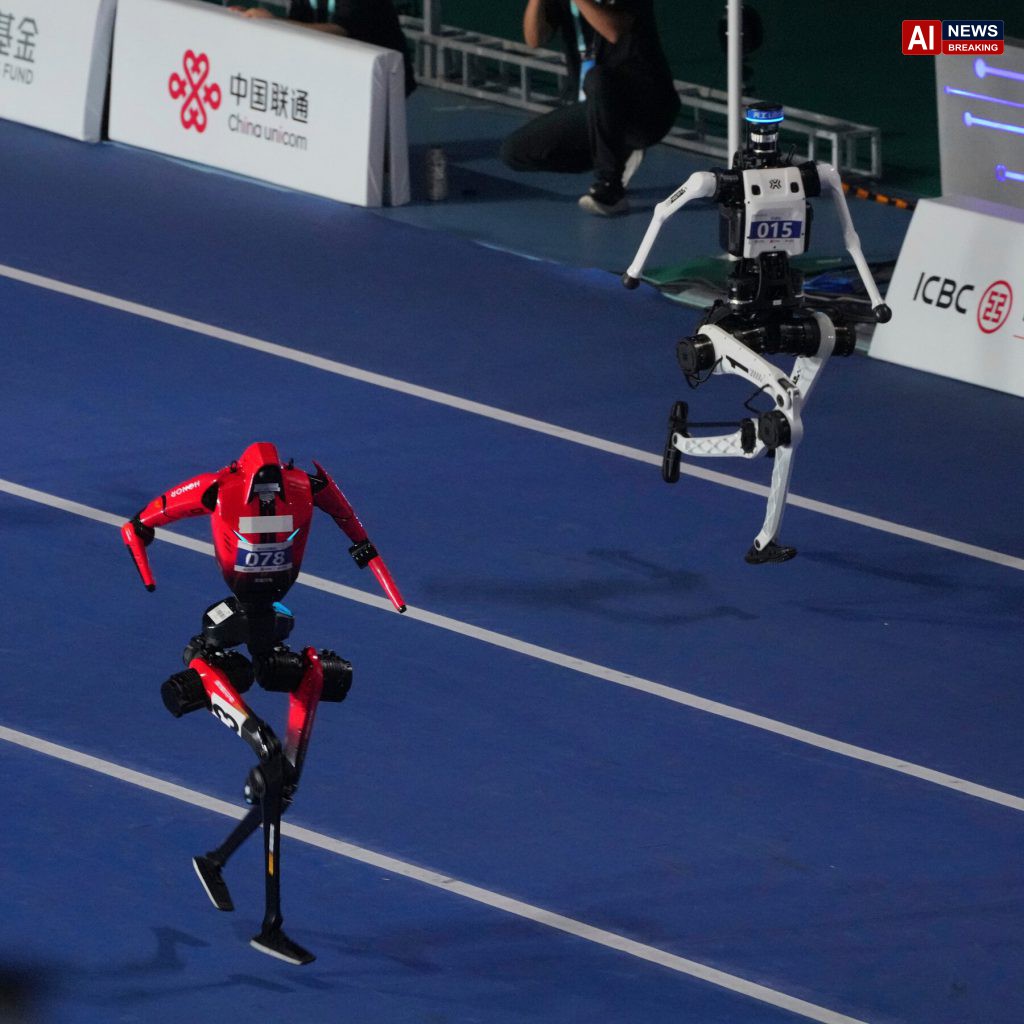
Xian, a city steeped in the ancient history of China’s western interior, has recently become the unlikely stage for what many are calling the next significant leap in robotics. In a demonstration that has captivated technology enthusiasts and skeptics alike, a humanoid robot developed by Unitree Robotics sprinted the 100-meter dash, reportedly clocking a time that surpasses the legendary world record set by Usain Bolt. The claim, if fully verified under standardized competitive conditions, would mark a watershed moment in the convergence of artificial intelligence, mechanical engineering, and athletic performance..
However, beneath the spectacle of a machine outrunning the fastest human in history lies a complex web of technical nuances, ethical considerations, and practical limitations that demand a measured and critical perspective.The robot in question, part of Unitree’s emerging lineup of bipedal machines, achieved this feat by leveraging a combination of advanced motor control systems, lightweight structural materials, and sophisticated algorithmic planning. Unlike the human body, which relies on biological fusion of muscle, bone, and nervous system, the robot operates through a symphony of servo motors and sensors that adjust its gait in real-time. This mechanical efficiency allows for a stride pattern that is technically optimized for speed, devoid of the biological fatigue, pain, or hesitation that governs human athletic potential..
The visual of a machine accelerating down a track with such precision highlights the rapid advancement in general-purpose robotics, suggesting that the gap between human capability and artificial execution is narrowing faster than many industry observers had predicted.Usain Bolt’s record of 9.58 seconds, set in Berlin in 2009, remains one of the most iconic benchmarks in sports history. It is not merely a number but a symbol of human physical potential, achieved through decades of training, genetic predisposition, and peak physiological conditioning. To compare a machine’s performance directly to this human milestone invites a category error, as the two entities operate on fundamentally different principles..
A robot does not breathe, does not tire in the metabolic sense, and does not experience the psychological pressure of competition. Therefore, while the comparative speed is striking, it serves more as a demonstration of engineering prowess than a direct athletic rivalry. The comparison underscores the expanding scope of what is considered possible in physical automation rather than challenging the concept of human sporting achievement.Experts in robotics and biomechanics caution against interpreting this event as a sign that machines will soon replace athletes in traditional sports..
The current generation of humanoid robots is still in its infancy regarding endurance, adaptability, and safety. While the sprint demonstrates impressive burst speed, it does not account for the complex dynamics of a live sporting environment, which includes strategy, interaction with opponents, and unpredictable variable conditions. Moreover, the energy consumption required for such feats is staggering..
A robot capable of sprinting requires a power source that is currently too heavy and inefficient for prolonged or repeated high-intensity activity, limiting its practical application to controlled demonstrations rather than sustained performance.The implications of such technological advancements extend far beyond the track and field arena. The core technologies enabling this rapid movement—such as dynamic balance algorithms, lightweight carbon-fiber structures, and high-torque motors—have significant potential in sectors that require rapid response and physical agility. In disaster relief scenarios, humanoid robots that can move quickly through unstable terrain could reach victims faster than human responders, navigating rubble or hazardous environments that would be dangerous for people..
Similarly, in manufacturing and logistics, robots with enhanced mobility could revolutionize warehouse operations, moving goods with a speed and precision that exceeds human capacity, thereby increasing efficiency and reducing labor costs in non-hazardous settings.However, the transition from laboratory demonstrations to real-world utility remains fraught with challenges. The robot’s ability to sprint on a flat, prepared track does not necessarily translate to navigating the uneven, cluttered, and unpredictable environments of daily life. Current humanoid robots still struggle with basic tasks such as manipulating small objects with dexterity, maintaining balance on irregular surfaces, or interacting safely with humans in close proximity..
The speed achieved in the 100-meter dash is a specific optimization for a linear task, whereas general-purpose robotics requires a breadth of capabilities that are not yet fully realized. Developing a machine that is not only fast but also safe, reliable, and adaptable requires significant further research and iteration.From a regulatory and ethical standpoint, the rise of superhuman robotic capabilities about liability, safety standards, and the societal role of automation. If a robot can move faster than a human, the potential for accidents in shared spaces increases, necessitating new protocols for human-robot interaction..
Current safety standards for industrial robots are designed for caged environments where humans are kept at a distance, but as humanoid robots move into open social and commercial spaces, these standards must evolve. Policymakers and engineers must collaborate to establish frameworks that ensure these machines operate within safe parameters, protecting human users from potential harm caused by malfunction or unexpected behavior.Furthermore, the economic impact of such technological breakthroughs cannot be ignored. As robots become more capable of performing physical tasks at speeds and efficiencies that exceed human workers, concerns about job displacement intensify..
While robotics experts argue that automation typically augments human labor rather than replacing it entirely, the shift in the nature of work is inevitable. Jobs that involve repetitive, high-speed physical tasks may increasingly be handled by machines, leading to a restructuring of the labor market. This transition requires proactive measures in education and workforce training to help workers adapt to a new economy where human value is shifted towards creative, strategic, and interpersonal roles that machines cannot easily replicate.The cultural reaction to a robot beating a human record is also telling of our evolving relationship with technology..
There is a sense of awe, but also unease, as artificial entities begin to exceed human limits in areas traditionally associated with human excellence. Sports have long been celebrated as a testament to human spirit, perseverance, and physical mastery. The notion of a machine surpassing these achievements challenges our understanding of what it means to be exceptional..
While the robot’s speed is a testament to human ingenuity in designing and building the machine, it does not carry the emotional resonance or narrative depth of a human athlete’s journey. This distinction is crucial in maintaining the cultural value of sports while acknowledging the progress in engineering.Critics of the technology argue that the focus on speed and athletic mimicry distracts from more immediate and useful applications of robotics. They suggest that resources might be better directed towards developing robots that assist the elderly, perform delicate medical procedures, or address environmental challenges..
While these applications may not generate the same media buzz as a broken world record, they offer tangible benefits to society. The debate highlights a tension between showcasing technological brilliance and addressing pressing human needs, a balance that the robotics industry must navigate carefully to maintain public trust and support.Looking ahead, the trajectory of humanoid robotics points towards greater integration of artificial intelligence and physical mobility. Future iterations of these machines.
Updated: August 24, 2026
A Chinese robotics firm recently demonstrated a humanoid machine that reportedly outpaced Usain Bolt’s world record in a 100-meter sprint.
While this feat showcases rapid engineering advancement, experts warn that biological limits and practical constraints prevent such machines from replacing human athletes.