 Pentagon directive bans troops from using nonpublic info to bet in prediction markets
 Plaintiffs in Trump arch project seek injunction to stop administration from beginning work Nov. 5
 Trump says he ‘heard something about’ Justice Department probe into longtime ally Corey Lewandowski
 Trump administration stopped sharing evidence in Good and Pretti killings, Minnesota officials say
“China Expands Military Footprint in Laos as New Ban Keun Air Facility Raises Regional Security Concerns”
**
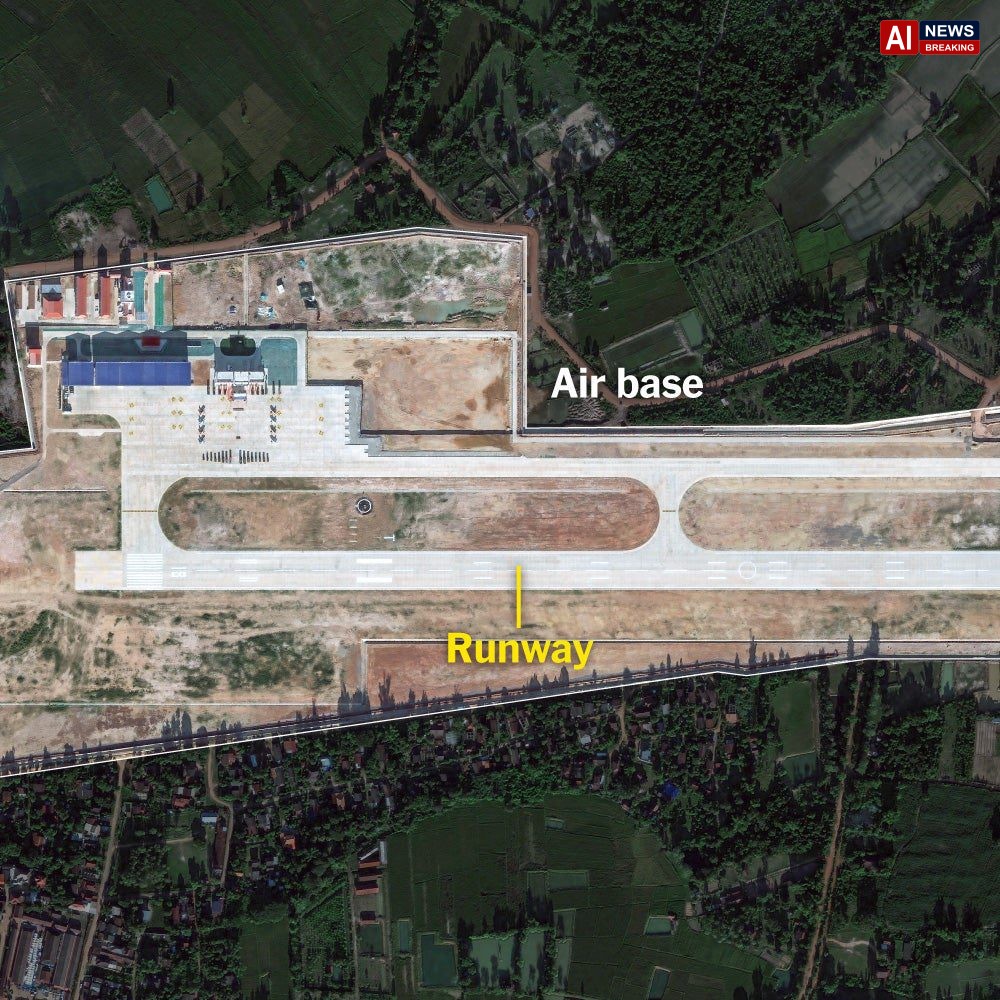
China opens airfield in Laos - AI News Breaking
China’s decision to construct a new airfield in the remote Laotian town of Ban Keen marks the latest phase of a growing military footprint in Southeast Asia, prompting neighbouring states to reassess the strategic balance in a region already fraught with great‑power rivalry. The runway, which was officially opened in April 2024, stretches 2,400 metres and is currently capable of handling small transport aircraft and light fighter jets.
While Laotian officials have stressed that the facility is intended for civilian use and disaster‑relief operations, satellite imagery and on‑the‑ground reports suggest that Chinese engineers have already installed the infrastructure necessary for rapid conversion to a full‑scale military base.The project, financed by a combination of Chinese loans and direct investment, is part of the broader Belt and Road Initiative (BRI) that has seen Beijing pour billions of dollars into infrastructure across the Mekong sub‑region..
In Laos, the BRI has already delivered a series of high‑profile projects, including a new high‑speed railway linking the capital Vientiane with the Chinese border, and a series of hydropower dams that feed both domestic grids and export markets. Critics argue that the airfield is the latest example of “debt‑trap diplomacy”, whereby Laos becomes increasingly dependent on Chinese financing and, consequently, on Beijing’s strategic priorities.Strategic analysts point out that the Ban Keen runway occupies a geographically significant position. It lies just 150 kilometres from the border with Thailand and within striking distance of key air corridors over the Gulf of Thailand and the South China Sea..
If Beijing were to upgrade the runway to accommodate larger combat aircraft, it could potentially project power deeper into the region, providing a forward operating base for surveillance drones, refuelling missions or even combat sorties. Such a capability would complement China’s existing network of bases in the South China Sea, notably on the artificial islands of the Spratly archipelago, and would give the People’s Liberation Army Air Force (PLAAF) a foothold on the mainland side of the maritime dispute.Vietnam, Thailand and Myanmar have all expressed “concern” in diplomatic statements, though the language remains measured to avoid overt confrontation.
In a press conference in Bangkok, Thailand’s foreign ministry spokesman noted that “regional stability is best served when all nations respect each other’s sovereignty and refrain from actions that could be perceived as militarisation of civilian infrastructure.” Vietnam’s Ministry of Defence, while not commenting directly on the Ban Keen site, reiterated its policy of “vigilance” regarding any expansion of Chinese military capabilities near its borders..
In Washington, the United States has warned that “any shift in the balance of power in the Indo‑Pacific that undermines freedom of navigation must be met with a coordinated response from our allies.”Laos’ own leadership, led by President Thongloun Sisoulith, has attempted to frame the project as a boon for the country’s development agenda. In a televised address, the president highlighted the runway’s potential to boost tourism, improve medical evacuation capacity and facilitate the transport of agricultural goods to markets in Thailand and China. He also underscored that the airfield would be operated under Laotian control, with any foreign presence subject to the nation’s laws and bilateral agreements..
Nevertheless, opposition voices within Laos, including a coalition of civil society groups and former military officers, have warned that the lack of transparency surrounding the contract terms could erode national sovereignty.The timing of the Ban Keen airfield’s inauguration coincides with a broader shift in Chinese defence policy that emphasizes “forward defence” and the integration of civilian infrastructure into military planning. Since 2022, the PLAAF has accelerated the development of dual‑use facilities, blurring the line between commercial airports and military bases. This doctrine reflects a strategic calculus that seeks to shorten response times and increase operational flexibility in the face of what Beijing perceives as encirclement by U.S..
alliances, notably the Quad and the AUKUS partnership.Satellite data released by independent monitoring groups show that, within weeks of the runway’s opening, a series of concrete aprons and hardened shelters were added to the perimeter. These structures are consistent with those used to protect aircraft from missile strikes and to store munitions. Additionally, the installation of a new communications tower equipped with encrypted frequencies suggests the establishment of a command and control node capable of linking the site to other PLAAF assets across the region..
While Laotian officials maintain that these upgrades are part of the airport’s “modernisation”, the pattern mirrors similar upgrades at other Chinese‑funded facilities in Cambodia and Myanmar.The United Nations, which has been monitoring the militarisation of infrastructure in fragile states, has yet to issue a formal assessment of the Ban Keen site. However, a recent briefing by the UN Office for Disarmament Affairs warned that “the proliferation of dual‑use infrastructure can exacerbate regional tensions and undermine confidence‑building measures.” The briefing called on donor nations to ensure that development aid is not leveraged for strategic coercion, a sentiment echoed by the European Union in a statement urging “transparent, accountable investment that respects the host country’s development priorities.
”In response to growing international scrutiny, Beijing has offered to allow a limited number of observers from ASEAN member states to tour the facility. A delegation from the Association of Southeast Asian Nations (ASEAN) visited the site in September, meeting with Laotian transport officials and inspecting the runway’s surface..
Their report, released in a terse communiqué, concluded that the airfield met “international civil aviation standards” and that there were “no immediate indications of exclusive military use.” Observers, however, noted that the delegation’s access was restricted to certain areas, and that key sections of the perimeter remained cordoned off.The Ban Keen airfield’s future remains uncertain, but its existence already underscores a shifting paradigm in how China extends its strategic reach.
Whether the runway will remain a civilian gateway or become a launchpad for a more assertive Chinese air presence will depend on a confluence of diplomatic negotiations, financial arrangements, and the evolving security calculations of both regional actors and the United States. For now, the quiet hum of small jets taking off from the remote strip serves as a reminder that infrastructure and security are increasingly intertwined in the geopolitics of Southeast Asia..
Updated: October 8, 2026
China has funded a new 2,400‑metre airfield in Laos’ Ban Keen, a dual‑use runway that can host light aircraft now but could be quickly upgraded for military operations, raising concerns among Thailand, Vietnam and the United States about a deeper Chinese foothold near the Gulf of Thailand. While Laos touts the strip as a boost for tourism and disaster relief, satellite images show hardened shelters and encrypted communications gear,
China’s covert militarisation of Laos’ new runway foreshadows a permanent forward‑air‑base that could tilt the Indo‑Pacific balance, forcing regional capitals to choose between costly counter‑measures or uneasy accommodation.
The debt‑laden “civilian” project also signals a broader shift: development aid is becoming a lever for strategic coercion, eroding sovereign decision‑making and complicating multilateral security architectures in Southeast Asia.