 Australia probes AI‑driven breach of My Health Record portal
  Engineering student’s ‘suicide’ turns out to be murder; two arrested
  Canada’s Capital Bids Good Riddance to Trump Avenue as Tensions With U.S. Rise
  Pentagon investigates after China obtains parts from F-35 stealth fighter jet
 CJP’s ‘Chalo Sansad’ Protest in Delhi Faces Police Crackdown as Heavy Security Deployed Around Parliament
The Cockroach Janata Party’s ‘Chalo Sansad’ march in Delhi faced a police crackdown, with heavy security deployed around Parliament and restrictions on protesters, amidst the Monsoon Session of Parliament and growing political attention.
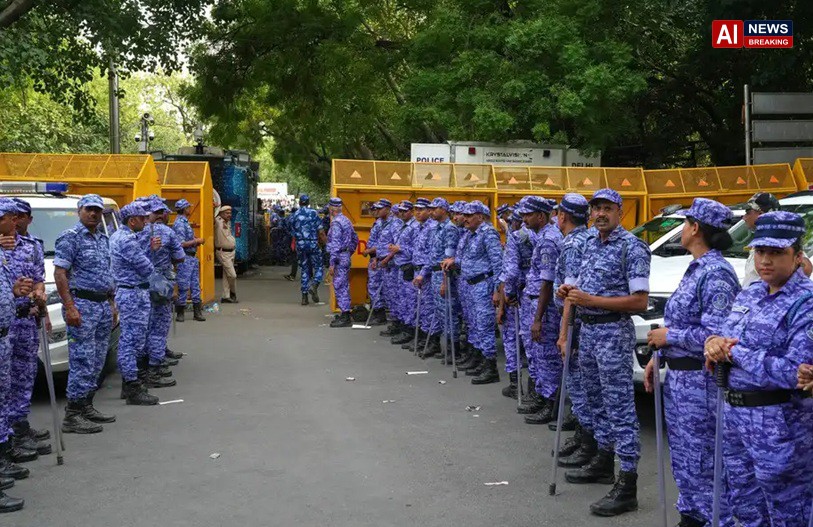
CJP's 'Chalo Sansad' Protest in Delhi Faces Police Crackdown as Heavy Security Deployed Around Parliament - AI News Breaking
cjps chalo sansad protest:
The Cockroach Janata Party (CJP)’s much-anticipated ‘Chalo Sansad’ march in New Delhi on Monday witnessed heightened security and police restrictions as authorities denied permission for the protest. Hundreds of supporters gathered at Jantar Mantar amid the Monsoon Session of Parliament, while activist Sonam Wangchuk’s hunger strike and hospitalization continued to dominate the movement’s narrative.
Key Highlights
- Delhi Police denied permission for CJP’s ‘Chalo Sansad’ march to Parliament.
- Heavy security, barricades and riot control vehicles have been deployed across central Delhi.
- Sonam Wangchuk remains under medical observation following his hunger strike.
- Abhijeet Dipke continues his indefinite fast at the protest site.
- The protest coincides with the beginning of Parliament’s Monsoon Session.
CJP Protest March in Delhi: Heavy Security, Police Restrictions and Growing Political Attention
The national capital witnessed heightened political activity on Monday as supporters of the Cockroach Janata Party (CJP) assembled for the proposed ‘Chalo Sansad’ march towards Parliament. The protest, which coincides with the opening day of Parliament’s Monsoon Session, has sparked a major confrontation between protesters and authorities over permissions, security arrangements and democratic rights to peaceful assembly.
Delhi Police refused permission for the planned march and declared that any unauthorised procession towards Parliament would invite legal action. Security arrangements across central Delhi were significantly strengthened, with hundreds of police personnel deployed around Jantar Mantar and nearby government installations.
Massive Security Deployment Across Central Delhi
Ahead of the protest, Delhi Police established multiple layers of barricading around Jantar Mantar and Parliament Street. Riot control vehicles, water cannons and Rapid Action Force personnel were stationed at strategic locations to prevent protesters from marching towards Parliament.
Authorities stated that prohibitory orders under Section 163 of the Bharatiya Nagarik Suraksha Sanhita (BNSS) remain in force across the New Delhi district. Under these restrictions, gatherings of five or more persons, protest marches and demonstrations are prohibited unless prior permission has been obtained at designated protest sites.
Police officials maintained that the security measures were necessary due to:
- The commencement of Parliament’s Monsoon Session.
- Security concerns surrounding Parliament House and government establishments.
- Traffic management in central Delhi.
- Prevention of law and order issues.
- Enforcement of existing prohibitory orders.
Protesters Continue to Gather at Jantar Mantar
Despite the denial of permission for the Parliament march, large numbers of CJP supporters continued gathering at Jantar Mantar from Sunday night and into Monday morning.
Party founder Abhijeet Dipke appealed to supporters to maintain peace throughout the protest. Organisers repeatedly emphasised that the demonstration was intended to remain non-violent and constitutional in nature.
Supporters carrying national flags and placards were seen participating in the ongoing agitation. Reports indicate that the turnout at Jantar Mantar significantly increased over the weekend as protesters travelled from various states to participate in the movement.
Sonam Wangchuk’s Hunger Strike Remains Central to Movement
A major development surrounding the protest has been the continued hunger strike of activist Sonam Wangchuk, who has become one of the prominent faces associated with the movement.
Wangchuk was recently shifted to Safdarjung Hospital after concerns regarding his health during his prolonged fast. His wife, Gitanjali Angmo, has publicly questioned aspects of his medical treatment and has stated that certain assurances from political leaders could potentially influence decisions regarding the continuation of his hunger strike.
Meanwhile, Abhijeet Dipke’s own hunger strike entered its third day on Monday as protesters sought to maintain momentum despite increased restrictions imposed by authorities.
Delhi Police Issues Strong Warning
Delhi Police reiterated on Sunday that no permission had been sought or granted for the Parliament march.
In an official advisory, the police warned that individuals participating in unauthorised demonstrations or violating prohibitory orders could face prosecution under relevant provisions of Indian law. Authorities urged citizens to cooperate with law enforcement agencies and avoid participating in prohibited assemblies.
Officials further clarified that:
- Parliament is a high-security zone.
- Security arrangements cannot be compromised.
- Protesters would not be permitted to march towards Parliament.
- Legal action could follow any violation of Section 163 BNSS restrictions.
Political Significance of the Protest
The protest has gained considerable political attention as Parliament’s Monsoon Session begins.
Several opposition leaders have reportedly expressed support for the movement and its demands, increasing political pressure during what is expected to be a contentious parliamentary session. Issues linked to education accountability and governance are likely to be raised by opposition parties during parliamentary proceedings.
The protest has also generated widespread discussion on social media, with supporters describing it as a youth-led movement demanding institutional accountability and democratic engagement.
Latest Developments
As of Monday morning, the latest developments include:
- Heavy police deployment around Jantar Mantar and Parliament.
- Delhi Police denying permission for the proposed Parliament march.
- Section 163 BNSS restrictions remaining in force across New Delhi district.
- Hundreds of supporters continuing their vigil at the protest site.
- Sonam Wangchuk remaining under medical observation.
- Abhijeet Dipke continuing his hunger strike.
- Enhanced security measures due to Parliament’s Monsoon Session.
What Happens Next?
The immediate future of the ‘Chalo Sansad’ protest remains uncertain. With police restrictions firmly in place, organisers may choose to continue demonstrations at Jantar Mantar or pursue legal and political avenues to press their demands.
The developments in Delhi are expected to remain closely watched throughout the Monsoon Session, particularly if political parties decide to raise the issue inside Parliament.
Whether the protest evolves into a larger national movement or remains confined to the national capital will largely depend on negotiations between organisers, authorities and political stakeholders in the coming days.
The developments surrounding the CJP protest illustrate the complex balance between democratic protest rights and security considerations in India’s capital. As Parliament convenes for an important legislative session, authorities are prioritising public safety and institutional security, while protesters continue to advocate for their demands through peaceful demonstrations. The coming days will likely determine whether the movement gains broader political traction or transitions into institutional dialogue and parliamentary debate.