
 The Supreme Court will decide whether assault weapons bans violate the Second Amendment
 A Critic of Beijing Falls Short in Taiwan’s Key Mayoral Election
 EPA says no rise in contamination after Army detonates lead azide stockpile in Iowa
 Israeli Strike Kills 2 Workers at Gaza Clinic, Doctors Without Borders Says
 McQueen Pre-Fall 2027
FedEx airplane overruns runway at Miami airport, temporarily closing all but 1 runway
**
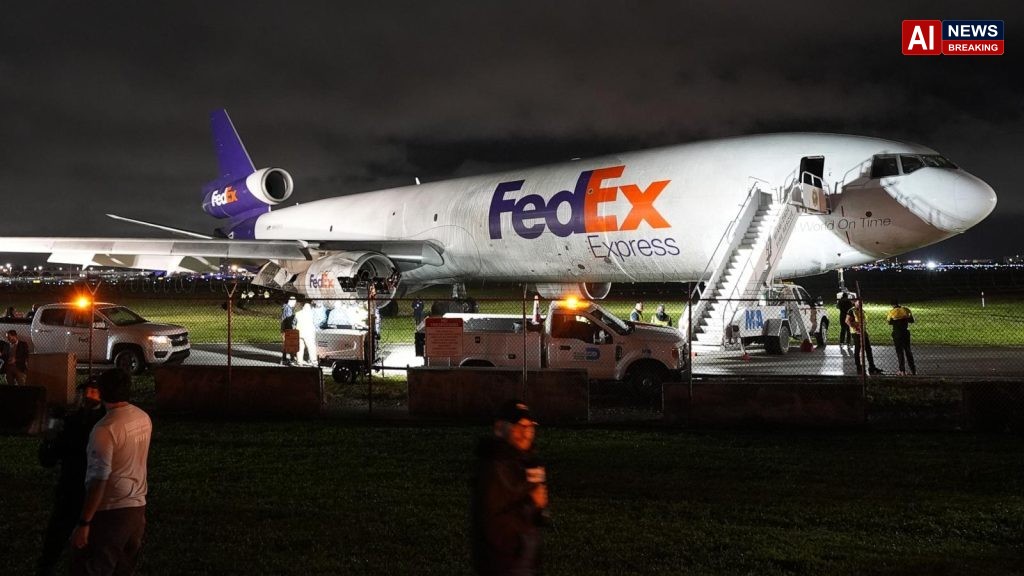
FedEx airplane overruns runway at Miami airport, temporarily closing all but 1 runway - AI News Breaking
A FedEx cargo aircraft overshot the end of a runway at Miami International Airport on Tuesday evening, prompting the temporary closure of three of the airport’s six runways and forcing a significant disruption to passenger and cargo operations. The incident, which occurred at approximately 19:45 local time, involved a Boeing 767‑300F that was on a scheduled cargo flight from Memphis to Miami. According to officials from the Federal Aviation Administration (FAA) and the airport’s own emergency response team, the aircraft failed to stop within the designated runway length and breached the perimeter fence before coming to a halt on a service road adjacent to the airfield.Initial investigations suggest that a combination of factors, including a wet runway surface following a brief afternoon shower, a higher-than-expected landing weight, and a possible delay in the deployment of thrust reversers, may have contributed to the overrun..
The FAA’s preliminary report, released in a statement early Wednesday, indicated that the aircraft’s landing speed was marginally above the calculated target, and that the crew’s decision to continue the landing despite the deteriorating conditions was under review. The airline, FedEx Express, has expressed its cooperation with the investigation and confirmed that all crew members are unharmed.Miami International Airport, which handles more than 30 million passengers a year and serves as a key hub for both domestic and international flights, moved swiftly to contain the situation. Airport management announced that runways 8R/26L and 8L/26R were closed to all traffic, while runway 9/27 remained operational under limited capacity..
The closures affected a total of 45 scheduled departures and arrivals, including flights from major carriers such as American Airlines, Delta Air Lines and United Airlines. Passengers were directed to alternate terminals where possible, and airline staff were instructed to provide rebooking options and accommodations for those stranded.The airport’s emergency services, in coordination with Miami-Dade Police and fire units, secured the perimeter around the aircraft and began assessing any potential damage to airport infrastructure. While the aircraft’s fuselage sustained minor structural deformation to the forward cargo hold, there were no reports of fuel leakage or fire..
The runway surface, however, suffered significant abrasion and a shallow gouge near the touchdown zone, requiring the deployment of specialized repair crews. Engineers from the FAA and the airport’s own maintenance division estimated that full restoration of the affected runway could take between 24 and 48 hours, depending on weather conditions and the availability of replacement paving materials.Airlines operating out of Miami International have issued statements urging passengers to remain patient as the situation unfolds. American Airlines, which has a major hub at the airport, announced that it would prioritize rebooking passengers on later flights and offered vouchers for meals and ground transportation where necessary..
Delta Air Lines similarly pledged to provide assistance and highlighted that its flight crews were already working to accommodate the displaced travelers. United Airlines, which operates several transcontinental routes from Miami, warned of possible cascading delays that could affect its network beyond the immediate impact of the runway closure.The incident has also reignited discussion among aviation safety experts about runway safety areas (RSAs) and the adequacy of current standards for handling overruns in densely populated airports. The International Civil Aviation Organization (ICAO) recommends a minimum RSA length of 300 meters beyond the runway end to accommodate aircraft that exceed their stopping distance..
Miami International’s RSA, like many major airports built in the mid‑20th century, is constrained by surrounding infrastructure and urban development, limiting the space available for expansion. Some analysts argue that the airport’s ongoing modernization program, which includes plans to extend and reinforce several runways, should accelerate the implementation of additional safety measures such as engineered material arresting systems (EMAS), which have proven effective in similar incidents elsewhere.FedEx Express released a brief statement confirming that the aircraft, registered as N313FE, will undergo a thorough inspection before returning to service. The cargo operator noted that the flight was carrying time‑sensitive medical supplies and other high‑value goods, all of which were secured and remained intact after the incident..
The company emphasized its commitment to safety and indicated that its pilots followed standard operating procedures throughout the flight, though it welcomed the FAA’s findings and pledged to implement any recommended corrective actions.The FAA has opened a formal investigation under the NTSB’s oversight, with a full report expected within 90 days. In the meantime, the agency has ordered a temporary reduction in landing weights for similar cargo aircraft operating at Miami International, pending the outcome of the preliminary safety assessment. The FAA also reminded airlines and pilots of the importance of adhering to runway condition reports (RCRs) and ensuring that braking performance calculations are updated in real time, particularly during periods of inclement weather.As Miami International works to restore full operations, passengers and freight customers alike are urged to monitor airline communications and airport advisories for the latest information..
The airport’s official website and social media channels have been updated regularly with details on runway status, expected wait times and alternative routing options. While the disruption is expected to subside once runway 8R/26L is repaired and reopened, officials caution that residual delays may linger for several hours as airlines adjust schedules and re‑accommodate affected flights. The incident underscores the challenges faced by busy hub airports in balancing operational efficiency with safety, and it will likely shape future policy discussions on runway design and emergency response protocols..
Updated: November 26, 2026
Summary: A FedEx 767‑300F overran a wet runway at Miami International, breaching the fence and forcing three of the airport’s six runways to close, halting dozens of flights and prompting a multi‑day repair effort. Investigators cite excess landing weight, higher than planned speed and delayed thrust‑reverse deployment, while airlines scramble to rebook passengers and the FAA orders temporary weight limits pending a full safety review.
Miami’s runway‑overrun reveals how tightly packed hub designs force airlines to gamble on weight and weather limits, turning a single miscalculation into a network‑wide bottleneck. The incident will likely accelerate EMAS installations, nudging regulators to rethink safety buffers before capacity pressures dictate runway layouts.







