 U.S. and Allies Agree to Release Diesel Reserves as Prices Soar
  Mother’s scream stops armed passenger from reaching cockpit
  American University of Afghanistan at Risk of Closure Amid Funding Cuts
  As Gas Prices Rose, Sales of Larger Vehicles Slid
  Airlines Set to Bring Israelis Back From U.A.E. After FlyDubai Cockpit Attack
 Gandhi Jayanti 2026: In a World at War, Why Gandhi’s Message of Non-Violence Still Matters
On Gandhi Jayanti 2026, the world remembers Mahatma Gandhi’s message of peace and non-violence as wars, terrorism and armed conflicts continue across multiple regions.
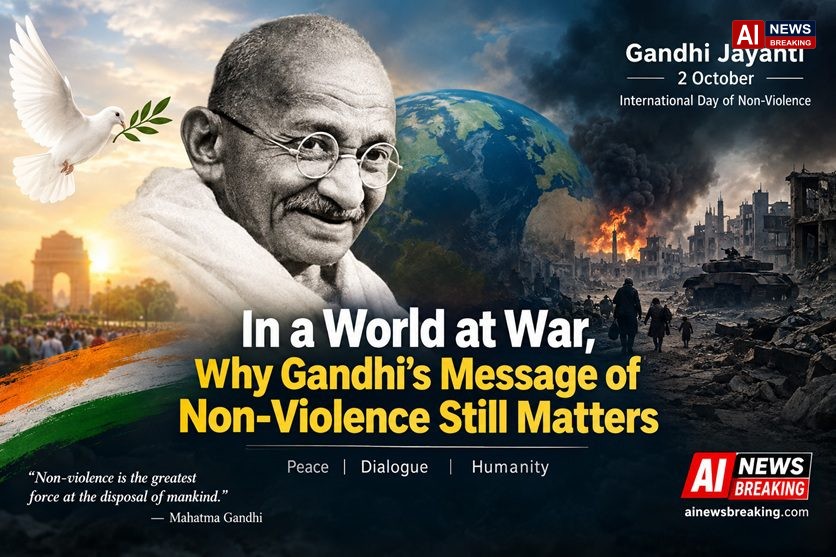
gandhi jayanti 2026 world:
Gandhi Jayanti 2026 | AI News Breaking Editorial Analysis
October 2 is remembered in India as Gandhi Jayanti, the birth anniversary of Mahatma Gandhi. Across the world, the same date is observed as the International Day of Non-Violence, established by the United Nations to promote the principles of peace, tolerance, dialogue and non-violent action.
But Gandhi Jayanti 2026 arrives at a particularly difficult moment for the international community.
Across different regions, wars and armed conflicts continue to destroy lives, displace civilians and deepen political divisions. Ukraine remains at the centre of a prolonged war involving Russia. Gaza and the wider Middle East continue to face the consequences of conflict and political confrontation. Sudan remains trapped in a devastating internal war, while terrorism, militant violence and political instability continue to threaten communities in several parts of the world.
The contradiction is difficult to ignore: on the day the world formally celebrates non-violence, millions of people are still living with the consequences of violence.
That contradiction makes Gandhi’s message more relevant to the present—not because the world has suddenly become capable of eliminating conflict, but because it raises a fundamental question: Can humanity resolve political and social disputes without continually turning to force?
Gandhi Jayanti is more than a remembrance
Mahatma Gandhi was born on October 2, 1869, in Porbandar. His political philosophy was built around truth, non-violence and Satyagraha—the idea that resistance to injustice could be organised without relying on physical violence.
The United Nations describes Gandhi as a pioneer of the philosophy and strategy of non-violence. In 2007, the UN General Assembly established October 2 as the International Day of Non-Violence, giving Gandhi’s philosophy a formal place on the international calendar.
The significance of the day therefore goes beyond ceremonies, speeches and floral tributes.
Gandhi’s central challenge was to the assumption that violence is the inevitable instrument of political change. His campaigns against colonial rule demonstrated that resistance did not necessarily require armed confrontation. Civil disobedience, non-cooperation, protest and mass mobilisation could also challenge political power.
The United Nations continues to describe non-violent action as a means of pursuing political and social change while rejecting physical violence.
That distinction is important in today’s world.
Non-violence does not mean ignoring injustice. It does not mean accepting oppression. It does not mean that societies should remain passive when people are being denied rights.
Instead, Gandhi’s approach attempted to separate resistance from hatred and political struggle from physical destruction.
The world Gandhi left behind—and the world we have created
Gandhi lived through an era of colonialism, imperial competition and two world wars. Yet the technological capacity for destruction available to governments today is vastly greater.
Modern warfare is no longer limited to soldiers meeting on battlefields.
Drones can strike targets from hundreds of kilometres away. Cyber operations can disrupt critical infrastructure. Artificial intelligence is increasingly becoming part of military planning and information warfare. Missiles can cross borders in minutes. Social media can spread propaganda, hatred and disinformation to millions of people almost instantly.
The battlefield has become simultaneously physical and digital.
This creates a new dimension to Gandhi’s message.
Violence today does not always begin with a gun or missile. It can begin with dehumanising language, hatred, misinformation, political extremism or the systematic portrayal of an entire population as an enemy.
That makes the struggle for peace partly a struggle over information, language and human dignity.
Ukraine: when war becomes prolonged
The war involving Russia and Ukraine remains one of the clearest examples of how difficult modern conflict resolution has become.
Years of fighting have created enormous humanitarian, economic and geopolitical consequences. The conflict has also affected European security, energy markets, food supplies and international relations.
At the United Nations General Assembly in September 2026, Ukraine was among the conflicts receiving significant international attention, alongside Gaza and Sudan.
The continuation of the war also demonstrates one of the hardest realities of diplomacy: ending a conflict is often more complicated than beginning one.
Once lives have been lost, territories occupied, infrastructure destroyed and political positions hardened, compromise becomes increasingly difficult.
Gandhi’s philosophy cannot provide a simple diplomatic formula for such conflicts.
But it does raise a question that remains central to every war:
At what point does continued violence stop solving the original political problem and begin creating new ones?
Gaza and the Middle East: the human cost of prolonged conflict
The Middle East presents another painful test for the international system.
The conflict surrounding Gaza has produced severe humanitarian consequences and intensified disagreements over security, sovereignty, territorial rights and the future of the region.
International discussions in 2026 have continued to focus heavily on Gaza and the broader Middle Eastern crisis.
For civilians, however, geopolitical language often becomes painfully simple.
A destroyed home is a destroyed home.
A displaced family is a displaced family.
A child growing up amid fear does not experience conflict as a diplomatic argument.
This is where Gandhi’s emphasis on human dignity becomes particularly significant.
His political philosophy repeatedly attempted to place human beings above political abstractions. National interests, territorial claims and political power may dominate diplomatic negotiations, but the consequences are ultimately experienced by ordinary people.
Sudan: a war that risks becoming forgotten
Sudan represents another dimension of the global conflict crisis.
The country’s war has created a severe humanitarian emergency and displaced large numbers of people. The conflict has also struggled to maintain international attention compared with more prominent geopolitical crises.
At the 2026 UN General Assembly, Sudan remained among the major conflicts discussed by world leaders and international organisations.
Sudan demonstrates why peace cannot be measured only by whether major powers reach agreements.
Peace also requires functioning institutions, humanitarian access, political dialogue and protection for civilians.
Without those foundations, a ceasefire can remain fragile and violence can return.
Terrorism: the opposite of Gandhi’s politics
Terrorism presents an even sharper contradiction to Gandhi’s philosophy.
Terrorist organisations use violence deliberately to generate fear, impose political demands, destabilise governments or provoke wider conflict.
The Global Terrorism Index 2026 documents terrorist violence using a database of reported terrorist incidents and examines terrorism as a continuing global security challenge.
The methods may differ from conventional warfare, but the consequences overlap: civilians become targets, communities become divided and fear becomes a political instrument.
Gandhi’s philosophy stands fundamentally opposed to the idea that political objectives can justify deliberately inflicting violence on innocent people.
At the same time, understanding the causes of terrorism cannot mean excusing terrorism.
A serious discussion of peace must distinguish between understanding why violence emerges and legitimising the violence itself.
Those are not the same thing.
The dangerous normalisation of violence
Perhaps the greatest danger facing the world is not any single war.
It is the gradual normalisation of war.
When conflict continues for years, headlines become routine. Death tolls become statistics. Refugees become numbers. Destroyed cities become satellite images.
Human beings can become accustomed to suffering that should never become normal.
This is precisely where Gandhi’s legacy remains uncomfortable.
He challenged the idea that violence should be accepted simply because it is politically convenient or historically familiar.
The UN’s 2026 message for the International Day of Non-Violence similarly warned that rising divisions, tensions and conflicts are occurring alongside disregard for the foundations of peace, including the UN Charter, human rights, international law, diplomacy and dialogue.
That warning is particularly relevant today.
Peace does not mean weakness
One of the common misunderstandings about non-violence is that it represents weakness.
Gandhi’s own political career suggests something different.
Non-violence, in his interpretation, required discipline, organisation, courage and willingness to confront injustice without reproducing the violence of the oppressor.
That is fundamentally different from surrender.
A peaceful society still requires institutions capable of protecting people. Governments still have responsibilities to defend citizens. International law still recognises the complexities of armed conflict and self-defence.
The challenge is to ensure that the pursuit of security does not become an endless justification for escalation.
What Gandhi’s message means in the age of drones and AI
The world of 2026 is technologically distant from Gandhi’s India.
Yet technology has not eliminated the oldest human problems: fear, hatred, inequality, nationalism, revenge and the desire for power.
In fact, technology can amplify them.
Artificial intelligence can accelerate information warfare. Algorithms can create echo chambers. Deepfakes can blur the distinction between fact and fabrication. Autonomous and semi-autonomous weapons raise new questions about human responsibility for decisions involving life and death.
The more powerful technology becomes, the more important human restraint becomes.
A machine can calculate a target.
It cannot independently provide humanity with a moral answer to whether violence is justified.
That remains a human responsibility.
Gandhi’s message is also about everyday violence
The relevance of non-violence should not be limited to wars between states.
Violence exists in homes, schools, workplaces, communities and online spaces.
Hate speech can turn disagreement into hostility. Religious and ethnic prejudice can create social divisions. Political polarisation can transform fellow citizens into enemies.
A culture of peace therefore cannot be created exclusively through treaties signed by governments.
It also depends on how societies communicate.
The UN has specifically highlighted the danger of hate speech and the way modern communication technologies can amplify hatred, discrimination and intolerance.
This is one area where Gandhi’s philosophy becomes immediately practical.
Non-violence begins not only with refusing to fire a weapon, but also with refusing to dehumanise another person.
The difficult question for world leaders
Every generation inherits conflicts created by previous generations.
But every generation also has the opportunity to stop passing those conflicts forward.
For today’s leaders, Gandhi’s legacy presents a difficult challenge: can diplomacy be attempted before military escalation becomes irreversible?
Can negotiations continue when public opinion demands confrontation?
Can political leaders acknowledge the humanity of their opponents without abandoning their own security interests?
Can international institutions enforce rules consistently enough to preserve confidence in diplomacy?
There are no easy answers.
But refusing to ask these questions creates an even greater danger.
Gandhi Jayanti 2026: A reminder rather than a ritual
On October 2, India will remember Gandhi with prayers, tributes and public programmes.
The United Nations will mark the same day as the International Day of Non-Violence.
But the true significance of the day cannot be measured by the number of speeches delivered or ceremonies held.
It should be measured by whether Gandhi’s central ideas remain part of the world’s political vocabulary when the pressure to choose confrontation becomes strongest.
The world does not need to romanticise Gandhi or pretend that non-violence can instantly resolve every modern conflict.
It needs to take seriously the questions his philosophy raised.
What is the human cost of revenge?
When does military victory fail to produce lasting peace?
How much suffering can diplomacy prevent?
And can political leaders resist the temptation to treat force as the first answer rather than the last resort?
AI News Breaking Editorial Analysis
Gandhi Jayanti 2026 arrives in a world that appears to have travelled far from the principles associated with its central figure.
Wars continue. Terrorist violence persists. Civilians remain trapped between competing political and military forces. International institutions struggle to turn diplomatic declarations into lasting solutions.
Yet that is precisely why the message of October 2 matters.
Peace is easiest to celebrate when there is no conflict.
The real test of peace comes when societies are angry, governments are under pressure and violence appears to offer a faster solution.
Gandhi’s legacy does not promise a world without disagreement. It offers a different way of responding to disagreement.
Truth instead of propaganda.
Dialogue instead of hatred.
Resistance without dehumanisation.
Justice without revenge.
And peace not merely as the absence of war, but as a political and human objective.
On Gandhi Jayanti, the world therefore faces a contradiction—but also an opportunity.
The contradiction is that humanity celebrates non-violence while fighting wars across multiple regions.
The opportunity is to recognise that every conflict eventually requires something weapons alone cannot provide: a political settlement, human dignity and a reason for former enemies to stop fighting.
That is perhaps the most enduring lesson of Gandhi in 2026.
The question is not whether the world can eliminate every conflict overnight.
The question is whether humanity is still willing to choose dialogue before destruction, reconciliation before revenge, and peace before another generation learns to live with war.