Indonesia denies foreign claim to rescued orangutans
 Turkey hosts COP31 climate talks in Antalya.
 Pope meets Argentine bishops.
 APOD: 2026 November 8 – Major Fireball Meteor
 Indonesian Horror Hit ‘Pabrik Gula’ Gets 2028 Sequel as MD Entertainment Lines Up Three Imax Films
Hyderabad’s drinking water sources Singur and Manjira reservoirs decline, Telangana to divert Godavari water
**
Hyderabad’s drinking water sources Singur and Manjira reservoirs decline, Telangana to divert Godavari water - AI News Breaking
hyderabads drinking water sources:
Hyderabad’s water authorities are confronting a sharp decline in supplies from the city’s two primary reservoirs, Singur and Manjira, prompting the state government to accelerate plans to tap the Godavari River for drinking water. The move comes after recent assessments revealed that the combined capacity of the two reservoirs, which have traditionally fed the capital’s municipal supply, has fallen to levels insufficient to meet the growing demand of a metropolis that now houses more than ten million residents. Engineers and officials say the shortfall is the result of a combination of factors, including prolonged drought, erratic monsoon patterns and increased water consumption driven by rapid urbanisation and industrial expansion.The Singur reservoir, located about 40 kilometres north of Hyderabad, historically contributed roughly 60 per cent of the city’s potable water..
Recent data from the Telangana Water Resources Department indicate that its live storage has dwindled to under 20 per cent of its designed capacity. Manjira, the smaller of the two reservoirs situated on the Manjira River about 70 kilometres southeast of the city, has fared no better, with its storage now hovering around 25 per cent. Both reservoirs rely on rainfall and runoff from the catchments in the semi‑arid Deccan plateau, a region that has experienced below‑average rainfall in the past two consecutive years.State officials say the situation is compounded by the fact that Hyderabad’s per‑capita water usage has risen from an estimated 140 litres per day a decade ago to nearly 180 litres per day today..
The city’s expansion into former agricultural lands, coupled with the proliferation of water‑intensive industries such as pharmaceuticals and information technology, has stretched the existing supply network to its limits. The municipal corporation’s water‑distribution system, which dates back to the 1970s, now serves an area that is twice as large as it was when the reservoirs were first commissioned.In response, the Telangana government has fast‑tracked a long‑planned inter‑basin transfer scheme that will draw water from the Godavari River, one of India’s largest watercourses, and convey it to Hyderabad via a series of large‑diameter pipelines. The project, which has been under discussion for more than a decade, involves linking a 3,000‑mm‑diameter Godavari ring main with the existing 1,200‑mm‑diameter Manjira Phase‑III and IV gravity main pipelines..
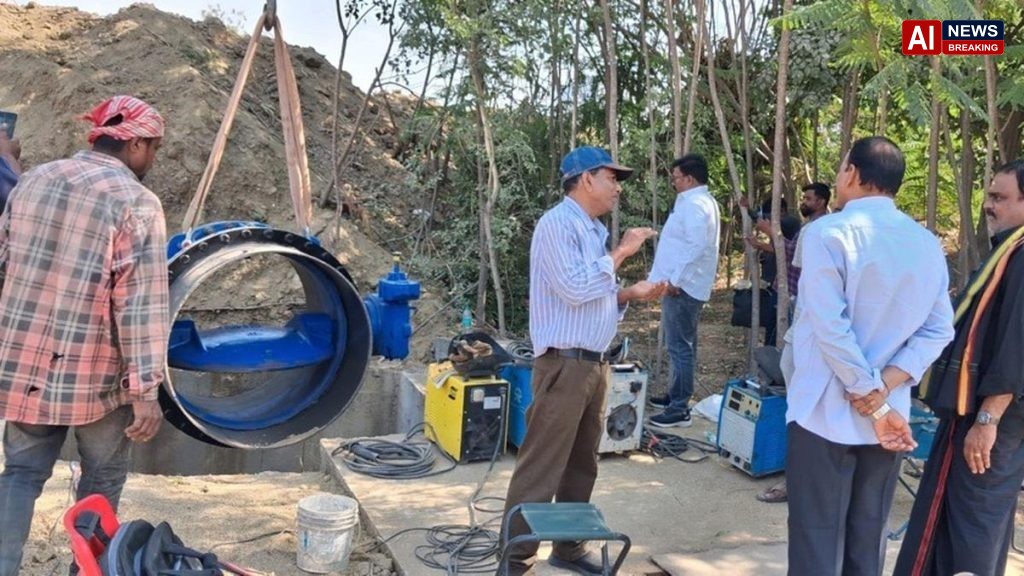
Works on the critical interconnection near Velimela village, close to the city’s Outer Ring Road, are now under way, with contractors excavating trenches, laying steel conduits and installing high‑capacity pumping stations.The engineering design for the Godavari ring main calls for a closed‑loop system capable of moving up to 1,200 million litres per day, a volume that would more than double Hyderabad’s current supply from the Singur‑Manjira network. The ring main will run parallel to the existing National Highway 44 before veering eastward to intersect the Manjira gravity mains at Velimela. Once connected, water will flow by gravity from the Godavari intake at the Polavaram reservoir, through a series of lift stations that compensate for the elevation gain, and finally into the city’s distribution grid..
Officials stress that the interconnection will not only augment the quantity of water available but also improve reliability by providing an alternative source during periods of low rainfall.Critics, however, warn that diverting water from the Godavari could have downstream implications for other states that share the river basin, particularly Andhra Pradesh and Maharashtra. The central government’s inter‑state water dispute tribunal has previously ruled that any new withdrawals must not affect the existing allocations for agriculture, domestic use and hydropower. Telangana’s water minister has assured that the project will adhere to the tribunal’s guidelines, noting that the Godavari intake will be positioned downstream of the existing Polavaram dam, where sufficient flow is expected even in lean years.Environmental groups have also raised concerns about the ecological impact of the new pipelines, particularly the potential disturbance to local habitats along the corridor between Velimela and the Godavari intake..
An independent environmental impact assessment, commissioned last year, concluded that while the construction phase would cause temporary disruption, the long‑term benefits of reduced groundwater extraction and improved water security outweigh the risks. Mitigation measures such as re‑forestation, wildlife crossings and strict sediment control are being incorporated into the project’s execution plan.The financial outlay for the Godavari‑Manjira linkage is estimated at around ₹12,000 crore, a sum that the state government plans to fund through a combination of central assistance, multilateral loans and a modest increase in water tariffs. The project is slated for completion by the end of 2028, with an initial pilot phase expected to become operational by mid‑2025..
In the interim, authorities have instructed residents to conserve water and have instituted a rotational supply schedule to stretch the dwindling reservoir stocks until the new supply line comes online.While the inter‑basin transfer scheme promises a decisive boost to Hyderabad’s water security, experts caution that it should be viewed as part of a broader strategy that includes demand‑side management, leakage reduction and the promotion of rainwater harvesting. Dr Ramesh Kumar, a water resources specialist at the Indian Institute of Technology Hyderabad, emphasised that “no single project can solve a systemic problem; we need an integrated approach that balances supply augmentation with sustainable consumption.” He added that the city’s rapid expansion will continue to pressure any supply system, making long‑term planning essential.As the pipeline works progress near Velimela, the eyes of both policymakers and the public remain fixed on the unfolding effort to safeguard Hyderabad’s water future. The success of the Godavari diversion will hinge not only on engineering execution but also on the ability of the state to manage inter‑state water politics, address environmental concerns and foster responsible water use among its citizens..
If these challenges are met, the project could set a precedent for other Indian megacities grappling with similar water‑security dilemmas..
Updated: October 26, 2026
Summary: Hyderabad’s dwindling Singur and Manjira reservoirs have forced the state to fast‑track a Godavari River diversion, linking a new 3,000‑mm pipeline to the city’s supply network to double available water. The ₹12,000‑crore project, slated for completion by 2028, faces inter‑state water‑sharing disputes and environmental concerns while urging residents to curb consumption.
Hyderabad’s pivot to the Godavari signals a reluctant shift from “build‑more‑reservoirs” to inter‑basin engineering, exposing how rapid urban sprawl now forces cities to wrestle with the political ecology of shared rivers.
If the pipeline delivers today’s water crunch without tightening demand