
 Trump administration offers mixed messages on limits to Ukraine’s Starshield access
  US Treasury proposes a rule to crack down on high-tech investments in China, other adversaries
  Calley Means, a key MAHA advocate, resigns as a top RFK Jr. adviser
  Spotify Tightens Family Plan Controls with QR Code Verification
  Use of Chief Minister C. Joseph Vijay’s deep fake videos to collect money: Rajasthan youth moves Madras High Court seeking bail
 Indonesian wildfires worsen as El Niño drives haze crisis
**
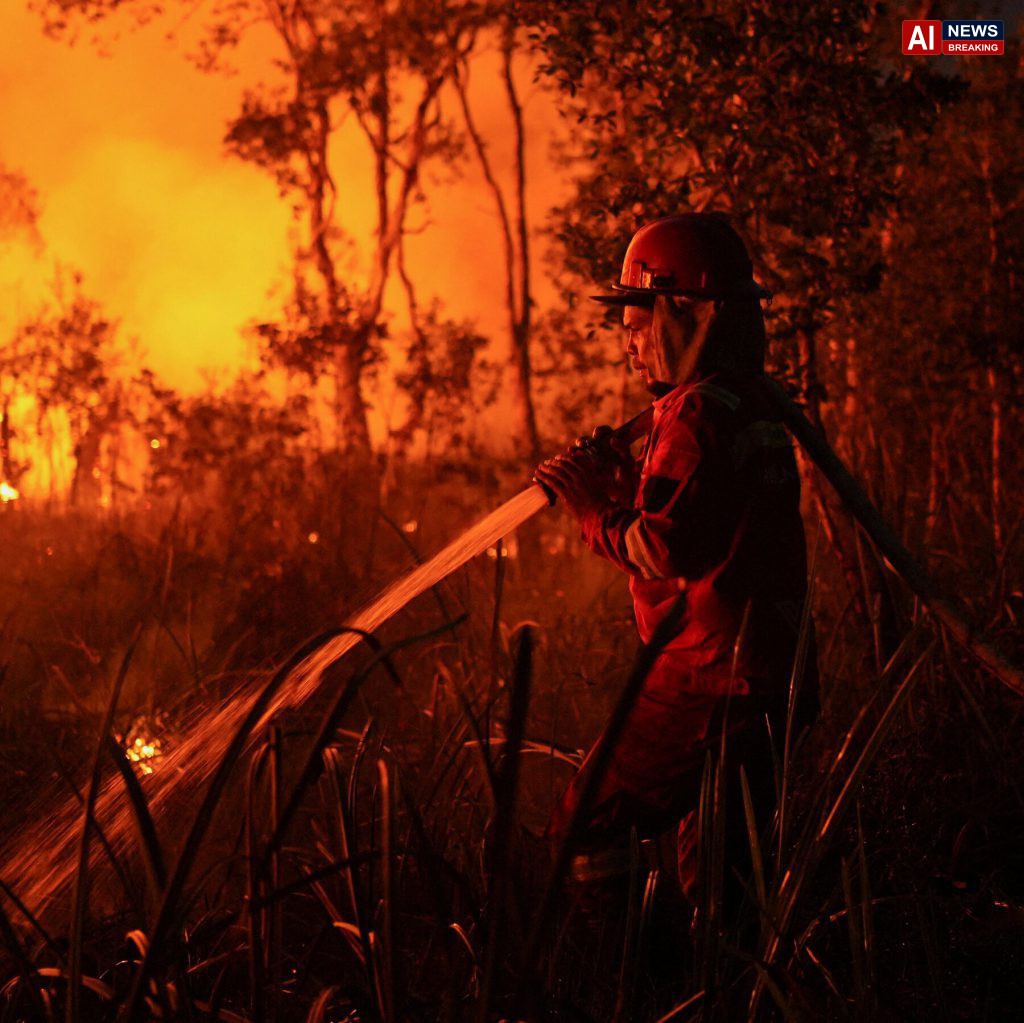
Indonesian wildfires worsen as El Niño drives haze crisis - AI News Breaking
indonesian wildfires worsen drives:
The skies over Sumatra and Kalimantan have turned a bruised shade of orange as thick plumes of smoke choke the horizon, signaling the return of one of Southeast Asia’s most persistent environmental crises. Indonesia, an archipelago of more than seventeen thousand islands, is once again grappling with the relentless spread of wildfires that have engulfed vast tracts of forest and peatland. These fires, often ignited by agricultural clearing practices, have been exacerbated by the return of El Niño, the cyclical warming of sea surface temperatures in the central and eastern Pacific Ocean..
This weather phenomenon disrupts global climate patterns, typically bringing drier and hotter conditions to the Indonesian archipelago, creating a volatile atmosphere where fire can spread with terrifying speed and intensity.For local communities, the onset of the dry season usually signals a time of harvest and agricultural activity, but this year, the air quality has deteriorated to hazardous levels within weeks. Residents in cities such as Pekanbaru and Palembang have reported waking to a world shrouded in haze, with visibility reduced to mere meters and the acrid taste of smoke lingering on the tongue. Schools have been forced to close their doors as respiratory complaints surge among children, while hospitals report a significant increase in cases of upper respiratory tract infections..
The health implications are severe, particularly for vulnerable populations including the elderly and infants, who lack the medical resources to cope with the prolonged exposure to fine particulate matter that can penetrate deep into the lungs.The primary fuel for these destructive blazes is not timber, but peat, a carbon-rich organic soil that forms in waterlogged conditions. In its natural state, peatlands are wetlands that act as massive carbon sinks, storing vast amounts of carbon dioxide and helping to mitigate global climate change. However, when these lands are drained for palm oil, acacia, or pulpwood plantations, the previously waterlogged soil becomes dry and highly flammable..
Once ignited, peat fires are particularly difficult to extinguish because they burn underground, often at depths of several meters, continuing to smolder long after the surface flames have been doused. This subterranean combustion can last for months, releasing toxic gases and creating a persistent source of pollution that defies conventional firefighting techniques.Environmental scientists have warned that the combination of El Niño and extensive peatland drainage creates a perfect storm for catastrophic fire seasons. The current El Niño cycle, while not the strongest on record, is sufficient to suppress rainfall in the region and raise temperatures, further drying out the peat..
Historical data shows that during previous strong El Niño events, such as those in 1997-1998 and 2015, Indonesia experienced some of its worst haze crises, with smoke drifting across the Strait of Malacca to affect neighboring countries like Malaysia and Singapore. This time, the patterns are similar, leading experts to predict that the current season could rival those historical precedents in terms of severity and duration if immediate and sustained action is not taken.The economic motivations behind the land-use changes are complex and deeply entrenched. Indonesia is the world’s largest producer of palm oil and a major exporter of pulp and paper, industries that drive significant portions of the national economy and provide livelihoods for millions..
The conversion of forest and peatland into plantations has been a rapid process, often facilitated by weak enforcement of environmental regulations and overlapping land rights issues. While large multinational corporations have faced intense international pressure to adopt sustainable practices, many smaller operators and independent planters continue to rely on traditional slash-and-burn methods, which are faster and cheaper than mechanical clearing but carry immense environmental and social costs.The diplomatic repercussions of the haze are also significant, often straining relations between Indonesia and its neighbors. When the smoke crosses borders, it triggers complaints from affected countries, leading to political tensions and accusations of negligence..
In previous years, these disputes have led to increased regional cooperation and the signing of transboundary haze agreements, yet enforcement remains a challenge. The Indonesian government has repeatedly stated its commitment to protecting the environment and managing forest fires, implementing moratoriums on new concessions in primary forests and peatlands. However, critics argue that these measures are often undermined by local economic pressures and a lack of resources for monitoring and enforcement in remote areas.Internationally, the fires have drawn scrutiny from environmental groups and governments concerned about the contribution of Indonesian land-use changes to global greenhouse gas emissions..
The burning of peatlands releases carbon that has been stored for thousands of years, making Indonesia one of the world’s top emitters when deforestation and peat fires are included in the calculations. This reality has put pressure on the Indonesian government to align its domestic policies with its international climate commitments under the Paris Agreement. Donor countries and development banks have offered financial support for fire prevention and peatland restoration, but the scale of the intervention required far exceeds current commitments, leaving a gap between ambition and implementation.On the ground, the response to the current crisis involves a mix of local firefighting efforts and aerial operations..
The Indonesian National Disaster Management Authority works alongside the military, police, and local communities to combat the blazes, using water bombers, land sprinklers, and manual labor to contain the spread. In some areas, artificial rainmaking operations have been employed, dispersing chemicals into the atmosphere to induce precipitation. However, the effectiveness of these measures is limited by the intensity of the El Niño-driven drought, which can render cloud-seeding attempts futile..
The reliance on local communities, who often live in close proximity to the burning lands, highlights the social dimension of the crisis, as residents are forced to balance their immediate economic needs against the long-term environmental damage.The impact on biodiversity is equally alarming. The fires threaten the habitat of iconic species such as the orangutan, tiger, and rhinoceros, many of which are endemic to the region and already classified as endangered. Forest fragmentation caused by fires reduces the available habitat, forcing animals into smaller, isolated pockets of forest where they are more vulnerable to poaching and human-wildlife conflict..
Conservationists warn that repeated fire cycles can degrade the ecological resilience of these forests, making it harder for them to regenerate and recover. The loss of these ecosystems not only represents a tragedy for wildlife but also undermines the natural barriers that protect against floods and landslides, which are critical for the stability of local infrastructure and communities.Community resilience is being tested as families adapt to the worsening conditions. In rural areas, access to clean water has become a pressing concern, as smoke and ash contaminate local water sources..
Schools that remain open have implemented health protocols, including masking and indoor air quality monitoring, but resources are often scarce. The psychological toll on communities is also significant, with residents expressing anxiety and frustration over the recurring nature of the crisis. For many, the haze is not just an environmental issue but a daily struggle for survival.
Updated: August 24, 2026
El Niño-driven drought has reignited severe wildfires across Indonesia, turning skies orange and paralyzing classrooms with hazardous haze. The crisis threatens public health and global climate goals while exposing the deep conflict between urgent economic interests and ecological preservation.
Indonesia’s inability to halt peatland drainage reveals that economic incentives consistently override climate commitments, ensuring these fires remain a predictable feature of regional development rather than an anomaly.
This cycle locks neighboring nations into a diplomatic stalemate, exposing the hollow nature of international aid when local enforcement mechanisms are structurally dismantled for short-term gain.