Europe warns of Russia’s hybrid attacks but struggles to counter them
  Former chief election commissioner calls SIR scheme illegal.
  A Corruption Scandal Is Reshaping Brazil’s Presidential Election
  US citizen injured in Illinois after ICE agents mistook him for fugitive, tried to arrest him
  At 10 years old, Smithsonian’s Black museum is undaunted amid pressure from Trump administration
 Japan PM Sanae Takaichi Likely to Visit India Next Month for High-Stakes Talks with PM Modi in Assam
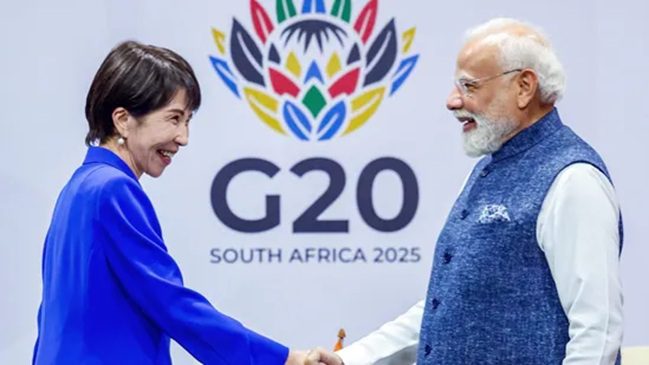
japan sanae takaichi likely:
Japan’s Prime Minister Sanae Takaichi is expected to visit India next month for a bilateral summit with Prime Minister Narendra Modi. While official confirmation is still pending from New Delhi, Japanese media reports suggest Assam as the likely venue.
The visit is expected to further deepen India–Japan strategic and economic cooperation.
Japan’s political leadership is preparing for a potential high-level diplomatic visit to India next month, as Prime Minister Sanae Takaichi is expected to travel for bilateral talks with Indian Prime Minister Narendra Modi. Although the visit has not yet been officially confirmed by Indian authorities, multiple Japanese media reports indicate that preparations are underway for a summit-level engagement between the two leaders.
According to early reporting, the proposed meeting is expected to take place in India’s northeastern state of Assam, marking a significant geographic and strategic choice for a Japan–India summit.
If finalized, the visit would continue a pattern of intensified diplomatic engagement between New Delhi and Tokyo, two key Indo-Pacific partners increasingly aligned on economic security, infrastructure development, and regional stability.
India–Japan Relations in a Strategic Decade
India and Japan share one of the most stable and strategically important bilateral relationships in Asia. Over the past decade, the partnership has evolved beyond traditional diplomacy into a multi-layered framework involving:
- Defense and security cooperation
- Infrastructure investment and connectivity projects
- Technology collaboration (semiconductors, AI, and clean energy)
- Supply chain resilience and economic security
- Indo-Pacific maritime cooperation
Both countries are also key members of the Quad grouping alongside the United States and Australia, which has further elevated the strategic importance of their bilateral engagement.
Recent summit interactions between PM Modi and Japan’s leadership have consistently emphasized long-term cooperation frameworks, including a 10-year roadmap for economic and technological collaboration.
The potential upcoming visit is expected to reinforce this trajectory, particularly at a time when global supply chain shifts and geopolitical tensions are reshaping Indo-Pacific priorities.
The Proposed Visit: What Has Been Reported
Likely Timing and Confirmation Status
Reports indicate that Prime Minister Sanae Takaichi may travel to India next month for a bilateral summit with PM Narendra Modi. However, Indian government officials have not yet formally confirmed the schedule or agenda.
This “expected but unconfirmed” status is typical in high-level diplomatic planning, where visits are often finalized only after coordination between foreign ministries on logistics, security, and agenda alignment.
Possible Venue: Assam
One of the most notable details emerging from early reports is that the summit may be hosted in Assam.
If confirmed, this would be strategically significant for several reasons:
- It highlights India’s “Act East Policy” focus on the Northeast region
- It promotes the region as a gateway to Southeast Asia
- It signals decentralization of high-level diplomacy beyond New Delhi
- It aligns with infrastructure and connectivity projects in the region
Hosting a Japan–India summit in Assam would also carry symbolic weight, emphasizing development in India’s eastern corridor and its integration with regional trade routes.
Strategic Context: Why This Visit Matters Now
1. Indo-Pacific Geopolitical Realignment
The Indo-Pacific region is currently undergoing rapid strategic recalibration, driven by:
- Maritime security concerns
- Supply chain diversification away from China
- Increased defense cooperation among Quad countries
- Expansion of infrastructure diplomacy
India and Japan have both positioned themselves as stabilizing forces in this evolving architecture.
A bilateral summit at this juncture would reinforce shared priorities on a “free and open Indo-Pacific” framework.
2. Economic Security and Supply Chain Cooperation
One of the most important pillars of India–Japan relations today is economic security.
Both countries have been actively working to:
- Diversify semiconductor supply chains
- Reduce dependency on single-country manufacturing hubs
- Build resilient logistics and industrial ecosystems
- Strengthen investment flows in critical sectors
Japan has been one of the largest technology and infrastructure investors in India, particularly in metro rail, high-speed rail planning, and industrial corridors.
The upcoming meeting is likely to focus on expanding these initiatives further.
3. Infrastructure and Connectivity Expansion
India and Japan have a long-standing partnership in infrastructure development, including:
- Mumbai–Ahmedabad bullet train project
- Industrial corridors in multiple Indian states
- Urban transport modernization (metro systems)
- Port and logistics infrastructure development
Japan’s funding and technical expertise through agencies like JICA have played a central role in several of these projects.
A summit could potentially unlock additional funding commitments or expansion into new infrastructure corridors.
4. Defense and Security Cooperation
Defense cooperation between India and Japan has strengthened significantly over the past decade.
Key areas include:
- Joint naval exercises
- Maritime domain awareness
- Defense equipment collaboration discussions
- Cybersecurity and space security dialogue
As maritime democracies, both countries share concerns about freedom of navigation in the Indo-Pacific.
A leadership-level meeting typically includes reaffirmation of defense cooperation frameworks and coordination in regional security mechanisms.
Political Significance of Leadership Engagement
Modi’s Foreign Policy Context
Prime Minister Narendra Modi has maintained an active global diplomatic schedule, strengthening India’s relationships across Asia, Europe, and the Middle East.
His engagement with Japan has been a consistent priority, reflecting:
- India’s “Act East” strategy
- Economic modernization goals
- Strategic autonomy in global affairs
- Technology and investment attraction policies
Japan’s Foreign Policy Direction
Japan, under its current leadership, continues to expand its global strategic footprint through:
- Increased Indo-Pacific engagement
- Strengthening alliances outside traditional Western frameworks
- Expanding economic diplomacy in South and Southeast Asia
India is a central pillar of Japan’s Indo-Pacific outreach strategy.
Assam as a Diplomatic Venue: Symbolism and Strategy
If Assam is confirmed as the venue, it would reflect a deliberate diplomatic signal.
Key implications include:
- Regional integration: Highlighting Northeast India as a strategic bridge to ASEAN
- Development diplomacy: Showcasing infrastructure and investment potential
- Geopolitical signaling: Emphasizing India’s eastern orientation in foreign policy
- Soft power projection: Using regional states as diplomatic hosts
Assam’s location makes it a natural link between India and Southeast Asia, reinforcing broader connectivity frameworks like BIMSTEC and ASEAN partnerships.
Expected Agenda of the Summit
While official agenda details are not confirmed, typical India–Japan summit discussions include:
Economic cooperation
- Trade expansion
- Investment pipelines
- Technology collaboration
- Industrial partnerships
Strategic cooperation
- Indo-Pacific security
- Defense coordination
- Maritime domain awareness
Infrastructure and connectivity
- Rail and metro expansion
- Industrial corridors
- Logistics infrastructure
Emerging technologies
- Semiconductors
- Artificial intelligence
- Clean energy transition
- Digital infrastructure
People-to-people ties
- Student exchanges
- Skilled workforce mobility
- Cultural cooperation
Broader Diplomatic Trends
The potential visit fits into a larger pattern of intensifying India–Japan engagement, including:
- Regular annual summits
- Strong coordination in Quad forums
- Expanded economic partnerships
- Joint technology and infrastructure initiatives
In recent years, both countries have increasingly framed their relationship not only as bilateral cooperation but as part of a broader regional stabilization effort.
Economic Stakes for Both Countries
For India:
- Increased foreign direct investment
- Technology transfer opportunities
- Infrastructure financing
- Industrial diversification
For Japan:
- Access to a large and growing market
- Supply chain diversification
- Strategic partnership in Indo-Pacific stability
- Opportunities for Japanese firms in Indian manufacturing expansion
Challenges and Constraints
Despite strong relations, several challenges remain:
- Project execution delays in infrastructure initiatives
- Regulatory complexity in large-scale investments
- Global economic slowdown risks
- Geopolitical tensions affecting trade flows
A summit visit is often used to address such bottlenecks at the highest political level.
A Visit with Strategic Weight
If confirmed, Prime Minister Sanae Takaichi’s visit to India next month would represent more than a routine diplomatic exchange. It would reinforce one of Asia’s most strategically aligned partnerships at a time of global uncertainty.
The potential choice of Assam as a venue adds further symbolic significance, reflecting India’s effort to project its eastern regions as integral to its international diplomacy.
Even before official confirmation, the reported visit underscores the continuing momentum in India–Japan relations and the shared commitment to long-term strategic cooperation.
From a geopolitical systems perspective, this reported visit reflects a tightening “middle-power convergence” in the Indo-Pacific, where India and Japan increasingly act as stabilizing nodes in a multipolar order. The emphasis on regional venues like Assam signals a decentralization of diplomatic geography, aligning foreign policy with domestic development corridors. Strategically, such engagements are less about isolated summits and more about reinforcing a persistent network architecture—spanning supply chains, defense interoperability, and technology ecosystems—designed to reduce systemic dependence on any single power center while increasing resilience across the Indo-Pacific balance of power.