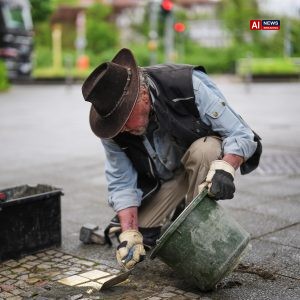
 German Town Votes to Stop Adding Memorials Outside Homes of Slain Jews
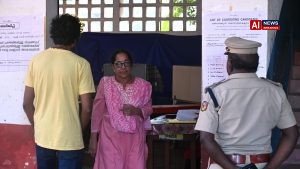
  Local body ward bypolls in Keralam see 58.81% voter turnout
  Trump administration slashes fuel economy standards for cars, light trucks: Here’s what changes
  Trump announces $15 billion steel investment in Iowa.
 Local body ward bypolls in Keralam see 58.81% voter turnout
**
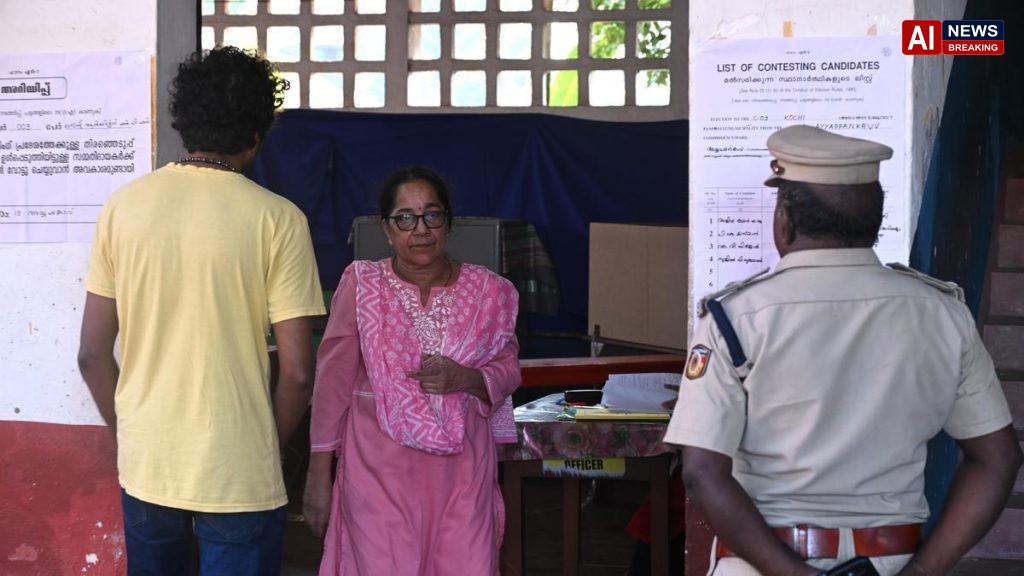
Local body ward bypolls in Keralam see 58.81% voter turnout - AI News Breaking
The Kerala State Election Commission reported a voter turnout of 58.81 per cent in the recent by‑elections for local body ward seats, a figure that signals a modest but notable rise from the 55.3 per cent recorded in the previous cycle of 2022. The bypolls, which were held across 45 gram panchayats, 12 block panchayats and six municipal wards in the southern state, were convened after a spate of resignations and disqualifications triggered vacancies in more than 150 seats. The commission’s data, released on Wednesday, shows that out of the 1.86 million registered electors, roughly 1.09 million cast a ballot, a level that analysts say reflects both an increased engagement among rural voters and the impact of intensified door‑to‑door campaigning by the major parties.The counting of the votes is scheduled to begin at 10 a.m..
on 29 September, with results to be declared at individual counting centres spread across the affected districts. Election officials have set up 1,200 counting tables in schools, community halls and panchayat offices, each equipped with electronic voting machines that will be fed into a centralised tallying system. The commission has also deployed over 300 security personnel and a fleet of vehicles to ensure the smooth transport of ballot boxes from the remote polling stations, many of which lie in hilly terrain that becomes difficult to navigate during the monsoon season.The bypolls were contested by the state’s three principal political formations – the United Democratic Front (UDF) led by the Indian National Congress, the Left Democratic Front (LDF) under the Communist Party of India (Marxist), and the National Democratic Alliance (NDA) spearheaded by the Bharatiya Janata Party – as well as a handful of independent candidates and local community groups..
While the LDF had held a comfortable majority in the affected local bodies prior to the resignations, the UDF has been aggressively targeting the seats, fielding high‑profile candidates in districts such as Alappuzha and Palakkad where the opposition believes anti‑incumbency sentiment is strongest.Political scientists note that the turnout figure, while not reaching the levels seen in general local body elections, is nonetheless encouraging for a contest limited to ward‑level positions. “By‑elections tend to suffer from lower voter interest because the stakes are perceived as less significant than in full council polls,” said Dr. Anil Menon, a professor of political science at the University of Kerala..
“A 58‑percent participation rate suggests that the electorate is responsive to the recent political turbulence, perhaps driven by concerns over local development projects, water management and the implementation of welfare schemes.” He added that the presence of younger voters, who have become increasingly active on social media platforms, likely contributed to the uptick.The Election Commission’s report also highlighted a gender disparity in the turnout, with women constituting 51.2 per cent of the votes cast, compared with 48.8 per cent for men. This marginal advantage aligns with a broader trend across Kerala, where female voter participation has consistently outpaced that of males in recent elections. Women’s groups, such as the Kerala Mahila Samithi, attribute the rise to sustained awareness campaigns that stress the importance of voting as a civic duty and the tangible benefits of women’s representation in local governance.In the lead‑up to the polls, the state government deployed a series of measures aimed at facilitating voter access, including the installation of additional polling booths in underserved villages and the introduction of a mobile voting unit that travelled to remote islands in the Lakshadweep archipelago under Kerala’s administrative purview..
The commission also extended the voting hours by an extra half hour, a move that local activists praised for accommodating agricultural workers who finish their duties later in the day.Election observers from the National Election Watch, an independent monitoring agency, noted a generally smooth conduct of the voting process, though they recorded isolated incidents of minor irregularities. In two gram panchayats in the Malabar region, there were reports of voters being turned away because of discrepancies in the electoral rolls. The observers urged the commission to expedite the updating of the rolls ahead of the next full‑scale local elections, scheduled for early 2027, to avoid disenfranchisement.The stakes of the bypolls extend beyond the immediate filling of vacant seats..
Control of the gram panchayats and block panchayats influences the allocation of development funds, the execution of public works and the implementation of state‑level welfare initiatives at the grassroots level. A shift in the balance of power could affect the rollout of the state’s ambitious ‘Kerala Green’ program, which aims to integrate renewable energy solutions into village infrastructure, as well as the distribution of subsidies for agricultural inputs under the ‘Krishi Vikas’ scheme.Opposition leaders have already begun projecting confidence in their prospects. UDF chief Ramesh Kumar, speaking at a rally in Kannur, asserted that “the people have spoken, and they have chosen change”..
He pointed to the higher turnout in traditionally LDF‑strong districts as evidence of a growing appetite for alternative governance. Meanwhile, the LDF’s state ary, Revathi Nair, cautioned against premature conclusions, reminding supporters that “the real test will be the final count, and we remain confident that our record of development will resonate with voters”.As the counting proceeds on 29 September, the political landscape of Kerala’s local bodies will become clearer. Regardless of the outcome, the 58.81 per cent turnout underscores a resilient democratic engagement at the ward level, reflecting both the efficacy of targeted voter outreach and an electorate increasingly attentive to the immediate impact of local governance..
The results are expected to be published in a staggered manner across the state, with final tallies available on the Election Commission’s website by the close of business on 30 September..
Updated: September 28, 2026
Summary: Kerala’s recent local‑body by‑elections saw voter participation climb to 58.81 %, up from 55.3 % in 2022, as door‑to‑door campaigning and extended polling hours boosted turnout, especially among women and younger voters. The higher engagement comes amid fierce contests between the UDF, LDF and NDA for over 150 vacant ward seats, with results due from 29 September.
Kerala’s modest turnout surge hints that voters are now treating ward‑level contests as proxies for broader policy battles, especially on climate‑linked development and welfare delivery.
The gender edge and youthful social‑media buzz suggest future elections could be reshaped by organized community outreach rather than traditional party machinery.