Europe warns of Russia’s hybrid attacks but struggles to counter them
  Former chief election commissioner calls SIR scheme illegal.
  A Corruption Scandal Is Reshaping Brazil’s Presidential Election
  US citizen injured in Illinois after ICE agents mistook him for fugitive, tried to arrest him
  At 10 years old, Smithsonian’s Black museum is undaunted amid pressure from Trump administration
 Monsoon Session Storm Brewing: Opposition Rallies Around Sonam Wangchuk, Slams Centre’s ‘Arrogance’ After Jantar Mantar Removal
** The Monsoon Session of Parliament is set to witness a stormy start as opposition parties unite to condemn the Centre’s handling of activist Sonam Wangchuk’s hunger strike, which was forcibly ended by Delhi Police, sparking a major political controversy over democratic rights and governance.
News Highlights
- Opposition parties have united ahead of Parliament’s Monsoon Session after activist Sonam Wangchuk was forcibly shifted from Jantar Mantar to Safdarjung Hospital during his indefinite hunger strike.
- Leaders from Congress, Samajwadi Party, TMC, AAP and other INDIA bloc parties have termed the government’s action “shameful” and an assault on democratic rights.
- The controversy is expected to become one of the biggest political flashpoints during the Monsoon Session, with demands for accountability from the Centre growing louder.
New Delhi: Just days before the start of Parliament’s Monsoon Session, the political temperature in the national capital has risen sharply over the forcible removal and hospitalisation of climate activist and education reformer Sonam Wangchuk. Opposition parties have found a common cause in condemning the Centre’s handling of Wangchuk’s hunger strike, describing the government’s action as “arrogant,” “shameful,” and an attack on democratic protest.
What began as a protest over alleged examination paper leaks and demands for accountability in India’s education system has now evolved into a major political controversy. The Opposition is preparing to raise the issue aggressively during the Monsoon Session of Parliament, potentially turning it into one of the government’s biggest political challenges in the coming days.
Sonam Wangchuk Removed After 21-Day Hunger Strike
Sonam Wangchuk, the renowned engineer, educator, environmentalist and Ramon Magsaysay Award recipient, had been on an indefinite hunger strike at Delhi’s Jantar Mantar since June 28. His protest was organised in solidarity with students and activists demanding reforms in India’s examination system and seeking the resignation of Union Education Minister Dharmendra Pradhan over repeated allegations of examination paper leaks.
After more than 20 days without food, doctors monitoring Wangchuk’s health reportedly warned that his condition had become critical. Medical experts raised concerns about severe potassium deficiency and other complications arising from prolonged fasting.
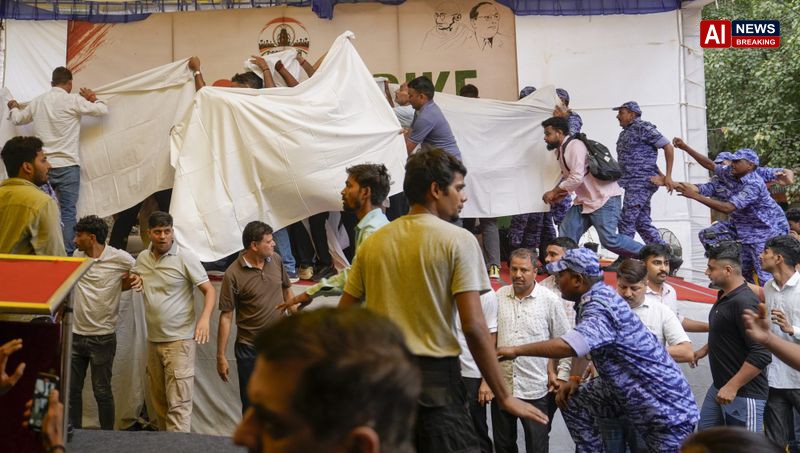
Early Saturday morning, Delhi Police personnel arrived at the protest site and shifted Wangchuk to Safdarjung Hospital. The operation was conducted amid heavy security deployment and sparked immediate controversy after supporters alleged that he had been taken away against his wishes.
According to Delhi Police, the decision was taken following medical recommendations and directions issued by the Delhi High Court regarding daily health monitoring of the activist. Officials maintained that their priority was to protect Wangchuk’s life and ensure necessary medical intervention.
However, protest organisers and Opposition leaders argue that the High Court’s observations did not explicitly direct authorities to forcibly remove Wangchuk from the protest site, leading to questions over whether the government exceeded its mandate.
Opposition Finds Common Ground
The incident has unexpectedly united several Opposition parties that often disagree on political strategy. Congress, the Trinamool Congress, Samajwadi Party, Aam Aadmi Party and leaders from the INDIA bloc have condemned the government’s actions in unusually strong language.
Congress president Mallikarjun Kharge accused the government of systematically suppressing democratic voices. Drawing parallels with previous protests involving farmers, wrestlers and environmental activists, Kharge said dissent has repeatedly been met with force rather than dialogue.
Rahul Gandhi described Wangchuk’s removal as “wrong” and criticised what he termed the BJP government’s politics of “asatya and hinsa” — falsehood and violence. His intervention signals that the Congress leadership intends to make the issue a significant parliamentary and political matter.
Samajwadi Party MP Dimple Yadav called the incident an assault on democracy and constitutional rights, while several Opposition MPs have questioned why a peaceful hunger strike required police intervention if the government’s stated intention was solely medical care.
AAP leader Manish Sisodia termed the incident “cowardice” and accused authorities of silencing peaceful protest instead of engaging with legitimate public concerns.
Why the Timing Matters
The timing of Wangchuk’s hospitalisation is politically significant.
The Monsoon Session of Parliament is set to witness heated debates on multiple national issues, including examination paper leaks, unemployment, inflation and governance concerns. Opposition parties are likely to use the Wangchuk controversy to question the government’s commitment to democratic values and its treatment of peaceful protesters.
Political observers believe that the incident has provided Opposition parties with an emotive issue that cuts across ideological lines. Wangchuk enjoys widespread public goodwill because of his contributions to education, sustainable development and environmental conservation, making criticism of government action politically sensitive.
Unlike conventional political protests, Wangchuk’s image as an educator and social activist gives the controversy greater public resonance, particularly among students and young voters.
Parliament March Planned
The Cockroach Janta Party (CJP), the youth-led organisation backing the protest movement, has announced plans for a peaceful march towards Parliament coinciding with the Monsoon Session. The organisers have insisted that the movement will continue despite Wangchuk’s hospitalisation.
Following Wangchuk’s removal, CJP founder Abhijeet Dipke announced that he would continue the indefinite hunger strike on behalf of the movement. Protest organisers maintain that their demands remain unchanged and have urged supporters across the country to continue peaceful demonstrations.
Activists have also alleged that heavy police deployment, restrictions around the protest site and the manner in which Wangchuk was removed indicate an attempt to minimise public attention before Parliament convenes. These allegations have further intensified political criticism.
Government’s Position
The government and Delhi Police have defended their actions.
Official statements emphasise that Wangchuk’s deteriorating health left authorities with little choice but to ensure medical treatment. Police officials stated that the hospital transfer followed expert medical advice and compliance with judicial directions. They have denied allegations of excessive force or misconduct during the operation.
According to medical assessments, Wangchuk’s prolonged hunger strike had placed him at risk of serious health complications, including life-threatening electrolyte imbalance. Authorities argue that preserving human life remains their constitutional and legal responsibility regardless of the circumstances of a protest.
Government supporters have questioned whether political parties are attempting to politicise what was essentially a medical intervention. They argue that allowing a prolonged hunger strike to continue despite serious health risks could have led to far more severe consequences.
Nevertheless, Opposition parties maintain that medical concerns do not justify removing a protester without consent unless legally mandated under exceptional circumstances.
The Larger Debate: Democratic Rights vs State Responsibility
The controversy has once again revived a longstanding constitutional debate in India.
How should governments balance an individual’s right to peaceful protest with the state’s obligation to protect human life?
Indian courts have repeatedly upheld the right to peaceful protest as an essential democratic freedom while also recognising that governments have a responsibility to intervene when lives are endangered.
Hunger strikes occupy a particularly sensitive space in democratic politics. Throughout India’s political history, fasting has served as a powerful form of moral and political persuasion. From Mahatma Gandhi’s fasts during the freedom movement to more contemporary social movements, hunger strikes have often compelled governments to engage with protesters rather than forcibly intervene.
Critics argue that if governments begin routinely removing protesters citing medical concerns, it could establish a troubling precedent for future democratic movements.
Supporters of government intervention counter that democratic rights cannot extend to permitting preventable loss of life.
The Wangchuk case has therefore evolved beyond immediate political controversy into a broader discussion about constitutional freedoms and administrative powers.
Growing Public Support
Support for Wangchuk has expanded beyond political parties.
Civil society organisations, student groups and public figures have expressed solidarity with the activist following his hospitalisation. Social media campaigns calling for transparency and accountability have gained momentum over the past 48 hours.
Film personalities including Vishal Dadlani and actor Prakash Raj criticised the government’s handling of the situation, describing the incident as deeply troubling for democratic institutions. Their statements have helped bring additional public attention to the controversy.
At Jantar Mantar, supporters continued their protest even after Wangchuk was shifted to hospital. Volunteers and student activists have vowed to carry forward the movement and ensure that the issues raised during the hunger strike remain in public discourse.
Will the Issue Dominate the Monsoon Session?
Political analysts believe the Wangchuk controversy possesses several characteristics that could make it particularly significant during Parliament’s Monsoon Session.
First, it combines issues of democratic rights, education reforms and government accountability.
Second, it has succeeded in bringing together diverse Opposition voices that might otherwise focus on separate political agendas.
Third, Wangchuk’s personal credibility makes the controversy difficult to dismiss as conventional partisan politics.
Finally, the visual imagery surrounding his removal from Jantar Mantar has generated considerable public attention, increasing pressure on both the government and Opposition leaders to address the issue in Parliament.
The Opposition is expected to demand explanations from the government regarding:
- The legal basis for Wangchuk’s removal.
- The interpretation of the Delhi High Court’s directions.
- The government’s response to the demands raised by protesters.
- The broader issue of examination reforms and paper leaks.
- The treatment of peaceful protesters in India.
Whether the government chooses to engage substantively with these questions or characterises the controversy as politically motivated could significantly shape parliamentary proceedings over the coming weeks.
What’s Next for Sonam Wangchuk?
Medical reports indicate that Wangchuk remains under observation at Safdarjung Hospital. Protest organisers have stated that he had previously expressed unwillingness to receive medical treatment without his consent and that his family is closely monitoring developments.
Meanwhile, supporters are preparing for further peaceful demonstrations in Delhi. With Parliament set to reconvene, pressure on the government is likely to intensify.
The controversy has already moved far beyond the boundaries of a single protest site. It now represents a larger political and constitutional conversation about dissent, governance and democratic accountability in India.
AI Insight: The Sonam Wangchuk controversy is emerging as one of the most politically consequential developments ahead of Parliament’s Monsoon Session because it intersects three powerful narratives—democratic rights, student concerns over examination integrity and the government’s handling of dissent. Unlike routine political protests, Wangchuk’s stature as an educator and environmental activist gives the issue wider public appeal across political lines. If the Opposition remains united and public sentiment continues to build, the government may face sustained parliamentary pressure not only over Wangchuk’s hospitalisation but also on broader questions surrounding protest rights, institutional accountability and education reforms in India.