 Major fire breaks out in Mumbai’s Dongri, dousing ops on; one dead in November 7 highrise blaze
 Australia drops Marnus Labuschagne from New Zealand Test squad
 Targeted by U.S., Armed Group Strikes Back in Colombia
 Here’s the full text of Jensen Huang’s memo to Nvidia
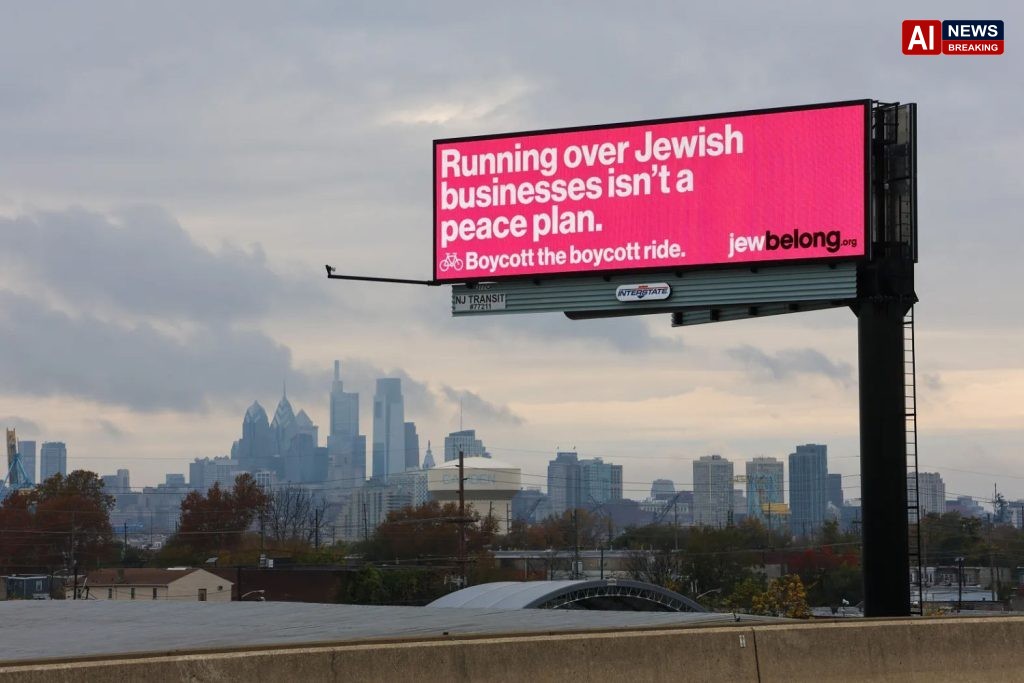
Philadelphia billboards push back against planned boycott of Jewish-owned restaurants
Billboards flashing “Support local, not hate” have appeared on Philadelphia’s highways, challenging a recent online boycott targeting Jewish‑owned restaurants. Backed by business leaders and civil‑rights groups, the ads defend the right to judge businesses on conduct—not religion—while legal experts warn that discrimination‑based boycotts can breach anti‑discrimination statutes. The city watches closely as the debate over free expression and community cohesion unfolds.
Philadelphia billboards push back against planned boycott of Jewish-owned restaurants - AI News Breaking
New billboards have begun appearing on streets and highways across Philadelphia, bearing messages that challenge a proposed boycott of Jewish‑owned restaurants that has been circulating on social media and among activist groups. The signs, which feature slogans such as “Support local, not hate” and “All food, no discrimination”, are being funded by a coalition of business owners, community leaders and civil‑rights organisations that say the boycott threatens the city’s long‑standing tradition of culinary diversity and economic inclusion. The campaign, which emerged late last year, called for a coordinated refusal to patronise eateries identified as owned by members of the Jewish community, alleging that some establishments had profited from or failed to condemn actions taken by the Israeli government in the ongoing Gaza conflict.The billboard initiative was launched after a series of petitions and online posts urged residents to avoid dining at specific venues, naming more than two dozen restaurants ranging from well‑known steak houses to family‑run bakeries..
Organisers of the boycott argued that the targeted businesses were “complicit” in supporting policies they deemed oppressive, and they sought to exert pressure through consumer choice. However, the counter‑campaigners contend that the boycott amounts to collective punishment based on ethnicity or religion, and that it undermines the principle of judging each business on its own conduct rather than the heritage of its owners.City officials have refrained from taking an official position on the boycott, citing the First Amendment’s protection of both expressive speech and the right to boycott as a form of protest. Philadelphia’s mayor, Jim Kenney, told reporters that the administration would monitor the situation for any signs of harassment or threats directed at restaurant staff, but emphasized that “the city does not police opinions, it ensures safety and fairness for all workers.” The police department confirmed that it has received a handful of reports of verbal abuse and a single incident of vandalism at a deli that was listed in the boycott call‑out, but said no arrests have been made and investigations are ongoing.Legal experts note that while boycotts are generally permissible, they can cross a line into unlawful conduct if they involve intimidation, threats or discriminatory intent..
Professor Elena Ramirez, a constitutional law scholar at Temple University, explained that “the Supreme Court has recognised the right to boycott as a form of political expression, but that right is not absolute. When a boycott is organized on the basis of a protected characteristic such as religion, it may be subject to anti‑discrimination statutes.” She added that any coordinated effort that encourages harassment or violent acts could trigger civil or criminal liability under state and federal law.Jewish community leaders have expressed concern that the boycott, even if non‑violent, creates a hostile environment for a segment of the city’s population that already feels targeted. Rabbi David Goldstein of Congregation Beth El described the situation as “a modern echo of historic anti‑Semitic tactics that sought to isolate and marginalise our community through economic pressure.” He called for dialogue instead of exclusion, urging activists to direct their criticism toward specific policies rather than broad, ethnicity‑based campaigns..
The rabbi also highlighted the contributions of Jewish‑owned restaurants to Philadelphia’s food scene, noting that many have been family‑run for generations and employ staff from diverse backgrounds.Supporters of the billboard response argue that their messages are not an attempt to silence dissent but a defence of the principle that businesses should not be judged solely on the religious identity of their owners. “We are not denying anyone the right to protest,” said Maya Patel, director of the Philadelphia Business Alliance, a group that helped finance the advertising. “What we are asking is for that protest to be grounded in facts about actions, not assumptions about faith..
Our restaurants are part of the city’s fabric, and they deserve the same respect as any other business.” Patel pointed to a recent study by the Pennsylvania Chamber of Commerce that showed restaurants owned by minority groups contribute disproportionately to local employment and tax revenues.Critics of the billboard campaign contend that the advertisements themselves could be interpreted as a form of counter‑propaganda, potentially inflaming tensions further. Some community activists have called for a mediated town hall where representatives from the boycott organizers, the targeted restaurateurs and neutral facilitators can discuss grievances and seek common ground. The Philadelphia Foundation has offered to host such a forum, emphasizing the need for “constructive conversation that acknowledges the pain on both sides while upholding the city’s values of inclusion and free expression.”The economic impact of the boycott, though still limited, is beginning to be felt..
A few of the named establishments reported a slight dip in evening reservations during the past month, according to data shared by a local hospitality analytics firm. However, owners of several other venues said they have seen a modest rise in patronage from residents who wish to demonstrate solidarity against what they view as a discriminatory campaign. One owner, whose family runs a kosher bakery in South Philadelphia, noted that “the outpouring of support from neighbours has been heartening; it shows that many Philadelphians understand the difference between political protest and bigotry.”As the billboard messages continue to rotate across the city’s visual landscape, the broader debate touches on national conversations about the limits of consumer activism, the responsibilities of businesses in geopolitical conflicts, and the ways in which ethnic and religious identities intersect with public discourse..
Observers note that Philadelphia’s history of civil‑rights activism, from the 1960s Freedom Rides to recent movements for LGBTQ+ equality, provides a backdrop against which the current controversy is being framed. Whether the billboard effort will succeed in dampening the boycott or simply add another layer to the public debate remains to be seen, but the episode underscores the delicate balance between protecting free speech and guarding against discrimination in a pluralistic urban environment..
Updated: November 8, 2026
Billboards funded by local businesses and civil‑rights groups have sprung up across Philadelphia to counter a social‑media‑driven boycott of Jewish‑owned restaurants, arguing the campaign unfairly targets owners by religion. City officials and legal experts warn that while boycotts are protected speech, they may cross into unlawful discrimination if they incite harassment or violence.