The Supreme Court will decide whether assault weapons bans violate the Second Amendment
 A Critic of Beijing Falls Short in Taiwan’s Key Mayoral Election
 EPA says no rise in contamination after Army detonates lead azide stockpile in Iowa
 Israeli Strike Kills 2 Workers at Gaza Clinic, Doctors Without Borders Says
 McQueen Pre-Fall 2027
Shiv Sena UBT leader Aaditya Thackeray writes to CM Fadnavis over 935 Pagdi buildings
**
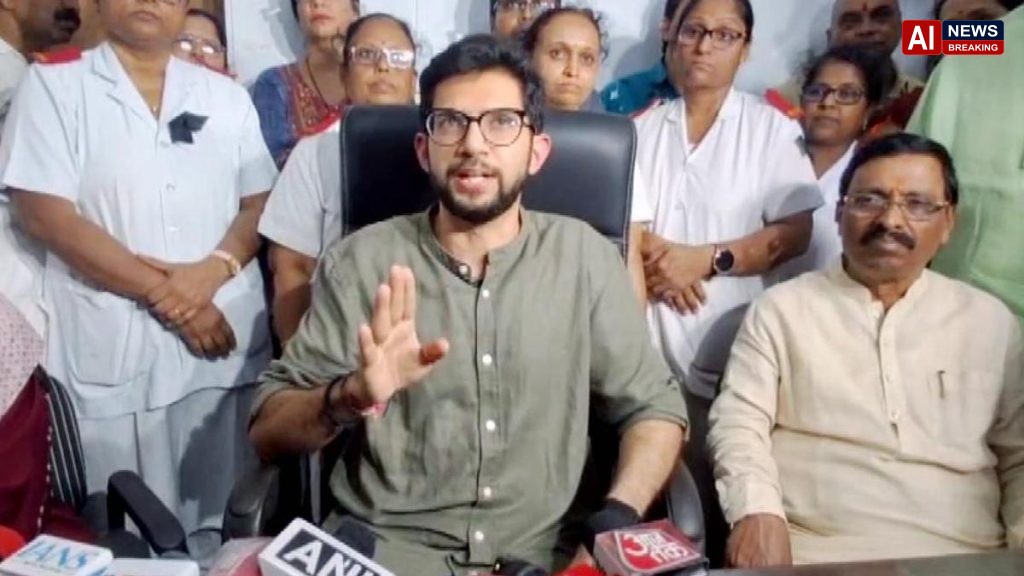
Shiv Sena UBT leader Aaditya Thackeray writes to CM Fadnavis over 935 Pagdi buildings - AI News Breaking
shiv sena leader aaditya:
Aaditya Thackeray, the leader of the Shiv Sena’s urban development wing, has sent a formal letter to Maharashtra’s chief minister, Devendra Fadnavis, raising concerns over the status of 935 “pagdi” buildings across the state. The correspondence, dated early June, outlines a series of grievances that the party’s youth wing claims have been neglected for years, despite the legal framework that governs these structures. Thackeray’s appeal seeks a comprehensive audit of the properties, clarification of ownership records, and expedited resolution of disputes that have left thousands of tenants in a state of uncertainty.Pagdi buildings, a term rooted in Maharashtra’s colonial‑era tenancy system, refer to a specific class of tenanted properties where occupants made a substantial one‑time payment to the landlord and subsequently paid a nominal monthly rent..
Under the Maharashtra Rent Control Act of 1999, which came into force in 2000, this arrangement conferred semi‑ownership rights on tenants, allowing them to claim a form of security of tenure while still recognising the landlord’s residual interests. The legislation was intended to balance the need for affordable housing with the protection of property owners, creating a hybrid model that has, over the past two decades, become a distinctive feature of the state’s urban landscape.In his letter, Thackeray highlights that many of the 935 buildings in question were constructed during the early 2000s, a period when the rent control provisions were being actively implemented. He argues that the original agreements—often documented on paper and lacking digital verification—have been lost, misplaced, or remain inaccessible to the tenants who rely on them to prove their rights..
The resulting opacity, he says, has opened the door to illegal evictions, forced sales, and exploitation by unscrupulous landlords who seek to capitalize on the valuable real estate without honoring the statutory obligations owed to tenants.The Shiv Sena’s urban development board has compiled a dossier that includes testimonies from over 2,000 residents across Mumbai, Pune, Nagpur, and smaller towns in the Vidarbha region. Many of these accounts describe a pattern of landlords demanding additional payments, threatening to terminate tenancy, or attempting to convert the properties into commercial spaces without proper consent. According to the dossier, at least 150 families have been displaced in the past year alone, an outcome that Thackeray claims violates both the spirit and the letter of the 1999 Act.Thackeray’s request to the chief minister is two‑fold..
First, he seeks the establishment of a state‑wide task force comprising officials from the Urban Development Department, the Revenue Department, and the Housing Board to conduct a systematic verification of the pagdi records. The task force would be mandated to cross‑reference existing land titles, rent receipts, and the original one‑time payments to create a definitive registry of legitimate tenants. Second, he urges the government to issue a clear directive that any attempt to alter the status of a pagdi building—whether through demolition, redevelopment, or conversion—must receive prior approval from the task force, ensuring that tenant rights are not overridden by market pressures.The chief minister’s office has not yet issued a public response to the letter, but sources within the administration indicate that the issue has been on the agenda of recent cabinet meetings..
Officials note that the rapid escalation of real‑estate prices in metropolitan areas has intensified interest in repurposing older tenement blocks, placing additional strain on the existing legal framework. A senior bureaucrat, speaking on condition of anonymity, said that the government is considering a “digitalisation drive” for tenancy records, which could streamline verification but would also require substantial resources and coordination among multiple departments.Legal experts caution that the path to resolution is fraught with procedural complexities. Professor Arvind Joshi of the University of Mumbai’s Law Faculty explains that while the 1999 Act provides a clear definition of pagdi rights, the enforcement mechanisms rely heavily on local courts and municipal bodies, which are often overburdened..
“Even if the state creates a task force, the ultimate adjudication of disputes will still flow through the judiciary,” he said. “A holistic approach must therefore include judicial reforms that expedite hearing of tenancy cases, along with the administrative measures proposed by Thackeray.”Housing activists have welcomed Thackeray’s initiative, viewing it as a potential catalyst for broader reforms. The Maharashtra Tenants’ Association, representing a coalition of resident welfare groups, issued a statement praising the letter’s focus on “transparent governance and tenant protection.” The association, however, warned that without binding legal safeguards, any task force could become merely an advisory body..
It called for the amendment of the Rent Control Act to incorporate stricter penalties for landlords who violate pagdi agreements, as well as the introduction of a statutory timeline for dispute resolution.The issue of pagdi buildings also carries significant political implications. In recent municipal elections, the Shiv Sena campaigned on promises to safeguard affordable housing and prevent the unchecked gentrification of historic neighborhoods. By foregrounding the plight of pagdi tenants, Thackeray seeks to reinforce the party’s image as a champion of the urban poor, a demographic that has traditionally formed a core part of its voter base..
Observers note that the timing of the letter, coinciding with the state’s upcoming budget session, may be aimed at securing budgetary allocations for the proposed task force and related initiatives.As the debate unfolds, the 935 pagdi buildings remain a microcosm of the broader challenges facing Maharashtra’s housing sector: balancing rapid urban growth with the preservation of tenure security for vulnerable residents. Whether the chief minister’s administration will act on Thackeray’s appeal, and how effectively any measures will be implemented, remains to be seen. For now, thousands of tenants await clarity, hoping that the legal safeguards enshrined two decades ago will finally be enforced in practice, offering them the stability and dignity that the original pagdi scheme was designed to provide..
Updated: November 27, 2026
Thackeray’s push for a “pagdi” audit signals a rare political gamble: leveraging historic tenancy rights to block lucrative redevelopment, turning a housing‑law quirk into a voter‑mobilising shield against gentrification. If the task force becomes a bureaucratic echo chamber, it will merely legitimize