Europe warns of Russia’s hybrid attacks but struggles to counter them
  Former chief election commissioner calls SIR scheme illegal.
  A Corruption Scandal Is Reshaping Brazil’s Presidential Election
  US citizen injured in Illinois after ICE agents mistook him for fugitive, tried to arrest him
  At 10 years old, Smithsonian’s Black museum is undaunted amid pressure from Trump administration
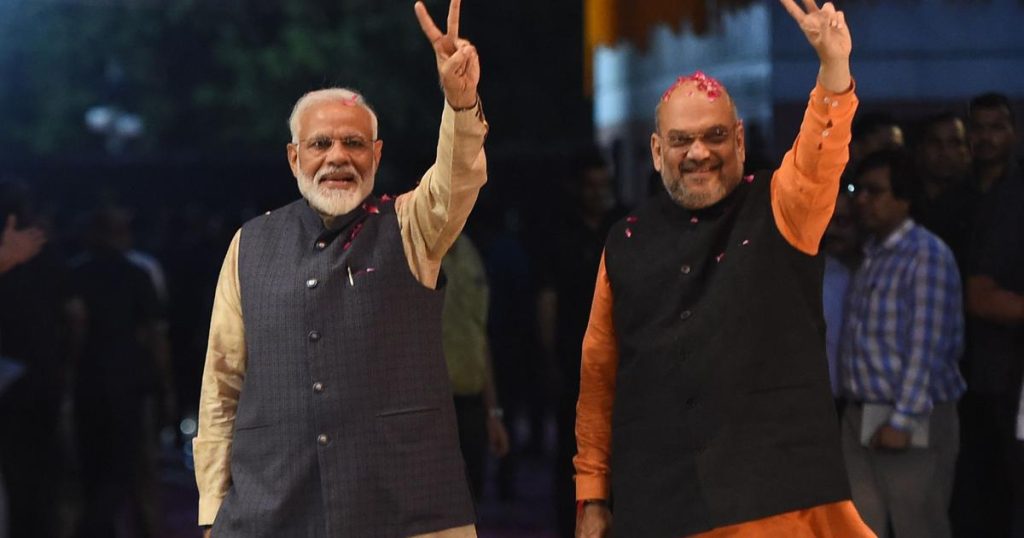
 The Unstoppable Duo: Modi and Shah’s Unprecedented Success in Indian Politics
The unstoppable duo of Narendra Modi and Amit Shah has achieved unprecedented success in Indian politics, transforming the BJP into a formidable pan-India force and redefining the rules of electoral politics, despite anti-incumbency pressures and economic anxieties.
unstoppable modi shahs unprecedented:
Modi-Shah Era: How India’s Most Powerful Political Duo Rewrote the Rules of Electoral Politics
In the vast and unpredictable theatre of Indian politics, where alliances collapse overnight, caste equations mutate with every election, and regional satraps often overshadow national narratives, one political partnership has managed to achieve what many once believed impossible: sustained electoral dominance across geography, language, class, and ideology.
Prime Minister Narendra Modi and Union Home Minister Amit Shah have transformed the Bharatiya Janata Party (BJP) from a largely Hindi-heartland force into a formidable pan-India political machine. Their latest string of victories in assembly bypolls and state elections has reinforced a question increasingly dominating political discourse in India: has the opposition found itself confronting not merely a party, but a deeply institutionalized electoral ecosystem built around the Modi-Shah axis?
The BJP’s recent successes in West Bengal, Assam, Gujarat, Tripura, Nagaland, and other regions have once again demonstrated the remarkable organizational and narrative control exercised by Modi and Shah. Analysts now argue that the BJP’s victories are no longer episodic. They are structural.
What makes this phenomenon particularly significant is that it persists despite anti-incumbency pressures, economic anxieties, unemployment debates, opposition coalitions, and localized grievances. Historically, Indian voters have displayed a tendency to punish ruling governments after prolonged periods in power. Yet under Modi and Shah, the BJP has repeatedly managed to either neutralize anti-incumbency or convert elections into broader ideological referendums.
The Modi-Shah partnership represents a fusion of mass charisma and relentless organization. Modi remains the BJP’s most powerful public face — a leader who continues to command unmatched popularity among large sections of Indian voters. Amit Shah, meanwhile, has emerged as the architect of the BJP’s election machinery, micro-management strategy, booth-level expansion, and coalition arithmetic.
Together, they have fundamentally altered the grammar of Indian elections.
From Gujarat to Delhi: The Origins of a Political Partnership
The Modi-Shah story began long before Delhi became the center of Indian politics. Their partnership was forged in Gujarat during the BJP’s rise in the state through the 1990s and early 2000s. Narendra Modi, an RSS pracharak turned political strategist, emerged as Chief Minister of Gujarat in 2001. Amit Shah, younger and organizationally sharp, became one of Modi’s closest political associates.
What distinguished the duo even then was their understanding that elections were no longer merely ideological contests. They were logistical operations requiring precision, messaging discipline, cadre expansion, and constant voter engagement.
The Gujarat model eventually evolved into a national template.
When Narendra Modi became the BJP’s prime ministerial candidate in 2013, Amit Shah was entrusted with managing Uttar Pradesh during the 2014 Lok Sabha elections. The BJP’s stunning performance in India’s largest state laid the foundation for Modi’s national ascent.
The duo never looked back.
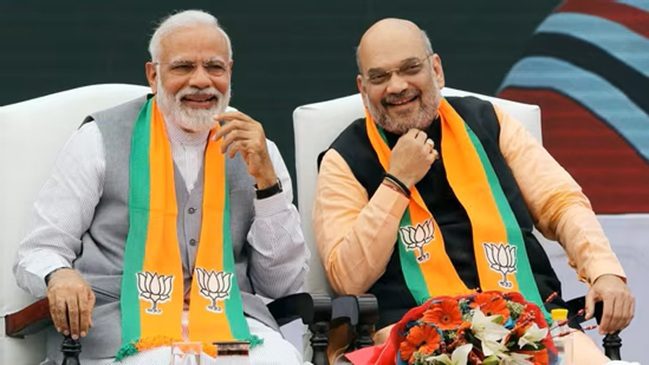
Since 2014, the BJP has steadily expanded its electoral footprint beyond traditional strongholds. States once considered inaccessible — including parts of the Northeast, eastern India, and southern regions — gradually entered the BJP’s strategic radar.
In the past decade, Modi’s leadership has been instrumental in BJP’s resurgence. Here’s a brief timeline of key events:
1. 2014: Narendra Modi becomes India’s 14th Prime Minister, promising to revive the country’s economic growth and boost India’s global stature.
2. 2016: Amit Shah assumes the role of BJP president, playing a crucial part in the party’s election machinery.
3. 2017: Modi government passes the Goods and Services Tax (GST), a monumental economic reform aimed at consolidating India’s position as a unified market.
4. 2019: The BJP secures a historic victory in the general elections, winning an absolute majority and propelling Modi into a second term as Prime Minister.
5. 2022: Amit Shah is appointed as the Union Home Minister, further solidifying the duo’s grip on the country’s politics.
The latest state election victories further illustrate this expansionist success. Reports indicate that the BJP not only retained influence in established bastions but also significantly strengthened its position in states where it once lacked organizational depth.
The Bypoll Message: Momentum Matters
By-elections in India are often treated as political mood indicators rather than isolated contests. While governments may dismiss defeats as local aberrations, victories are frequently projected as evidence of momentum.
For Modi and Shah, momentum has become a political weapon.
The BJP’s recent bypoll successes in Gujarat, Nagaland, Tripura, and Maharashtra reinforced the perception that the party’s machinery remains unmatched in converting organizational strength into electoral outcomes.
This matters because bypolls typically witness lower voter turnout, making cadre mobilization crucial. Parties dependent solely on broad narratives often struggle in such elections. The BJP, however, has invested heavily in booth-level networks, data-driven campaigning, voter segmentation, and hyper-local messaging.
Amit Shah’s influence is particularly visible here.
Within the BJP, Shah is widely regarded as the party’s master strategist — a leader obsessed with electoral arithmetic, constituency mapping, and turnout optimization. His reputation for building election-winning structures has elevated him into one of the most consequential political operators in contemporary India.
Political observers increasingly note that under Shah, elections are approached with corporate-style precision. Constituencies are analyzed like market territories. Volunteers operate through layered command structures. Data analytics, social media narratives, caste calculations, welfare beneficiary outreach, and ideological messaging are synchronized into a single campaign architecture.
The result is a political machine capable of functioning continuously, not merely during election season.
The Modi Factor: Still the BJP’s Biggest Asset
Yet organization alone cannot explain the BJP’s success.
At the center of the party’s electoral appeal remains Narendra Modi.
More than a decade after first becoming Prime Minister, Modi continues to dominate India’s political imagination in ways few leaders in democratic history have managed. Supporters view him not merely as a politician, but as a symbol of national aspiration, cultural confidence, welfare delivery, and strong leadership.
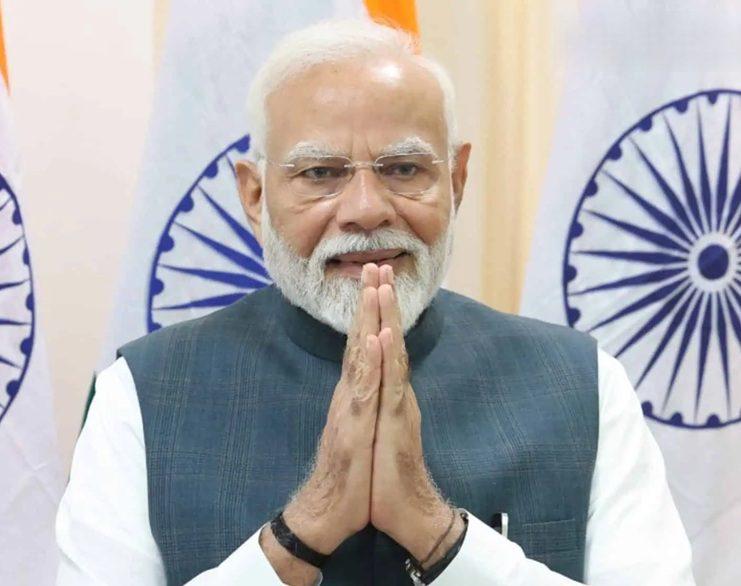
Even critics acknowledge his extraordinary communication skills.
Modi’s political messaging operates simultaneously across multiple emotional registers. To middle-class urban voters, he speaks of India’s global rise and infrastructure transformation. To poorer voters, he emphasizes welfare delivery, housing schemes, free rations, sanitation, and direct benefit transfers. To nationalist constituencies, he projects muscular security and civilizational pride. To youth, he frames India as an emerging global power.
This ability to maintain diverse voter coalitions has become central to BJP dominance.
The Reuters analysis on recent elections highlighted how the BJP continues consolidating Hindu support across regions, while opposition parties struggle to build similarly cohesive social coalitions.
For many BJP voters, Modi remains the overriding reason to support the party regardless of local candidates.
This “presidentialization” of Indian politics is one of the defining characteristics of the Modi era.
Traditionally, Indian elections were highly localized affairs shaped by caste dynamics, regional leaders, and state-specific grievances. Under Modi, however, even state elections increasingly become referendums on national leadership.
The BJP’s opponents have struggled to counter this centralization of political messaging.
Amit Shah: The Architect Behind the Machine
If Modi is the BJP’s face, Amit Shah is its operational engine.
Few politicians in India inspire as much fascination — or fear — among rivals as Shah. Revered within the BJP for his electoral instincts, Shah has cultivated an image as a relentless strategist capable of engineering victories in difficult political terrain.
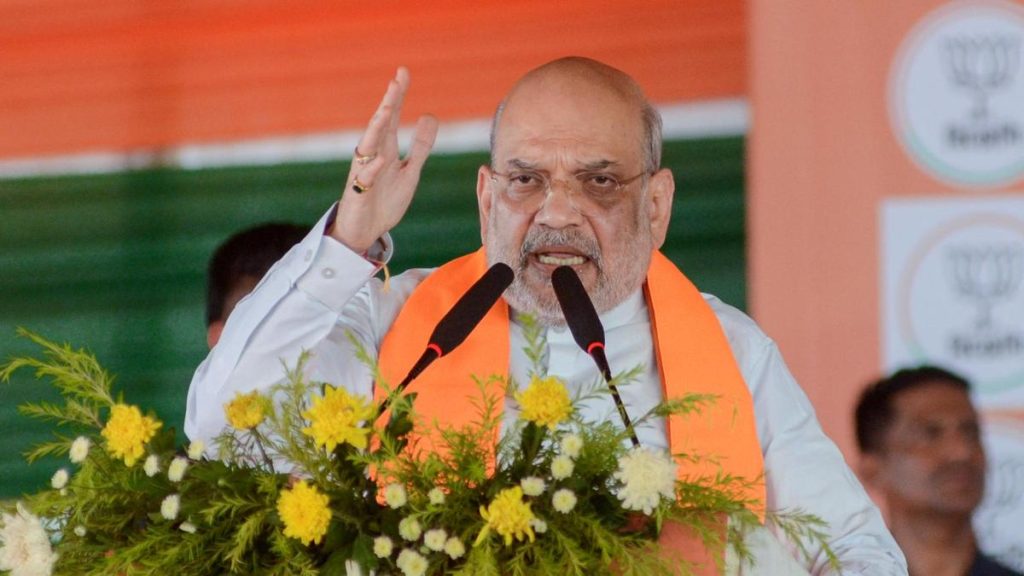
His approach rests on several pillars.
1. Booth-Level Dominance
The BJP under Shah transformed booth management into a science. Every polling booth is treated as a battlefield unit with assigned workers, voter lists, outreach strategies, and turnout responsibilities.
This hyper-local approach allows the BJP to outperform rivals even in closely contested constituencies.
2. Social Coalition Engineering
The BJP’s rise was once heavily associated with upper-caste Hindu support. Under Modi and Shah, however, the party aggressively expanded into Other Backward Classes (OBCs), Dalits, women voters, and beneficiaries of welfare schemes.
In multiple elections, the BJP successfully fractured traditional caste alliances that once benefited regional parties.
3. Welfare Plus Nationalism
The Modi-Shah formula blends welfare politics with ideological nationalism. Free ration schemes, rural housing, LPG connections, and infrastructure projects coexist with strong messaging on national security, Hindutva, and civilizational identity.
This dual strategy has proven electorally potent.
4. Continuous Campaigning
Unlike many opposition parties that become active primarily during elections, the BJP campaigns year-round. Modi’s rallies, government events, welfare outreach programs, digital campaigns, and ideological mobilization create constant political visibility.
This ensures narrative dominance.
Bengal: The Symbolic Breakthrough
Perhaps no recent victory better illustrates the BJP’s transformation than its breakthrough in West Bengal.
For decades, Bengal resisted the BJP’s expansion. The state’s politics revolved around Left ideology, Bengali regionalism, and later Mamata Banerjee’s Trinamool Congress.
Yet the BJP gradually emerged as the principal challenger.
The recent electoral success in Bengal is now being interpreted as a watershed moment in Indian politics. Reports suggest the BJP’s victory stemmed from a combination of anti-incumbency, women voter mobilization, organizational expansion, welfare promises, and communal polarization.
Amit Shah’s role in Bengal has been repeatedly highlighted by observers.
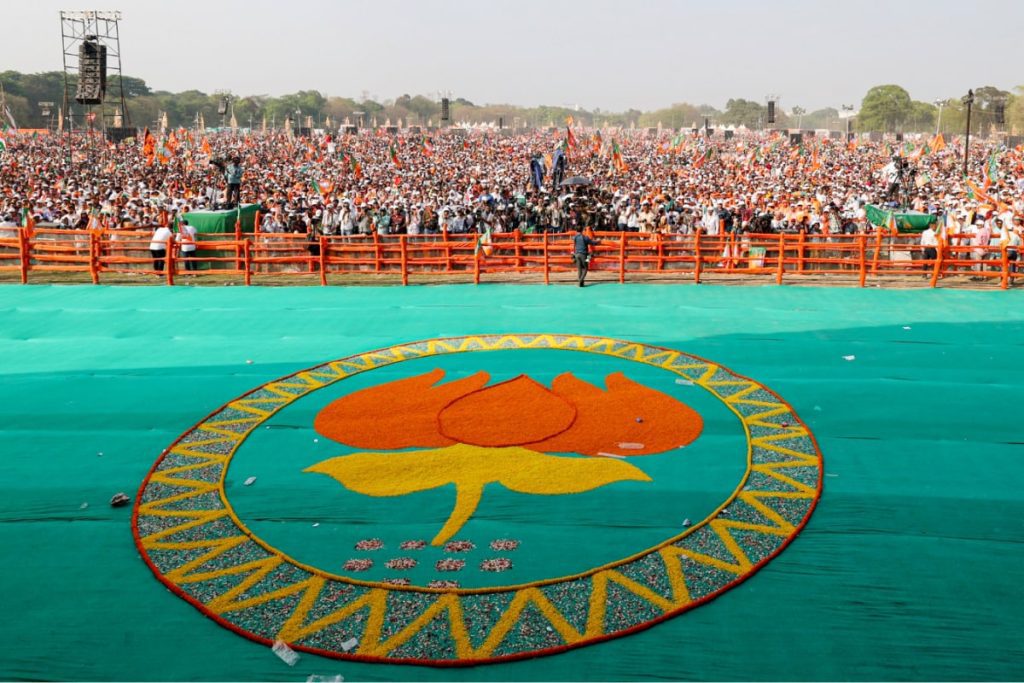
The scale of preparations for the BJP’s first swearing-in ceremony in Bengal reflected the symbolic importance attached to the victory.
For the BJP, Bengal represents more than a state victory. It represents ideological penetration into territory long viewed as resistant to Hindutva politics.
For the opposition, it represents a warning.
Why the Opposition Keeps Struggling
The opposition’s inability to effectively counter Modi and Shah stems from multiple structural weaknesses.
Leadership Vacuum
No opposition leader currently commands pan-India popularity comparable to Modi.
Regional leaders remain influential within their states, but opposition unity often collapses because of competing ambitions and ideological contradictions.
Organizational Weakness
Many opposition parties rely heavily on charismatic leaders but lack the BJP’s booth-level organizational depth.
The BJP’s cadre system — strengthened by RSS networks — provides continuity that many regional parties cannot match.
Narrative Deficit
The BJP offers voters a coherent political story: nationalism, development, welfare, stability, and Hindu civilizational identity.
Opposition parties frequently appear reactive rather than visionary.
Fragmented Alliances
The INDIA bloc showed potential during the 2024 Lok Sabha elections, but maintaining unity across states has proven difficult. Reports suggest opposition parties struggled to replicate national coordination in state elections.
Ideological Confusion
Many opposition parties attempt simultaneously to appeal to minority voters, secular liberals, caste blocs, and regional interests. This often produces inconsistent messaging.
The BJP, by contrast, maintains ideological clarity.
The Hindutva Consolidation
One of the most consequential aspects of the Modi-Shah era is the consolidation of Hindu political identity.
Analysts increasingly argue that Indian politics is witnessing a profound realignment in which religious identity plays a larger electoral role than before. Reuters noted evidence of growing polarization between Hindu and Muslim voting patterns.
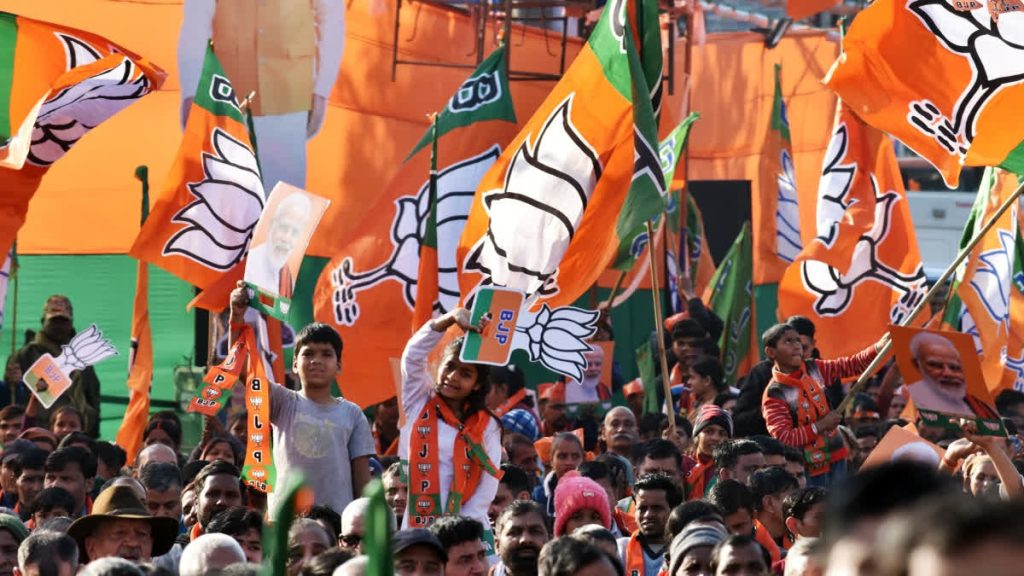
The BJP’s ideological ecosystem — anchored in Hindutva — frames the party not simply as a political organization but as a civilizational movement seeking to reshape India’s national identity.
Critics argue this threatens India’s secular framework.
Supporters counter that the BJP represents long-suppressed Hindu aspirations and cultural confidence.
Either way, the political consequences are undeniable.
The BJP’s ability to consolidate large sections of Hindu voters across caste lines has significantly altered electoral arithmetic.
Welfare Politics and Women Voters
One of the underappreciated aspects of BJP success under Modi and Shah is the party’s growing support among women voters.
Schemes involving free cooking gas connections, toilets, direct benefit transfers, housing assistance, and welfare distribution have strengthened the BJP’s outreach among lower-income women.
Campaign narratives increasingly emphasize women’s safety, dignity, and welfare access.
Reports from Bengal indicated that women voters played a critical role in BJP gains.
This matters because women voters are emerging as a decisive electoral constituency across India.
The BJP’s Southern Push
For decades, the BJP’s weakness in South India limited its national expansion.
Modi and Shah have systematically attempted to change this.
Recent elections showed the BJP making gains even in states where it traditionally lacked dominance.
Tamil Nadu and Kerala remain difficult terrain, but the BJP’s strategy is no longer based solely on immediate victories. It is focused on long-term organizational expansion.
The party increasingly uses cultural nationalism, welfare outreach, temple politics, anti-corruption narratives, and alliances with regional actors to build gradual acceptance.
The Data-Driven Party
Another defining feature of the Modi-Shah era is the BJP’s embrace of data analytics.
The BJP arguably operates the most technologically sophisticated political apparatus in India.
Social media war rooms, voter databases, targeted messaging, WhatsApp outreach, booth analytics, beneficiary mapping, and digital mobilization form the backbone of its campaigns.
The party’s ability to dominate digital discourse often gives it a significant advantage in narrative-setting.
Opposition parties frequently accuse the BJP of overwhelming media ecosystems and controlling public narratives. Critics on social media platforms have increasingly voiced concerns over institutional imbalance and information dominance.
Yet even critics acknowledge the BJP’s communication efficiency.
The Cult of Permanence
Perhaps the most remarkable achievement of Modi and Shah has been creating the perception that BJP dominance is becoming permanent.
Indian politics historically resisted permanence.
Governments rose and fell rapidly. Coalitions fractured. Regional leaders challenged national parties.
But today, even opposition strategists increasingly speak of the BJP as the default governing party of India.
That psychological shift matters enormously.
Political dominance is not merely about winning elections. It is about shaping expectations.
When voters begin believing a party is likely to win, that perception itself can influence political behavior, alliances, donations, media narratives, and undecided voters.
The BJP under Modi and Shah has mastered this psychological dimension of politics.
Yet Challenges Remain
Despite their extraordinary success, Modi and Shah are not invincible.
The 2024 Lok Sabha election demonstrated that the BJP can still face setbacks. The party lost its standalone majority and required coalition support to continue governing nationally.
Some analysts argue that beneath the BJP’s victories lie warning signs, including economic distress, unemployment concerns, rural dissatisfaction, and questions regarding institutional balance.
There are also concerns about over-centralization.
Critics argue the BJP increasingly revolves around Modi and Shah to such an extent that second-rung leadership remains underdeveloped.
The question of succession looms in the background.
While Modi remains immensely popular, Indian politics eventually enters post-charismatic phases. Whether the BJP can sustain its dominance beyond Modi’s personal appeal remains an open question.
Interestingly, even online discussions among supporters and critics reflect debates over whether Modi’s mass popularity can be replicated by future BJP leadership.
Key Concerns
So, what sets Modi and Shah apart from their predecessors?
1. Strategic Leadership: Modi and Shah have implemented a series of bold reforms, including GST, demonetization, and the Ayushman Bharat health insurance scheme. These measures have not only boosted economic growth but also resonated with the country’s masses.
2. Electoral Machinery: Under Amit Shah’s stewardship, the BJP’s election machinery has become more efficient and sophisticated. The party’s extensive network of volunteers, social media presence, and data-driven approach have enabled it to effectively target and win key contests.
3. Nationalist Agenda: Modi and Shah have successfully tapped into the country’s sentiment on nationalism, security, and development. Their policy initiatives have been carefully crafted to resonate with the electorate’s aspirations and fears.
4. State Party Dynamics: The BJP’s success has been further facilitated by the party’s ability to maintain a delicate balance with other regional players, while also absorbing smaller parties into its fold.
What Next?
The BJP’s dominance has significant implications for Indian politics:
1. Congress Party’s Decline: The Indian National Congress party, once the country’s longest-serving and most influential party, continues to struggle to regain its former glory. The BJP’s success has eroded the Congress’s electoral base, leaving it with a dwindling presence in the country’s politics.
2. Regional Players: The BJP’s national footprint has compelled smaller regional parties to either ally with the party or lose ground in the electoral battles.
3. Economic Developments: The BJP’s electoral successes have reinforced the party’s commitment to economic reforms, which is likely to continue to guide India’s growth trajectory.
4. National Politics: The BJP’s dominance has led to a concentration of power in New Delhi, which may have implications for the country’s federal structure and regional autonomy.
The Opposition’s Last Window?
For opposition parties, the next few years may prove decisive.
If they fail to build coherent leadership structures, stronger state-level coordination, compelling welfare narratives, and organizational depth, the BJP’s dominance could become further entrenched.
The challenge is no longer simply defeating a ruling party.
It is countering a political ecosystem that combines:
- ideological clarity,
- charismatic leadership,
- technological sophistication,
- welfare outreach,
- cadre organization,
- and narrative discipline.
Few democracies have witnessed such a concentrated fusion of electoral assets.
Beyond Elections: Reshaping Political Culture
The Modi-Shah era has altered not just electoral outcomes, but political culture itself.
Political communication has become more centralized, leader-centric, and media-driven. National security, religious identity, welfare delivery, and aspirational nationalism dominate discourse.
Election campaigns increasingly resemble presidential contests.
Political branding has become more sophisticated.
The BJP’s messaging ecosystem operates with corporate efficiency while simultaneously invoking emotional-cultural themes.
Even opponents increasingly adapt their strategies in response to BJP frameworks.
In that sense, Modi and Shah have not merely succeeded within Indian politics.
They have redefined it.
AI Insights: The Most Consequential Political Partnership of Modern India
History may ultimately judge Narendra Modi and Amit Shah as the most consequential political partnership India has seen since independence.
Jawaharlal Nehru shaped the Congress era. Indira Gandhi centralized political power during the 1970s. Atal Bihari Vajpayee expanded the BJP’s acceptability.
But Modi and Shah achieved something different: the creation of a nationwide political machine capable of winning repeatedly across vastly different terrains while reshaping ideological discourse itself.
Their success is not accidental.
It rests on relentless organization, narrative control, welfare politics, ideological consolidation, technological sophistication, and an unparalleled understanding of electoral psychology.
For supporters, they symbolize decisive leadership, national pride, and political stability.
For critics, they represent centralization, polarization, and the erosion of older democratic balances.
But regardless of perspective, one fact is undeniable:
In contemporary India, no political story is bigger than the Modi-Shah story.
And for now, the duo appears far from finished.