 Australia probes AI‑driven breach of My Health Record portal
  Engineering student’s ‘suicide’ turns out to be murder; two arrested
  Canada’s Capital Bids Good Riddance to Trump Avenue as Tensions With U.S. Rise
  Pentagon investigates after China obtains parts from F-35 stealth fighter jet
 Ukrainian Drone Strikes Hit Russian Wildberries Warehouses, Killing Seven and Disrupting Logistics Operations
Ukrainian Drone Strikes Hit Russian Wildberries Warehouses, Killing Seven and Disrupting Logistics Operations - AI News Breaking
ukrainian drone strikes russian:
News Highlights
- Ukrainian drones struck two logistics facilities operated by Russian online retail giant Wildberries in the Tambov and Moscow regions, leaving at least seven people dead and dozens injured.
- Ukrainian President Volodymyr Zelenskyy said the targeted sites were supplying sanctioned components used in Russia’s drone and navigation equipment production.
Ukraine has carried out one of its most significant long-range drone operations deep inside Russian territory, targeting logistics facilities owned by Wildberries, Russia’s largest online retailer, in attacks that killed at least seven people and injured dozens more.
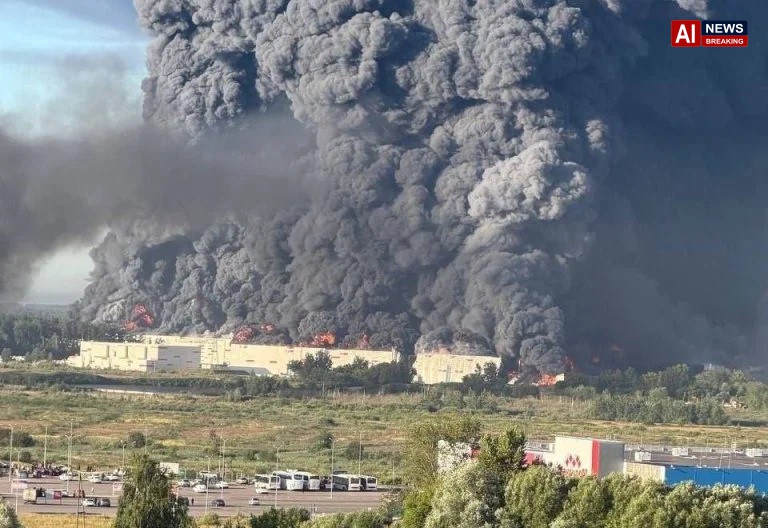
The strikes hit warehouse complexes in Kotovsk in Russia’s Tambov region and Elektrostal near Moscow, causing major fires and disrupting logistics operations. Russian authorities described the attacks as acts of terrorism, while Ukraine defended the operation by claiming the facilities played a role in supplying sanctioned components for Russia’s military-industrial complex.
Deadly Strike in Tambov Region
The deadliest attack occurred in the city of Kotovsk, approximately 475 kilometers southeast of Moscow. Russian officials confirmed that seven warehouse employees working the night shift were killed when Ukrainian drones struck the Wildberries logistics center.
Tambov Governor Evgeniy Pervyshov said that at least 25 people were injured in the strike. Emergency services quickly arrived at the scene and managed to extinguish the resulting fire.
Regional authorities reported that Russian air defense systems intercepted 28 drones approaching the area, suggesting that the logistics center was part of a wider Ukrainian drone offensive targeting strategic infrastructure.
Moscow Region Warehouse Also Targeted
A second Wildberries warehouse located in Elektrostal, east of Moscow, was also hit during the overnight attack.
According to Moscow Region Governor Andrei Vorobyov, at least 24 people sustained injuries following the strike. The incident sparked a large fire that required an extensive emergency response.
Drone debris also reportedly damaged nearby buildings, including a kindergarten. Russian emergency authorities continue to assess the full extent of the damage caused by the attack.
Ukraine Claims Military Significance
Ukrainian President Volodymyr Zelenskyy publicly confirmed the operation, describing the targeted facilities as “major logistics facilities” that were allegedly involved in supplying sanctioned components used for the production of drones and navigation systems.
According to Zelenskyy, the logistics hubs were located more than 500 kilometers from the frontline and formed part of Russia’s supply chain supporting its military capabilities.
The Ukrainian leader referred to the operation as part of Ukraine’s “long-range sanctions” campaign aimed at disrupting Russia’s ability to sustain its war effort.
Ukraine has increasingly relied on domestically developed long-range drones to strike critical infrastructure deep inside Russian territory, including oil refineries, military facilities, logistics hubs, and transportation networks.
Wildberries: Russia’s E-Commerce Giant
Wildberries is Russia’s largest online marketplace and one of the country’s most important logistics and e-commerce companies.
Often described as Russia’s equivalent of Amazon, Wildberries operates an extensive network of:
- Logistics centers.
- Warehouses.
- Distribution hubs.
- Data infrastructure.
- Delivery operations across Russia and neighboring countries.
The company has played a crucial role in Russia’s rapidly growing digital retail sector, handling millions of customer orders daily.
Following the attacks, Wildberries CEO Tatyana Kim described the incident as a “terrible night” for both the company and Russia. The company has pledged assistance to the families of those killed and injured in the strikes.
Oil Depot Also Comes Under Attack
The Ukrainian drone offensive extended beyond warehouse facilities.
In Noginsk, within the Moscow region, falling drone debris ignited a fire at an oil depot, forcing authorities to evacuate a nearby maternity hospital. Two people were reportedly injured in the incident.
Russian officials stated that emergency services managed to contain the fire while aviation and regional security measures were temporarily heightened in response to the drone attacks.
Russia Reports Massive Drone Interceptions
Russia’s Defense Ministry claimed that its air defense systems intercepted or destroyed 379 Ukrainian drones across multiple regions, including:
- Moscow region.
- Tambov region.
- Crimea.
- The Black Sea.
- The Sea of Azov.
- Several western Russian territories.
The scale of the drone attacks highlights Ukraine’s growing ability to conduct coordinated long-range operations against strategic targets hundreds of kilometers from the battlefield.
Growing Trend of Deep Strikes
Ukraine has steadily expanded its campaign of deep strikes against Russian infrastructure since the beginning of the war.
Key targets in recent months have included:
- Oil refineries.
- Fuel storage facilities.
- Military airfields.
- Rail infrastructure.
- Naval assets.
- Logistics centers.
Military analysts suggest that these operations are designed to impose economic and logistical costs on Russia while disrupting supply chains that support military operations in Ukraine.
The latest attacks indicate that commercial infrastructure may increasingly become a focus when it is alleged to serve dual civilian and military purposes.
International Implications
The strikes underscore the evolving nature of modern warfare, where logistics networks and supply chains have become critical strategic targets.
Ukraine’s use of long-range drones reflects broader changes in military tactics that allow nations to project force far beyond traditional frontlines without deploying conventional aircraft or missiles.
At the same time, attacks involving commercial infrastructure inevitably raise difficult questions concerning proportionality, civilian safety, and the dual-use nature of modern logistics facilities.
The loss of civilian lives in the Wildberries attacks is likely to intensify international debate regarding the expanding scope of military targets in the Russia-Ukraine conflict.
As both nations continue to develop increasingly sophisticated long-range strike capabilities, the war’s economic and logistical dimensions are becoming as strategically important as battlefield developments themselves.
Insight: The Ukrainian strikes on Wildberries warehouses illustrate how modern conflicts increasingly target logistics ecosystems that support national military capabilities. Commercial infrastructure can become strategically significant when it plays a role in supplying dual-use technologies or sanctioned components. The incident also highlights the growing importance of drone warfare, which is reshaping military strategy by enabling precision attacks deep inside an adversary’s territory while simultaneously raising complex legal and humanitarian questions.