Europe warns of Russia’s hybrid attacks but struggles to counter them
  Former chief election commissioner calls SIR scheme illegal.
  A Corruption Scandal Is Reshaping Brazil’s Presidential Election
  US citizen injured in Illinois after ICE agents mistook him for fugitive, tried to arrest him
  At 10 years old, Smithsonian’s Black museum is undaunted amid pressure from Trump administration
 Vijay Wins Crucial Tamil Nadu Assembly Floor Test, TVK Government Secures Majority With 144 MLAs
Tamil Nadu Chief Minister and TVK founder C. Joseph Vijay successfully passed his first major political test after winning the Assembly floor test with support from 144 MLAs. The victory cements the stability of the newly formed Tamilaga Vettri Kazhagam (TVK)-led government and marks a dramatic shift in Tamil Nadu’s political landscape.
The trust vote also exposed cracks within the opposition, particularly the AIADMK, as rebel legislators and alliance partners backed Vijay during the high-stakes confidence motion in the Assembly.
Vijay Wins Crucial Tamil Nadu Assembly Floor Test, TVK Government Secures Majority With 144 MLAs
Tamil Nadu Chief Minister C. Joseph Vijay cleared his first and most significant legislative hurdle on Wednesday after the Tamilaga Vettri Kazhagam (TVK)-led government comfortably won the floor test in the state Assembly. The confidence motion saw 144 MLAs voting in favour of the government, confirming Vijay’s majority and formally stabilizing the newly formed administration.
The trust vote marks a defining moment not only for Vijay’s political career but also for Tamil Nadu politics, where the traditional dominance of the DMK and AIADMK has been dramatically disrupted by the meteoric rise of TVK.
The floor test victory effectively silences immediate doubts over the survival of the Vijay-led government and signals that the actor-turned-politician has rapidly evolved into a formidable political force capable of managing alliances, attracting opposition support, and navigating complex legislative arithmetic.
A Historic Political Transition in Tamil Nadu
The 2026 Tamil Nadu Assembly election produced one of the most unexpected verdicts in the state’s modern political history.
For decades, Tamil Nadu politics revolved almost exclusively around the Dravidian giants — the DMK and AIADMK. However, Vijay’s Tamilaga Vettri Kazhagam shattered that bipolar structure by emerging as the single largest party in the Assembly.
TVK secured 108 seats initially, falling short of the majority mark of 118 in the 234-member Assembly. While the mandate established Vijay as the central political figure in the state, it also created uncertainty regarding government formation and legislative stability.
Following days of intense negotiations and political maneuvering, Vijay managed to gather support from alliance partners including Congress, VCK, IUML, Left parties, and crucially, sections of rebel AIADMK legislators. This coalition-building effort eventually enabled the TVK government to comfortably cross the majority threshold during the floor test.
How Vijay Crossed the Majority Mark
Ahead of the confidence motion, political observers closely watched the evolving numbers game inside the Tamil Nadu Assembly.
The majority mark stood at 118. TVK’s own tally was not sufficient after Vijay vacated one of the two Assembly seats he had won. This made alliance support critical for government survival.
The support structure gradually expanded through multiple political developments:
- Congress extended support to TVK
- VCK, CPI and CPM joined the coalition arrangement
- IUML legislators backed the government
- Rebel AIADMK MLAs crossed political lines
- An AMMK MLA also supported Vijay
These developments transformed what initially appeared to be a fragile coalition into a more stable legislative bloc.
When the vote finally took place, Vijay secured the backing of 144 MLAs, far exceeding the minimum required number. According to reports, 22 MLAs voted against the motion while five abstained.
The scale of the victory surprised many political analysts who had anticipated a far narrower margin.
AIADMK Rebellion Changes Political Equations
One of the biggest stories emerging from the floor test was the visible division inside the AIADMK.
Several rebel MLAs reportedly supported the TVK government, exposing internal dissatisfaction within the party leadership. The rebellion has intensified pressure on AIADMK chief Edappadi K. Palaniswami, who is already facing questions regarding the party’s declining electoral performance and organizational cohesion.
The support extended by dissident AIADMK legislators proved politically significant because it indicated that Vijay’s influence now extends beyond his immediate alliance network.
Political observers believe some opposition legislators view Vijay as a rising force capable of reshaping Tamil Nadu politics for the next decade. Supporting the government during the floor test may therefore represent an early political realignment rather than a temporary tactical move.
The rebellion also demonstrated how the post-election environment has destabilized traditional Dravidian political structures.
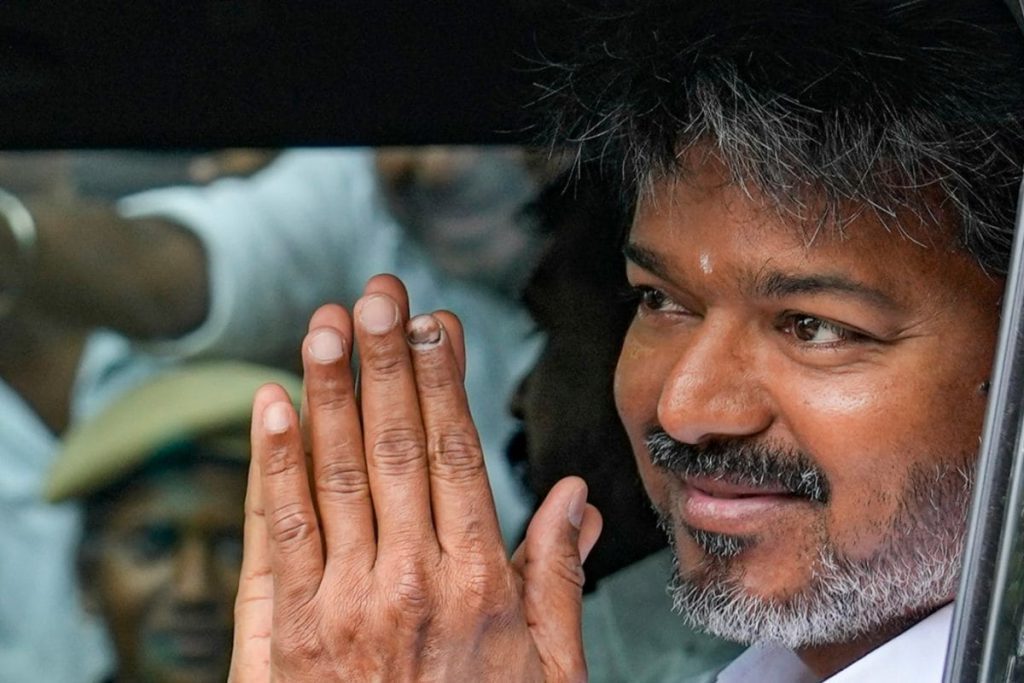
Vijay’s Rapid Political Evolution
The successful floor test represents a major milestone in Vijay’s transition from cinema superstar to full-time political leader.
When Vijay launched TVK, critics dismissed the party as a celebrity-driven experiment lacking ideological clarity or organizational depth. Many analysts expected TVK to function merely as a vote-splitter rather than a serious contender for power.
However, the 2026 Assembly election fundamentally altered that perception.
TVK’s strong electoral performance, followed by Vijay’s successful government formation and floor test victory, has established him as one of the most influential political figures in contemporary Tamil Nadu.
Importantly, Vijay has shown an ability to:
- Manage coalition politics
- Attract smaller parties
- Negotiate legislative support
- Maintain public momentum
- Convert fan-based popularity into electoral structure
This combination of charisma and political adaptability has strengthened his image among supporters and neutral observers alike.
Inside the Assembly: A High-Stakes Political Showdown
The atmosphere inside the Tamil Nadu Assembly remained tense throughout the proceedings.
The floor test came amid intense political speculation, opposition pressure, and uncertainty regarding cross-voting. Governor R.N. Ravi had directed the Vijay government to prove its majority quickly following the swearing-in ceremony.
Ahead of the vote:
- TVK issued whips to coalition MLAs
- Alliance leaders held strategy meetings
- Opposition parties debated voting tactics
- Rebel legislators came under pressure from party leaderships
Despite the uncertainty, the voting process ultimately produced a decisive outcome in favour of the government.
The election of senior TVK leader JCD Prabhakar as Speaker without opposition earlier had already indicated that the government possessed broader-than-expected support inside the Assembly.
The successful floor test further reinforced that impression.
DMK Faces New Political Reality
The emergence of TVK has created perhaps the most serious challenge the DMK has faced in decades.
Although the DMK remains a major political force, the election results and subsequent floor test revealed that Tamil Nadu politics is no longer exclusively shaped by the old Dravidian rivalry.
For the first time in over half a century:
- A non-DMK/AIADMK leader became Chief Minister
- A new party emerged as the dominant electoral force
- Coalition politics replaced traditional bipolar competition
This transformation has forced the DMK to reassess its long-term political strategy.
The party now faces competition not only from AIADMK but also from a rapidly expanding TVK that combines celebrity influence, youth appeal, welfare messaging, and anti-establishment sentiment.
Why Vijay’s Victory Matters Beyond Numbers
The significance of the floor test extends beyond simple legislative arithmetic.
The trust vote symbolized three broader developments:
1. Collapse of Traditional Political Monopoly
Tamil Nadu’s long-standing two-party political framework has been disrupted. Vijay’s rise signals the beginning of a more competitive multi-polar era.
2. Celebrity Politics Has Matured
Tamil Nadu has a long history of film stars entering politics, but Vijay’s success suggests a new generation of celebrity politics that combines digital outreach, youth mobilization, and structured electoral organization.
3. Coalition Governance Is Returning
Unlike earlier eras of single-party dominance, Tamil Nadu may now witness prolonged coalition negotiations and alliance-based governance.
Public Expectations From the TVK Government
Following the floor test victory, expectations from the Vijay-led government have increased significantly.
Supporters expect the administration to focus on:
- Employment generation
- Youth welfare
- Education reforms
- Corruption control
- Industrial growth
- Governance modernization
Vijay has consistently attempted to position himself as a reform-oriented leader focused on clean governance and youth empowerment.
However, converting electoral enthusiasm into administrative performance will be far more challenging.
The government must now manage:
- Coalition pressures
- Opposition attacks
- Bureaucratic restructuring
- Fiscal constraints
- Policy implementation
The coming months will therefore determine whether TVK can evolve from a powerful electoral movement into a durable governing force.
Opposition Strategy After the Floor Test
The floor test outcome has triggered intense introspection within opposition parties.
The AIADMK now faces an internal leadership challenge after visible divisions surfaced during the vote. Questions are also emerging about whether more legislators could eventually shift toward the ruling side.
The DMK, meanwhile, is expected to reposition itself as the principal ideological opposition force against TVK.
Political analysts believe both parties may attempt to portray Vijay’s coalition as unstable or opportunistic. However, the scale of the trust vote victory makes immediate destabilization difficult.
National Implications of Vijay’s Political Rise
Vijay’s success is also being closely watched outside Tamil Nadu.
National parties and regional leaders are studying the TVK model because it demonstrates how:
- Charismatic leadership
- Pop culture influence
- digital mobilization
- anti-establishment messaging
- regional identity politics
can combine to produce rapid electoral success.
His rise could influence future political strategies in other southern states where traditional parties face voter fatigue.
Conclusion
C. Joseph Vijay’s successful floor test victory marks a watershed moment in Tamil Nadu politics. By securing the support of 144 MLAs, the TVK government has moved beyond initial uncertainty and established itself as a stable ruling coalition.
More importantly, the event signals a historic political transition in a state long dominated by the DMK-AIADMK axis.
Vijay’s transformation from film icon to Chief Minister is now politically complete. The trust vote demonstrated not only numerical strength but also his growing ability to manage alliances, attract support from rival camps, and command legislative confidence.
Yet the larger challenge begins now.
The excitement surrounding TVK’s rise must eventually translate into governance, policy delivery, and administrative credibility. Tamil Nadu voters have historically rewarded performance and punished instability. Vijay’s long-term success will therefore depend not merely on symbolism or popularity, but on whether his government can effectively deliver results in one of India’s most politically sophisticated states.
AI Insight
Vijay’s floor test victory represents more than a routine constitutional exercise — it reflects the emergence of a new political era in Tamil Nadu where celebrity charisma, digital-era campaigning, and coalition-building are reshaping traditional electoral structures. The success of TVK shows how voter fatigue with legacy parties can rapidly create space for outsider movements if they combine emotional appeal with organizational discipline. However, sustaining such momentum requires a transition from personality-driven politics to institutional governance. The real test for Vijay will not be winning votes, but maintaining coalition stability, delivering administrative performance, and proving that TVK can evolve into a long-term governing force rather than a one-cycle political phenomenon.