
 Pakistan’s leaders hail first astronaut aboard Chinese craft: ‘Proud one of us has gone into space’
 British tourist travels 29 hours from Mumbai to Amritsar for ₹5,461, rates Indian Railways 10/10 | Viral video
 The Supreme Court will decide whether assault weapons bans violate the Second Amendment
 A Critic of Beijing Falls Short in Taiwan’s Key Mayoral Election
 EPA says no rise in contamination after Army detonates lead azide stockpile in Iowa
2 planes collide on the ground in Miami, only minor injuries reported
A ground collision between a Boeing 737‑800 and an Embraer 175 at Miami International Airport resulted in minor injuries and superficial damage. Federal investigators are probing the event, while the airport continues normal operations.
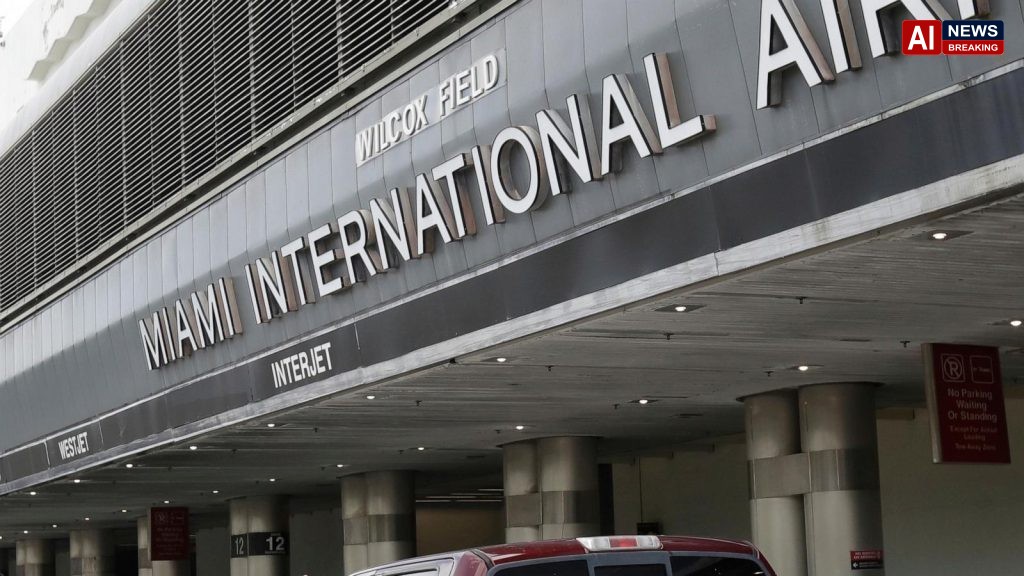
2 planes collide on the ground in Miami, only minor injuries reported - AI News Breaking
planes collide ground miami:
A minor ground collision involving two aircraft at Miami International Airport has prompted an investigation by federal aviation safety officials, although only slight injuries were reported among those on board. The incident occurred at a taxiway intersection shortly after one of the planes completed its landing roll and was cleared to proceed toward the terminal. While the aircraft involved sustained damage to their forward structures, there were no fatalities and the airport remained operational for the remainder of the day.The collision was first reported to airport authorities at approximately 10:45 a.m..
local time, when air traffic controllers observed an abnormal movement on the airport’s surveillance system. Controllers immediately instructed both pilots to bring their aircraft to a halt and initiated emergency protocols. Ground crews were dispatched to the scene within minutes, and emergency medical personnel were on site to assess the health of passengers and crew..
Initial statements from the airline representatives indicated that eight occupants – four from each aircraft – reported minor injuries, primarily bruises and whiplash, and were treated on the tarmac before being transferred to nearby medical facilities for further observation.The two aircraft involved were a Boeing 737‑800 operated by a major U.S. carrier and a regional jet, an Embraer 175, belonging to a regional airline that provides feeder services to the hub. According to the airlines, both flights had been scheduled to arrive on time and were carrying a combined total of roughly 150 passengers..
The Boeing 737 had just landed on runway 9L and was instructed to taxi toward gate C13, while the Embraer was taxiing from the same runway toward a different gate when the paths intersected. Witnesses among airport staff described a “soft thud” followed by a brief burst of smoke from the forward fuselage of the larger aircraft, but no fire broke out.Federal Aviation Administration (FAA) investigators arrived at the airport shortly after the incident and began a preliminary assessment of the sequence of events. The agency’s Office of Accident Investigation and Prevention has released a statement confirming that a full investigation will be undertaken, with a focus on communication protocols between air traffic control and flight crews, as well as the functioning of the airport’s ground‑movement radar..
The FAA has also indicated that the data from the aircraft’s flight data recorders, as well as the airport’s surveillance footage, will be examined to determine whether any procedural deviations contributed to the collision.Airport officials have emphasized that the incident did not compromise overall safety operations. “Our priority remains the safety and well‑being of passengers, crew and staff,” said the airport’s director in a press briefing. “We have activated all standard emergency response measures, and we are cooperating fully with the FAA and the National Transportation Safety Board, which will be involved in the investigative process.” The director also reassured the travelling public that all flights scheduled for later in the day would continue as planned, with only a brief delay to accommodate the removal of the damaged aircraft from the taxiway.The airlines involved released coordinated statements expressing concern for those injured and gratitude for the swift response of emergency services..
Both carriers said that passengers affected by the incident would receive appropriate care and compensation in line with airline policy. The regional carrier also announced that it would provide alternative transportation for passengers whose onward travel was disrupted, including rebooking on later flights or arranging ground transport where feasible.The incident comes at a time when Miami International Airport, one of the busiest hubs in the United States, has been coping with heightened traffic levels following the gradual recovery of air travel after the pandemic. The airport handled more than 35 million passengers in the previous year, a figure close to its pre‑COVID‑19 peak, and has been implementing a series of infrastructure upgrades aimed at reducing congestion on the ground..
Aviation experts note that while ground collisions are relatively rare compared to in‑flight incidents, they can highlight systemic pressures on airport operations, especially in high‑traffic environments.Aviation safety analyst Dr Laura Martínez of the International Air Transport Association commented that “ground‑movement incidents often stem from a combination of human factors and technological limitations.” She added that modern airports rely heavily on advanced surface detection equipment, but that effective communication between pilots and controllers remains paramount. “When aircraft are taxiing at low speeds, any lapse in situational awareness can have immediate consequences, even if the impact is minor,” Martínez said. “The investigation will likely examine whether the controllers had an accurate picture of both aircraft’s positions and whether the pilots followed standard taxiing procedures.”The National Transportation Safety Board (NTSB) has not yet released an official report, but it is expected to join the FAA’s investigative team as the inquiry progresses..
According to standard procedure, the NTSB will produce a detailed report within six months, outlining probable causes and recommending safety improvements. In similar past incidents, recommendations have included enhancements to ground‑radar resolution, mandatory read‑back of taxi clearances, and the adoption of automated collision‑avoidance systems for aircraft on the ground.In the meantime, the damaged aircraft have been towed to a remote holding area for inspection. Preliminary assessments suggest that the Boeing 737 sustained dents and deformation to its nose cone and forward landing gear, while the Embraer’s left wing root exhibited minor structural stress..
Both aircraft are expected to undergo comprehensive maintenance checks before returning to service, a process that could take several days depending on the extent of the repairs required.As the investigation unfolds, passengers and industry stakeholders alike will be watching closely for findings that could influence future operational protocols at Miami International and other congested airports worldwide. The incident underscores the ongoing challenge of balancing high traffic volumes with stringent safety standards, a balance that regulators and airlines continue to refine through technology, training and rigorous oversight..
Miami’s near‑miss lays bare the fragility of even the most advanced ground‑radar systems when traffic surges outpace human coordination, urging regulators to mandate stricter read‑back protocols and automated taxi‑conflict alerts before congestion becomes a safety liability.







