Pond heron found dead in Coimbatore tests positive for avian influenza
 Pakistan’s leaders hail first astronaut aboard Chinese craft: ‘Proud one of us has gone into space’
 British tourist travels 29 hours from Mumbai to Amritsar for ₹5,461, rates Indian Railways 10/10 | Viral video
 The Supreme Court will decide whether assault weapons bans violate the Second Amendment
 A Critic of Beijing Falls Short in Taiwan’s Key Mayoral Election
An Idaho man gets 18 years in prison for an Islamic State support plot
** A federal judge in Boise handed down an 18‑year prison term to a 34‑year‑old Idaho man convicted of providing material support to the Islamic State after he shipped hard drives and USB sticks containing training videos and encrypted communications to an overseas contact. The case underscores the severe penalties for aiding designated foreign terrorist organizations.
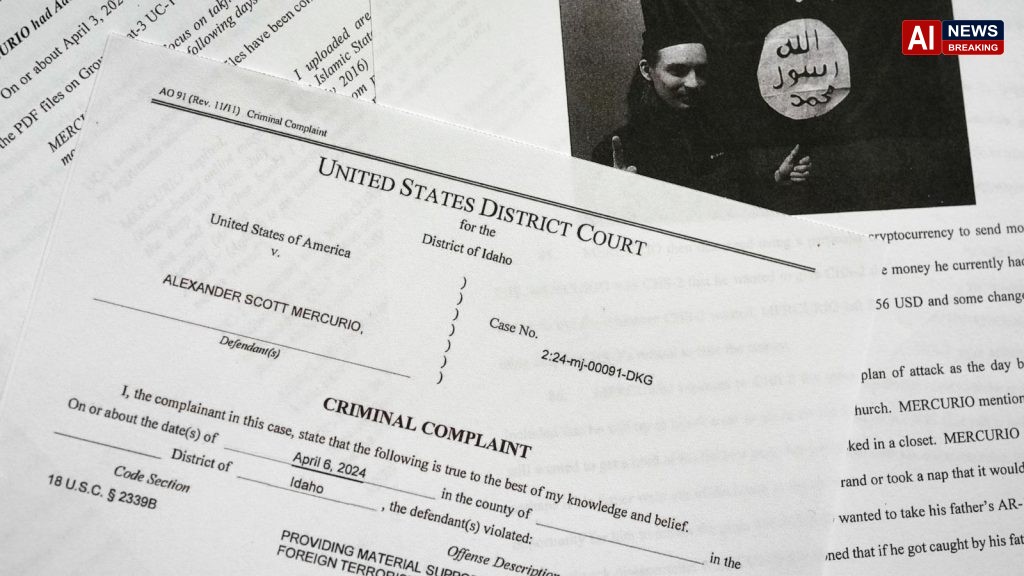
An Idaho man gets 18 years in prison for an Islamic State support plot - AI News Breaking
idaho gets years prison:
In a decision delivered on Wednesday, a federal judge in Boise sentenced a man from Idaho to 18 years in prison for an attempt to provide material support to the Islamic State. The defendant, identified only as a 34‑year‑old resident of Nampa, was convicted of one count of providing material support to a designated foreign terrorist organization, a charge that carries a maximum penalty of 30 years and can result in life imprisonment. The court found that the defendant had gathered and transferred a cache of electronic devices, including hard drives and USB sticks, to a contact overseas who was believed to be an operative of the extremist group..
The devices contained training videos, financial records and encrypted communications that could aid the group’s strategic operations.The indictment, filed by the U.S. Attorney’s Office in the District of Idaho, alleged that the defendant had worked with an intermediary in the Middle East from early 2021. According to prosecutors, the defendant had met the intermediary twice in Boise before shipping the equipment through a series of couriers..
The package was seized by the Department of Homeland Security’s Customs and Border Protection at the Port of Portland before it could reach its intended destination. In a statement, the attorney’s office said the evidence demonstrated a clear intent to assist an organization that has been designated as a terrorist group by the U.S. government since 2014.The defendant’s defense team argued that his actions were motivated by curiosity and not by a desire to support violent extremism..
They claimed that he had been a hobbyist interested in digital security and that he had no knowledge of the ultimate use of the materials he collected. The court, however, found that the defendant’s communications with the intermediary were consistent with a plan to facilitate the group’s operational capabilities. In a key piece of evidence, the defendant’s email correspondence with the intermediary discussed the logistics of shipping the devices and the timing of their delivery..
The judge noted that the defendant’s failure to seek counsel or verify the legitimacy of the intermediary’s affiliations demonstrated a reckless disregard for the law.During the trial, witnesses testified about the defendant’s background and personality. A former employer described him as a “quiet and reliable” employee, noting that he had never exhibited extremist tendencies. A former schoolteacher added that the defendant had been involved in community service projects and had no record of political activism..
Despite these character references, the judge emphasized that the defendant’s actions had placed the country at risk and that the severity of the offence warranted a significant sentence.The defendant’s sentence was based on a plea agreement that was reached earlier in the year. Under the agreement, the defendant pleaded guilty to providing material support to a foreign terrorist organization, admitting that he had transferred the electronic devices to a contact in the Middle East. In exchange, the prosecution agreed to recommend an 18‑year term..
The judge approved the agreement, citing the defendant’s cooperation with investigators and the absence of any violent conduct. The sentence is set to run consecutively with a 10‑year term for possession of unregistered firearms that the defendant had in his possession at the time of the arrest.Federal law mandates that material support to a designated terrorist organization must be punished severely to deter others from engaging in similar conduct. The defendant’s actions violated Title 18 of the U.S..
Code, Sections 2339A and 2339B, which prohibit assistance, including financial or logistical aid, to foreign terrorist organisations. The law was enacted in 1997 and has been invoked in cases ranging from the 9/11 attacks to the financing of al‑Qaeda. The prosecution argued that the defendant’s role, though limited, contributed to the operational capacity of the Islamic State, an organisation that has claimed responsibility for attacks in more than 30 countries.In his sentencing remarks, the judge warned that the defendant’s actions, if successful, could have facilitated the planning or execution of violent attacks..
The judge stated that the sentence “reflects the seriousness of the offence” and “serves as a deterrent to those who might consider supporting extremist causes.” The judge also noted that the defendant had no prior criminal record, but that the nature of the crime warranted a strict punishment. The judge’s comments were recorded as part of the public record and are available through the federal court’s online docket system.The defendant will report to the Federal Bureau of Prisons for the commencement of his sentence at a minimum security facility. Attorney’s Office indicated that the defendant would be housed in a state-approved federal prison and that his release will be contingent upon the completion of his term, successful completion of the mandatory rehabilitation programs, and the granting of a pardon, if any..
The defendant’s family has not yet issued a statement regarding the outcome of the case.This case follows a series of federal prosecutions aimed at disrupting the support network of extremist organisations. In recent months, law enforcement agencies across the United States have seized a variety of communications, financial transactions and training materials that have been linked to the Islamic State. The Department of Justice’s terrorism unit has highlighted the importance of monitoring digital infrastructure and preventing the flow of technology that could be used to facilitate terrorist operations..
The current case is cited as an example of the judiciary’s commitment to upholding these priorities.The sentencing decision also underscores the broader conversation about the balance between national security and individual rights. Critics of the law argue that broad provisions could be used to criminalise innocent political expression or support for humanitarian causes. Supporters, however, stress the necessity of maintaining a robust legal framework to counter threats from transnational terror networks..
In the present case, the court’s strict interpretation of the law is seen by many experts as a reaffirmation of the United States’ stance against supporting extremist groups.The verdict and sentence are likely to be appealed by the defendant’s legal counsel, who has indicated that they will file a notice of appeal with the Ninth Circuit Court of Appeals within the statutory period. The appellate team will argue that the defendant’s lack of intent to facilitate violent acts mitigates the severity of the offence. The federal appellate courts will review the lower court’s application of the law and the appropriateness of the sentence..
Whether the sentence will be upheld or reduced remains to be seen.In the meantime, the Idaho community, the legal system and the broader public will watch the case for its implications on future prosecutions and the continued fight against extremism. The case serves as a reminder that individuals who facilitate the operational needs of extremist organisations can face substantial legal consequences, regardless of the motives that might be claimed. It also illustrates the judiciary’s ongoing commitment to enforce the statutes that safeguard the nation from the threats posed by international terrorist groups..
Updated: November 11, 2026
The harsh sentence underscores the federal judiciary’s willingness to use the full weight of anti‑terrorism statutes as a deterrent, signaling that even seemingly minor logistical aid can trigger decades‑long incarceration. This precedent may embolden prosecutors nationwide, but it also risks chilling legitimate tech‑sharing and community engagement if the law’s breadth is not carefully calibrated.