
 Pond heron found dead in Coimbatore tests positive for avian influenza
 Pakistan’s leaders hail first astronaut aboard Chinese craft: ‘Proud one of us has gone into space’
 British tourist travels 29 hours from Mumbai to Amritsar for ₹5,461, rates Indian Railways 10/10 | Viral video
 The Supreme Court will decide whether assault weapons bans violate the Second Amendment
 A Critic of Beijing Falls Short in Taiwan’s Key Mayoral Election
Three coaches of Sairang‑Kolkata Express derail near Digaru, Assam.
**
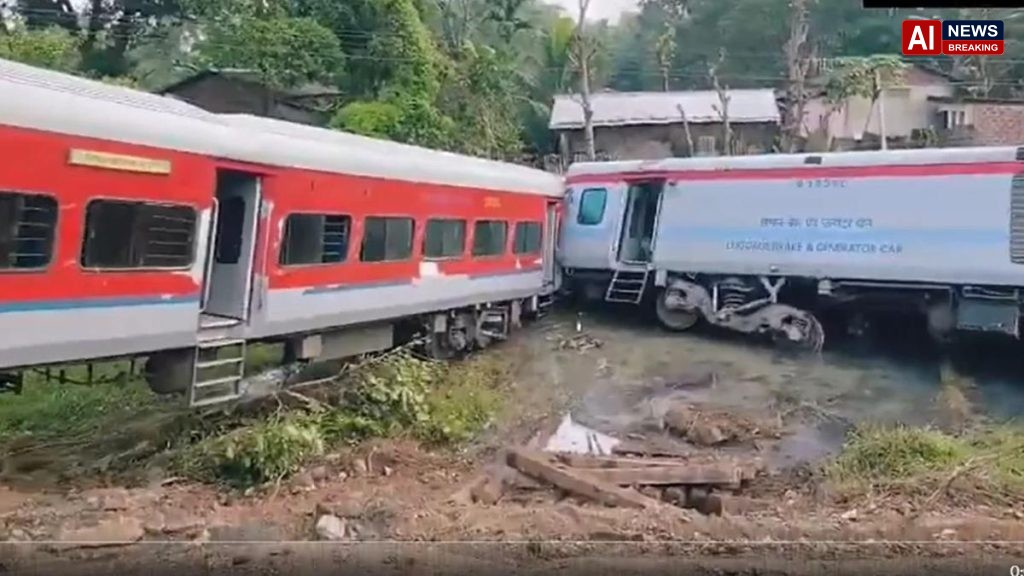
Several coaches of Sairang-Kolkata Express train derail at Digaru in Assam - AI News Breaking
three coaches sairangkolkata express:
Several coaches of the Sairang‑Kolkata Express derailed this morning near Digaru in Assam’s Cachar district, prompting an immediate response from railway officials and local authorities. The incident occurred at approximately 06:45 a.m. local time, when the train was approaching Digaru station on the Lumding‑Silchar line..
According to the East North East Railway zone, the derailment involved three of the train’s thirty‑seven coaches, all of which came to rest on the embankment beside the track. Fortunately, no passengers or staff were reported injured, and rescue teams were able to evacuate the occupants without serious harm.Preliminary investigations point to a loss of control by the locomotive pilot as the primary factor behind the mishap. The pilot, identified as a senior officer with over two decades of experience, reportedly reduced speed to allow a higher‑priority train to overtake on the adjacent line..
In doing so, the driver misjudged the braking distance on a section of track that is known for its steep gradients and tight curves. The sudden deceleration caused the locomotive to slip, and the forces transmitted through the couplings led to the separation and eventual derailment of the three trailing coaches.Railway officials have confirmed that the train was running on schedule and was carrying approximately 1,200 passengers, many of whom were commuters traveling between the northeastern state of Mizoram and West Bengal. The Sairang‑Kolkata Express, which departs Sairang each night, is a crucial link for both commercial and personal travel, connecting remote interior regions with major urban centres..
The disruption caused by the derailment forced the train to be halted at Digaru, and passengers were subsequently transferred to alternative services arranged by the railway’s emergency response unit.The Ministry of Railways issued a brief statement shortly after the incident, emphasising that safety remains its top priority and that a full technical audit of the route would be undertaken. “We are closely monitoring the situation and have deployed senior engineers to conduct a thorough examination of track conditions, signalling systems and locomotive performance,” the statement read. The ministry also pledged to provide compensation to affected passengers in accordance with existing railway policies, and to accelerate the restoration of regular services on the line.Local authorities, including the Assam Police and the district disaster management force, arrived on the scene within minutes of the report..
Their primary tasks involved crowd control, ensuring the safety of the surrounding area, and assisting railway staff in the evacuation process. Medical teams from the nearby Digaru Primary Health Centre were put on standby, although they were ultimately not required to treat any serious injuries. The prompt coordination between railway personnel and emergency services has been cited as a key factor in preventing any casualties.Railway engineers have begun the painstaking process of re‑railing the derailed coaches and inspecting the integrity of the track..
Preliminary visual checks indicated no obvious breakage in the rails, but a more detailed ultrasonic assessment will be carried out to rule out any hidden fissures that could compromise future operations. The damaged coaches are being lifted onto a flat‑bed wagon for transport to the Siliguri Diesel Locomotive Shed, where they will undergo repairs or, if deemed beyond economical repair, be retired from service.The incident has reignited debate over the safety of railway infrastructure in the Northeast, a region that has long struggled with under‑investment, challenging terrain and frequent weather‑related disruptions. Critics argue that the combination of aging rolling stock and insufficient modern signalling technology creates a perfect storm for accidents..
In response, the Railway Board has reiterated its commitment to the “Dedicated Freight Corridor” and “High‑Speed Rail” projects, which aim to modernise the network, but observers note that these initiatives are still years away from reaching remote sections such as the Lumding‑Silchar line.Passenger advocacy groups have called for greater transparency regarding the findings of the ongoing inquiry. The All‑India Railwaymen’s Federation (AIRF) released a statement urging the railways to publish the complete accident report within a fortnight, and to implement any recommended corrective actions without delay. “The families of those who travel daily on these routes deserve assurance that their safety is not being compromised by systemic neglect,” the statement read..
The federation also demanded that the railway management review crew scheduling and fatigue management policies, citing the possibility that the locomotive pilot may have been operating under extended duty hours.In the meantime, alternative arrangements have been made for travellers affected by the disruption. The East North East Railway has deployed additional passenger trains on the same route, and a special bus service has been set up between Digaru and Silchar to ferry commuters. Ticket counters at nearby stations have been instructed to issue refunds and rebook passengers at no extra cost..
Railway officials have urged passengers to remain patient as the line is expected to be fully operational by late afternoon, once the track inspection is concluded and safety clearance is granted.The derailment at Digaru serves as a stark reminder of the challenges facing India’s expansive rail network, particularly in regions where geography and infrastructure intersect in complex ways. While the swift response prevented loss of life, it also highlighted the need for continuous investment in modern safety systems, rigorous staff training and regular maintenance regimes. As investigations continue, the focus remains on restoring confidence among the thousands of daily commuters who rely on the Sairang‑Kolkata Express and on ensuring that similar incidents are averted in the future..
Three coaches of the Sairang‑Kolkata Express derailed near Digaru station in Assam after the driver misjudged braking on a steep, curved stretch, but swift action by rail and emergency crews prevented injuries. The railway has launched a technical audit, arranged alternate transport for the roughly 1,200 passengers, and pledged compensation while probing broader safety concerns on the line.
The Digaru derailment shows that even veteran pilots can’t offset systemic flaws—steep grades and outdated signalling turn routine speed‑adjustments into safety liabilities.
Unless the Northeast’s rail arteries receive the same high‑tech upgrades and crew‑fatigue safeguards as flagship corridors, isolated mishaps will keep er






