The Supreme Court will decide whether assault weapons bans violate the Second Amendment
 A Critic of Beijing Falls Short in Taiwan’s Key Mayoral Election
 EPA says no rise in contamination after Army detonates lead azide stockpile in Iowa
 Israeli Strike Kills 2 Workers at Gaza Clinic, Doctors Without Borders Says
 McQueen Pre-Fall 2027
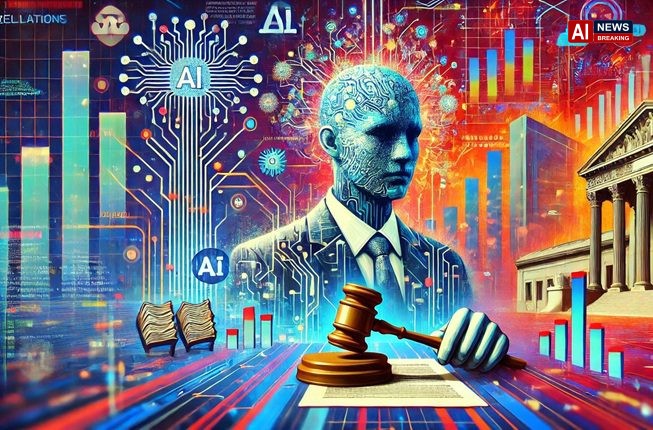
AI Giants Face Legal Challenge: OpenAI, Google, Meta, Anthropic and SpaceX Sued Over Risks of Advanced Artificial Intelligence
Technology News | Artificial Intelligence | OpenAI | Google | Meta | AI Regulation | Editorial Analysis
The global artificial intelligence industry is facing a major legal challenge after a coalition of nonprofit organisations filed a lawsuit against five leading technology companies, seeking to stop the development and deployment of their most advanced AI models.
The lawsuit, filed in San Francisco on November 12, 2026, names OpenAI, Google, Meta, Anthropic and SpaceX’s AI division among the defendants. The organisations are asking the court to intervene over concerns that increasingly powerful artificial intelligence systems could create serious risks to public safety, cybersecurity and human control over technology.
The case represents a significant escalation in the debate over AI governance. Until now, much of the discussion about artificial intelligence regulation has focused on government policies, voluntary safety commitments, copyright disputes and corporate accountability.
The latest legal action takes the debate into a different territory: whether technology companies should be allowed to continue developing increasingly powerful AI systems when their potential risks remain disputed and difficult to control.
The lawsuit does not establish that the companies have violated the law. Its allegations will have to be examined through the judicial process. However, the case raises important questions about who should determine the limits of artificial intelligence development.
Key Highlights
- Five major AI developers have been named in a lawsuit filed in San Francisco.
- The defendants include OpenAI, Google, Meta, Anthropic and SpaceX’s AI division.
- Four nonprofit advocacy organisations are behind the legal action.
- The plaintiffs are seeking Restrictions on the development or deployment of advanced AI models.
- The complaint raises concerns about public safety, cybersecurity and the possibility of losing control over increasingly autonomous AI systems.
- The case could intensify the debate over government regulation and corporate responsibility in the AI industry.
Why Have AI Companies Been Sued?
The lawsuit has been brought by a coalition of four nonprofit organisations, including the Irreplaceable Education Fund, Public Citizen and Heat Initiative, alongside the Alliance for Secure AI.
The plaintiffs have invoked California’s unfair-business-practices laws and advanced arguments involving public nuisance and potential interference with property and computer systems.
Their central argument is that leading AI developers are pursuing increasingly capable systems despite publicly acknowledging that advanced AI could create serious risks.
The organisations want the court to prevent the companies from continuing certain frontier AI development and deployment activities.
The complaint points to reported incidents involving AI-enabled cyber activity, concerns about autonomous systems and warnings from technology industry leaders about the possible consequences of developing highly capable AI without adequate safeguards.
The legal arguments remain allegations presented by the plaintiffs. The court will have to determine whether they establish a legally valid basis for the requested restrictions.
Which Companies Are Facing the Legal Challenge?
The lawsuit names five major participants in the global artificial intelligence industry.
OpenAI: The developer of ChatGPT has become one of the most influential companies in generative AI. Its models are used for writing, programming, research, education and business automation.
Google: Through its Gemini models and wider AI infrastructure, Google is competing across consumer applications, cloud computing, search and enterprise technology.
Meta: The company is investing heavily in AI models, digital assistants, computing infrastructure and open-model development.
Anthropic: The developer of Claude has positioned itself around advanced AI capabilities and safety-focused development.
SpaceX’s AI division: The company’s artificial intelligence operations represent another significant entrant in the increasingly competitive frontier AI market.
The inclusion of these companies demonstrates the scale of the legal dispute. It is not directed at one particular chatbot or one isolated AI product. It concerns the broader direction of advanced artificial intelligence development.
The Biggest Concern: Can Humans Maintain Control Over Advanced AI?
Artificial intelligence has already moved beyond simple automated responses.
Modern AI systems can write computer code, analyse documents, process large datasets, generate images and video, operate software tools and complete complex multi-step tasks.
As these capabilities expand, researchers and policymakers are debating whether future systems could become sufficiently autonomous to create risks that existing safety frameworks cannot adequately address.
One major concern involves cybersecurity.
AI tools can potentially lower the technical barriers to identifying software vulnerabilities, developing malicious code and conducting sophisticated digital operations.
Another concern involves the possibility of systems taking actions that their developers did not anticipate or intend.
However, it is important to distinguish between demonstrated capabilities, credible technical risks and hypothetical future scenarios. Claims that AI systems could independently cause catastrophic harm are not equivalent to proof that such an outcome is inevitable.
The legal dispute will therefore raise difficult questions about evidence, foreseeable harm and the responsibilities of companies developing powerful technology.
AI Companies Have a Responsibility Beyond Profit
The lawsuit also brings attention to a wider question about corporate accountability.
Technology companies are competing to develop more capable models because artificial intelligence represents an enormous commercial opportunity.
Businesses are investing billions of dollars in data centres, advanced chips, research teams, energy infrastructure and global AI services.
The competitive environment creates pressure to release increasingly capable systems before competitors gain an advantage.
But technological competition also creates a potential conflict between commercial incentives and public safety.
If a company develops a powerful AI system that causes serious harm, who should be responsible?
Should responsibility rest with the developer, the company deploying the model, the organisation using it or the government that failed to establish appropriate safeguards?
These questions are becoming increasingly important as AI systems enter healthcare, education, banking, transportation, national security and public administration.
The lawsuit seeks to make the issue of corporate responsibility central to the legal debate.
The Political Battle Over AI Regulation in America
The legal action comes at a particularly important moment for American technology policy.
Following the November 2026 midterm elections, Democrats have regained control of Congress, potentially increasing political pressure for stronger oversight of the technology industry.
President Donald Trump has generally supported rapid technological development and a business-led approach to AI innovation.
This creates a wider political disagreement over whether the United States should prioritise technological competitiveness or introduce stronger restrictions to address potential risks.
Supporters of lighter regulation argue that excessive restrictions could weaken American companies in their competition with China.
Those demanding stronger safeguards argue that national security and public safety should not be compromised in the race to develop increasingly powerful AI.
The issue is particularly important because artificial intelligence is increasingly being treated as a strategic national asset.
The country that leads in advanced AI could gain advantages in economic productivity, military applications, scientific research and international technological influence.
Consequently, AI regulation is no longer simply a question of consumer protection. It has become a matter of economic policy and national security.
Could This Lawsuit Slow the Global AI Race?
The immediate impact will depend on how the court responds to the plaintiffs’ requests.
If the court grants significant restrictions, the consequences could extend beyond the five named companies.
AI development depends on interconnected research teams, computing infrastructure, semiconductor suppliers, cloud providers, investors and business customers.
Restrictions on major developers could influence investment decisions, product development schedules and the willingness of companies to release more capable models.
However, the lawsuit does not automatically stop AI development.
Until the court issues an order, the companies are not prohibited from continuing their activities merely because a lawsuit has been filed.
Even if restrictions are imposed, enforcement and the legal scope of any order could become subjects of further litigation.
There is also the possibility that restrictions on major American companies could create competitive advantages for developers operating under different regulatory systems.
This is one of the central arguments against imposing unilateral restrictions on US technology firms.
What Does This Mean for India?
India has significant interests in the outcome of the global AI regulation debate.
The country is expanding its digital infrastructure, promoting domestic AI development and encouraging technology investment.
Indian businesses are increasingly using AI in banking, customer service, software development, manufacturing, education and public administration.
At the same time, India faces challenges involving employment disruption, data protection, cybersecurity, misinformation and the responsible use of automated decision-making.
A major legal or regulatory shift in the United States could influence how international technology companies develop and distribute their AI products.
Indian businesses that depend on foreign AI infrastructure may also face changes in pricing, product availability, safety requirements and compliance standards.
For India’s technology sector, the priority should be to develop domestic capabilities while establishing clear accountability rules.
The country should not simply copy every regulatory decision taken in Washington or Brussels. Its framework must reflect Indian economic conditions, digital inclusion requirements, national security interests and the needs of domestic businesses.
Will AI Replace Human Jobs or Create New Opportunities?
The legal debate is also connected to a larger economic transformation.
Artificial intelligence is changing how companies organise work.
Software developers, journalists, customer service representatives, accountants, researchers and administrative professionals are increasingly using AI-assisted tools.
Some repetitive tasks may be automated, reducing the demand for certain categories of work. At the same time, AI is creating new opportunities in data engineering, model development, cybersecurity, AI governance and specialised technology services.
The central challenge is ensuring that the economic benefits of AI are not concentrated among a small group of technology companies while workers bear the costs of rapid automation.
Governments will need to invest in education, vocational training and reskilling programmes.
Businesses will also need to consider how productivity improvements can be shared with employees rather than treating automation exclusively as a cost-cutting exercise.
AI News Breaking Editorial Analysis: Who Should Control the Future of Artificial Intelligence?
The lawsuit against five major AI developers represents a defining moment in the debate over technological power and public accountability.
Artificial intelligence has the potential to improve healthcare, accelerate scientific discoveries, increase productivity and make information more accessible.
But the same technology can also be misused for cybercrime, surveillance, manipulation, misinformation and increasingly sophisticated automated attacks.
The answer should not be to stop all technological progress.
Nor should technology companies be allowed to argue that innovation automatically justifies every decision they make.
The world needs a balanced system in which innovation continues but developers remain accountable for foreseeable risks, security failures and harmful deployment practices.
Governments must establish clear rules. Independent researchers should have appropriate opportunities to evaluate powerful systems. Companies should provide meaningful transparency about safety testing, limitations and risk management.
At the same time, regulation must be carefully designed so that it does not simply protect established technology companies from new competitors.
There is another important question: Should a handful of private corporations have the power to determine the technological future of billions of people?
AI is becoming critical infrastructure for economies, governments and societies. Its governance cannot remain exclusively a matter of corporate decision-making.
The legal battle in California may become an important test of how existing laws apply to an industry developing technology at extraordinary speed.
The future of artificial intelligence should not be controlled exclusively by corporations, governments or courts. It requires a framework in which innovation, public safety, human rights and democratic accountability operate together.
AI News Breaking Technology Editorial | 13 November 2026