
 Pakistan’s leaders hail first astronaut aboard Chinese craft: ‘Proud one of us has gone into space’
 British tourist travels 29 hours from Mumbai to Amritsar for ₹5,461, rates Indian Railways 10/10 | Viral video
 The Supreme Court will decide whether assault weapons bans violate the Second Amendment
 A Critic of Beijing Falls Short in Taiwan’s Key Mayoral Election
 EPA says no rise in contamination after Army detonates lead azide stockpile in Iowa
Delhi surpasses Lahore as world’s most polluted city
**
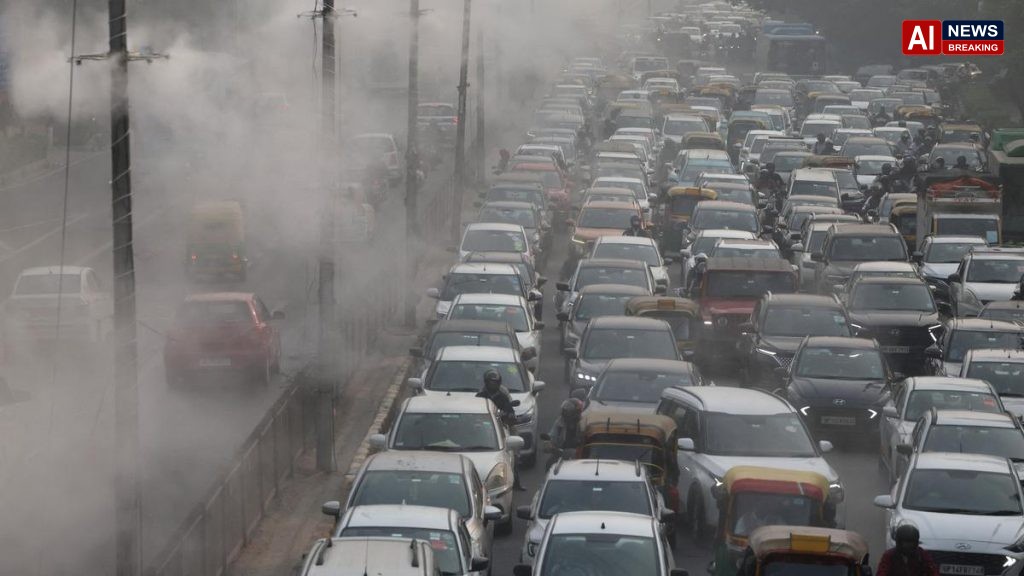
Delhi overtakes Lahore as world's most polluted city as air quality drops - AI News Breaking
delhi surpasses lahore worlds:
Delhi overtakes Lahore as world’s most polluted city as air quality drops Air quality index (AQI) in Delhi was “hazardous” at 334, making it the most polluted major city, according to Swiss group IQAir, which measures air quality levels based on the concentration of toxins. The report, released on Tuesday, shows that the Indian capital has slipped past Lahore for the first time in three years, a reversal that has sparked concern among health officials and environmentalists across South Asia. The study’s methodology, which combines satellite data, ground sensors and atmospheric modeling, offers a comprehensive view of particulate matter, ozone and nitrogen dioxide levels throughout the city’s 1,484 square kilometres..
Delhi’s AQI of 334 ranks it in the most dangerous category, defined by the World Health Organization as “hazardous.” The figure is far above the WHO’s recommended limit of 50 for an average day, and it represents a steep increase from last year’s average of 260. The city’s residents now face elevated risks of respiratory and cardiovascular ailments, as well as a higher incidence of asthma attacks and premature mortality. The government has issued advisories urging people to stay indoors, wear masks and avoid strenuous outdoor activity during peak pollution hours..
The IQAir analysis attributes the spike to a convergence of factors. Heavy vehicle emissions, industrial discharges from the nearby National Capital Region, and agricultural burning in surrounding states have all contributed to higher concentrations of fine particulate matter (PM2.5). In addition, a sudden winter inversion layer trapped pollutants close to the ground, preventing dispersion..
Meteorological conditions, such as reduced wind speeds and stagnant air, compounded the problem, creating a perfect storm of smog across the city. Lahore, Pakistan’s second‑largest city, fell to an AQI of 267, a significant decline from its previous record of 318. While the Pakistani capital still experiences hazardous air quality, the reduction is attributed to stricter enforcement of emission standards on local generators, an expansion of public transport routes and a temporary halt on large‑scale construction projects..
City officials announced a “clean air” initiative that includes the deployment of more electric buses and the installation of real‑time air‑quality monitors across the urban centre. Health ministries in both India and Pakistan have issued statements acknowledging the severity of the situation. Delhi’s Ministry of Health warned that “the current levels of air pollution are likely to increase the risk of chronic respiratory diseases among children and the elderly.” In Lahore, the Environmental Protection Agency highlighted the need for continued vigilance, noting that “industrial emissions remain a primary concern, and a comprehensive monitoring framework is essential for long‑term improvement.” International observers are noting the implications for global climate policy..
The World Bank’s latest report on air pollution in South Asia suggests that the economic cost of unhealthy air exceeds $22 billion annually, primarily through lost productivity and health care expenses. “Cities like Delhi and Lahore are emblematic of the broader challenge facing rapidly urbanising regions,” said Dr. Aisha Khan, a senior researcher at the Climate Policy Institute..
“Their air‑quality trajectories will shape future health outcomes and economic stability.” The Indian government has announced a multi‑tiered strategy to curb the pollution crisis. Key measures include the expansion of the Delhi Metro’s “clean energy” fleet, an acceleration of the National Clean Air Programme, and stricter penalties for illegal vehicular idling. Moreover, the government plans to invest $3 billion in greening projects, including the planting of 100 million trees along major arteries, which are expected to improve particulate capture and reduce urban heat islands..
Delhi’s municipal authorities have also introduced a “traffic‑management” plan aimed at reducing congestion during peak pollution periods. By implementing a staggered work‑shift system for government offices and encouraging remote working arrangements, the city hopes to cut vehicle miles travelled. The plan includes a temporary ban on two‑wheelers and three‑wheelers in high‑traffic zones during the most hazardous hours of the day, a measure that has already seen a 15 percent drop in local PM2.5 levels in pilot zones..
The public response has been mixed. While many residents report a noticeable improvement in visibility and a reduction in the number of people wearing masks, others point to the economic burden of changing lifestyles. “I can’t afford to buy an electric scooter, and the traffic jams are worse than ever,” said 32‑year‑old lawyer Rafiq Hussain..
“We need more subsidies and better public transport if we are to make any real change.” Academic studies suggest that the long‑term health impacts of Delhi’s air pollution could be profound. A recent analysis by the Indian Institute of Technology Delhi projected that the city could see a 12‑per‑cent increase in all‑cause mortality over the next decade if current trends persist. The research also highlighted the disproportionate burden on women and children, who are more vulnerable to airborne toxins and lack access to adequate health care..
In response, NGOs and civil‑society groups have intensified advocacy campaigns. The “Clean Air for Delhi” coalition, comprising over 30 organisations, is pushing for stricter enforcement of emission regulations and a nationwide rollout of low‑emission zones. “We are calling on the government to adopt a science‑based approach and to involve local communities in monitoring efforts,” said coalition chairperson Meera Patel..
“Only through transparency can we restore public trust.” The international community has also taken notice. The United Nations Environment Programme (UNEP) is preparing a briefing for the 2026 Climate Summit, focusing on the urgent need for cross‑border cooperation in the Indo‑Pak sub‑continent..
Updated: November 13, 2026






