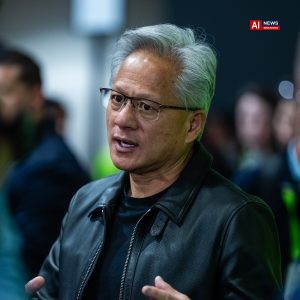
Pakistan’s leaders hail first astronaut aboard Chinese craft: ‘Proud one of us has gone into space’
 British tourist travels 29 hours from Mumbai to Amritsar for ₹5,461, rates Indian Railways 10/10 | Viral video
 The Supreme Court will decide whether assault weapons bans violate the Second Amendment
 A Critic of Beijing Falls Short in Taiwan’s Key Mayoral Election
 EPA says no rise in contamination after Army detonates lead azide stockpile in Iowa
Fallout from the Nvidia scandal may dampen the exuberance around the AI boom
**
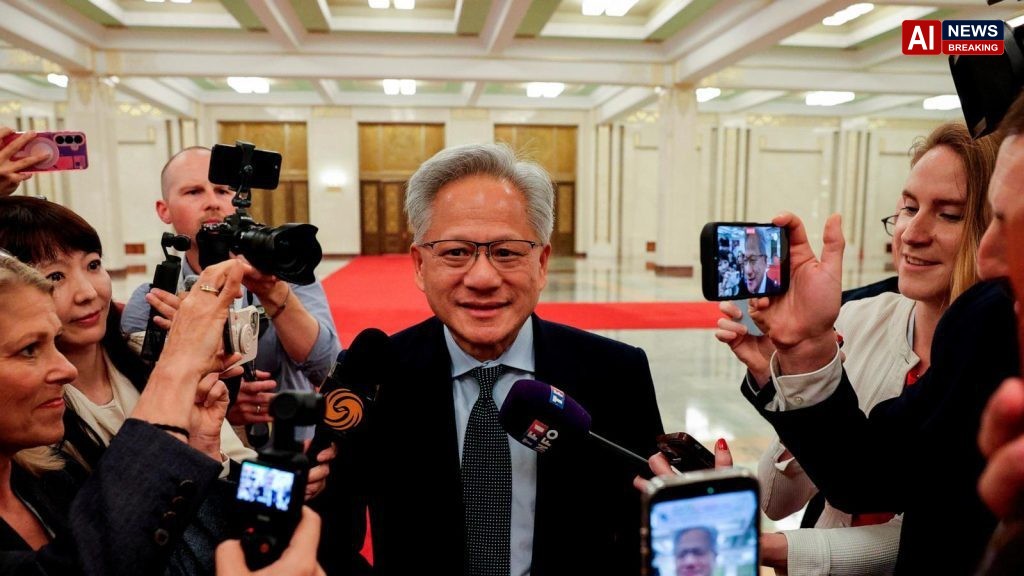
Fallout from the Nvidia scandal may dampen the exuberance around the AI boom - AI News Breaking
fallout nvidia scandal dampen:
Nvidia’s chief executive, Jensen Huang, surprised the industry on Tuesday by announcing his resignation after more than three decades at the helm of the world’s most valuable semiconductor company. The unexpected departure has sent shockwaves through the global technology sector, prompting analysts, investors and rival firms to reassess the trajectory of the artificial‑intelligence (AI) boom that has been largely driven by Nvidia’s graphics‑processing units (GPUs). While the company’s board has appointed long‑time insider Chris Malachowski as interim chief, the leadership vacuum has raised questions about the firm’s strategic direction and the broader market dynamics that have been built around its products.The timing of Huang’s exit could not be more consequential..
Nvidia’s stock has enjoyed a meteoric rise since the advent of generative AI, its market capitalisation swelling to over $1.5 trillion in the first half of the year. The firm’s GPUs now power the majority of large‑language models and other deep‑learning workloads, making it a linchpin in the supply chains of tech giants such as Microsoft, Amazon and Google. With the chief architect of this ecosystem stepping down, investors are wary that the company’s ability to maintain its technological edge could be compromised, potentially tempering the enthusiasm that has characterised recent market rallies.Industry observers note that the departure may also create opportunities for competitors to close the gap that Nvidia has long enjoyed..
Companies such as Advanced Micro Devices (AMD), Intel and emerging Chinese chip designers have been investing heavily in AI‑focused silicon, hoping to diversify the market away from a single supplier. In the short term, these firms are likely to intensify marketing efforts, touting alternative architectures that claim comparable performance at lower cost. The shift could accelerate a fragmentation of the AI hardware landscape, a development that analysts say might lead to more competitive pricing but also to a more complex procurement environment for cloud providers and data‑centre operators.For investors, the immediate reaction was a sharp sell‑off in Nvidia shares, which fell 7 percent in after‑hours trading, erasing roughly $100 billion in market value..
However, the broader AI sector showed resilience, with several peer stocks holding steady or even posting modest gains. The mixed response reflects a dual sentiment: confidence that the underlying demand for AI compute will endure, and apprehension that Nvidia’s leadership change could disrupt the momentum of product roll‑outs and partnership agreements that have been central to its growth.Regulators are also monitoring the fallout, particularly in the United States and the European Union, where concerns about supply‑chain security and market concentration have grown louder. The Department of Justice has previously signalled interest in the competitive dynamics of the AI hardware market, and the sudden leadership shift may prompt a fresh review of whether Nvidia’s market position could be abused..
At the same time, policymakers are keen to avoid any unintended slowdown in AI innovation, a sector they view as critical to national competitiveness.Within Nvidia, the board’s decision to appoint an insider as interim chief suggests a desire for continuity while a permanent successor is sought. Malachowski, who has overseen the company’s data‑center division for the past five years, is credited with steering the rapid expansion of the GPU portfolio that now dominates AI workloads. Insiders say his appointment is likely to reassure customers and partners, but they also acknowledge that a permanent leader will need to articulate a clear vision for the next generation of chips, particularly as rival firms unveil new architectures that claim to rival Nvidia’s performance‑per‑watt metrics.The broader AI boom, which has been marked by unprecedented levels of venture‑capital investment and a surge in corporate adoption, may also feel the indirect effects of the scandal that precipitated Huang’s resignation..
Earlier this year, an internal investigation into alleged misreporting of revenue targets and aggressive sales incentives at Nvidia was made public, leading to a brief but intense scrutiny of the company’s governance practices. While the investigation concluded without formal charges, the episode has amplified calls for greater transparency across the sector, especially as AI models become more integral to critical infrastructure.Analysts caution that the longer‑term impact on the AI ecosystem will depend on how quickly Nvidia can reaffirm its innovation pipeline. The company is expected to release its next‑generation Hopper‑based GPUs later this year, and any delay or perceived downgrade could accelerate the shift of market share to rivals..
Conversely, a smooth transition and a bold product roadmap could reinforce Nvidia’s dominance, reaffirming investor confidence and sustaining the high‑growth narrative that has underpinned the AI rally.For businesses that have built their AI strategies around Nvidia’s hardware, the leadership change introduces an element of uncertainty that may prompt a re‑evaluation of vendor lock‑in risks. Enterprises are now more likely to consider multi‑vendor approaches, integrating AMD’s Instinct accelerators or Intel’s Gaudi processors alongside Nvidia’s offerings to hedge against supply disruptions or pricing volatility. This diversification trend could, in turn, spur a wave of software optimisation efforts, as developers seek to ensure their models run efficiently across heterogeneous hardware stacks.In the weeks ahead, the market will watch closely how Nvidia’s board addresses the succession process, how the interim chief manages ongoing product launches, and whether the company can sustain its growth trajectory amid heightened scrutiny..
The episode serves as a reminder that even the most dominant players in the AI hardware arena are not immune to governance challenges, and that the sector’s future may be shaped as much by corporate stewardship as by technological breakthroughs. As the dust settles, the AI boom is likely to continue, but with a more cautious optimism that reflects the newfound awareness of the fragilities underlying the rapid expansion of the industry..
Updated: November 13, 2026
Huang’s exit injects a rare dose of uncertainty into an AI market that has hinged on Nvidia’s singular vision, prompting investors and cloud providers to hedge against a potential slowdown in innovation and pricing power.
If the interim leadership fails to deliver a compelling next‑gen roadmap, rivals like AMD and Intel could capitalize on the disruption, accelerating a fragmented hardware ecosystem that reshapes supply‑chain dynamics and regulatory scrutiny.