
 Pakistan’s leaders hail first astronaut aboard Chinese craft: ‘Proud one of us has gone into space’
 British tourist travels 29 hours from Mumbai to Amritsar for ₹5,461, rates Indian Railways 10/10 | Viral video
 The Supreme Court will decide whether assault weapons bans violate the Second Amendment
 A Critic of Beijing Falls Short in Taiwan’s Key Mayoral Election
 EPA says no rise in contamination after Army detonates lead azide stockpile in Iowa
With shifting Iran rhetoric following US elections, Trump leaves Mideast in limbo about path ahead
**
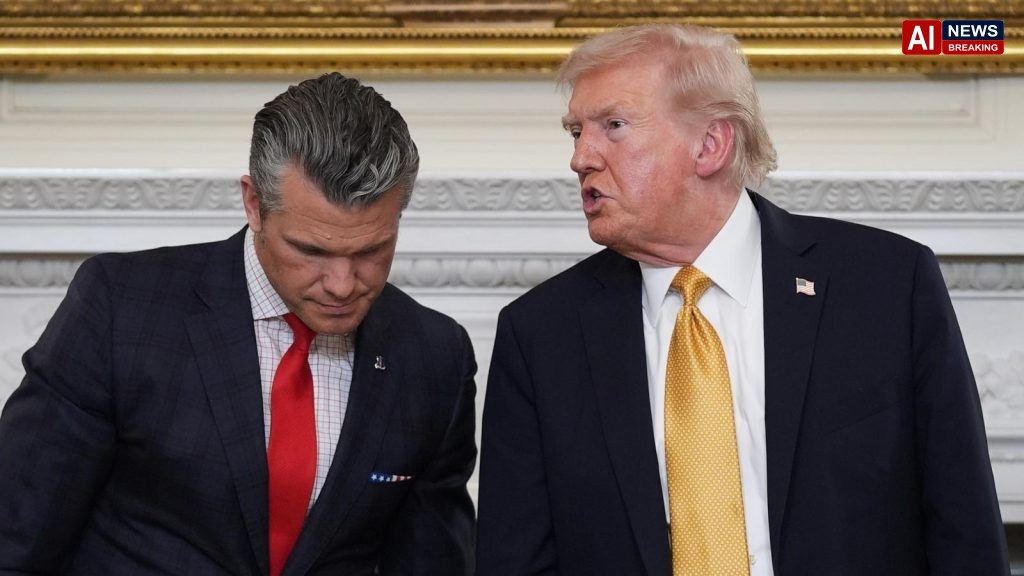
With shifting Iran rhetoric following US elections, Trump leaves Mideast in limbo about path ahead - AI News Breaking
With shifting Iran rhetoric following US elections, Trump leaves Mideast in limbo about path ahead President Donald Trump has been all over the map as he’s articulated his thinking about the Iran war since last week’s midterm elections. In a series of off‑the‑cuff remarks on talk‑shows, at a rally in Ohio and in a brief interview with a foreign‑policy blogger, the former president swung from an aggressive “maximum‑pressure” stance to an almost conciliatory tone that hinted at possible back‑channel talks. The lack of a coherent policy line has rattled allies in the Gulf, alarmed Tehran and forced Washington’s own diplomatic corps to scramble for clarity as the region watches nervously..
The first pivot came on Tuesday night when Trump, addressing a crowd in Dayton, declared that “the whole Iran thing has been blown out of proportion” and that the United States should “stop playing the war game” with Tehran. He claimed that the “big media” had turned a “minor dispute” into a “full‑blown crisis” and suggested that a “real‑deal” could be struck if both sides simply stopped “talking about sanctions.” The remarks were met with laughter from supporters but a sharp rebuke from senior officials who warned that any reduction in pressure could embolden Iran’s regional proxies. Just hours later, during a live interview with a popular cable news host, Trump back‑tracked, insisting that “we are still keeping Iran on a very short leash.” He invoked the 2015 Joint Comprehensive Plan of Action (JCPOA) as a “bad deal” but insisted that “the pressure is still there, the sanctions are still in place, and we will keep it that way until we get something better.” This flip‑flop left observers questioning whether the former president was rehearsing a new diplomatic overture or simply trying to appeal to disparate voter bases ahead of the 2028 presidential race..
The White House, now under the stewardship of National Security Adviser Stephen Biegun, issued a terse statement late Wednesday, saying “the United States remains committed to a stable Middle East and will continue to enforce existing sanctions against Iran in accordance with law.” The statement avoided any mention of the President’s comments, underscoring the administration’s attempt to compartmentalise Trump’s public musings from official policy. Yet insiders say the ambiguity is causing friction within the State Department, where career diplomats fear mixed signals could undermine ongoing negotiations with European partners. In Tehran, the reaction was equally mixed..
A senior official at the Ministry of Foreign Affairs, speaking on condition of anonymity, described Trump’s remarks as “a welcome sign of flexibility” but warned that “the United States must prove its seriousness by halting the endless cycle of sanctions that harm ordinary Iranians.” The official added that Iran remains ready to return to the negotiating table if Washington signals a genuine willingness to lift economic pressure, a stance that mirrors Tehran’s long‑standing position of “maximum pressure, maximum reward.” The Gulf Cooperation Council (GCC) states – Saudi Arabia, the United Arab Emirates and Bahrain – issued a joint communiqué on Thursday, urging “all parties to refrain from rhetoric that escalates tensions.” Their foreign ministers, meeting in Riyadh, expressed concern that the United States’ wavering stance could destabilise the already fragile security architecture of the Persian Gulf. Saudi Crown Prince Mohammed bin Salman reportedly called Trump’s comments “confusing” and urged the White House to reaffirm its “zero‑tolerance” approach to Iranian malign activities, especially in Yemen and Iraq. Washington’s allies in Europe are also watching closely..
The British Foreign Office, in a briefing to parliament, said “the United Kingdom expects consistent U.S. policy on Iran, as unpredictability hampers our collective ability to counter Tehran’s destabilising actions.” Germany’s foreign minister echoed the sentiment, noting that the EU is preparing a new package of sanctions that will be implemented regardless of U.S. domestic politics, but that “co‑ordination remains essential.” The transatlantic divide over how to handle Iran could become a test case for post‑midterm US‑European relations..
Meanwhile, the Congressional leadership, newly reshuffled after the elections, is grappling with its own internal debate. Democrats, led by Senate Foreign Relations Committee Chair Senator Chris Murphy, are pushing for a bipartisan resolution that would reaffirm the United States’ commitment to the JCPOA or a comparable framework, citing national‑security concerns. Republicans, meanwhile, are split between hard‑liners who champion a “maximum‑pressure” campaign and moderates who see political advantage in a diplomatic reset..
The resulting legislative gridlock may leave the administration with limited legislative tools to shape its Iran strategy. In the background, the Iranian Revolutionary Guard Corps (IRGC) continues its proxy campaigns across the region. Recent drone strikes in Syria, attributed to the IRGC, have heightened Israeli alarm and prompted the Israeli Defence Forces to conduct a series of retaliatory air raids..
Israel’s foreign minister, Eli Cohen, warned that “any perceived U.S. indecision on Iran is a dangerous opening for Tehran to expand its influence,” and urged the United States to stand firm with “clear, unwavering resolve.” Analysts at think‑tanks such as the Carnegie Endowment and the Brookings Institution suggest that Trump’s erratic messaging could be a calculated gambit to test the limits of the Biden administration’s diplomatic leverage. Nadia al‑Sayeed, a senior fellow at Carnegie, argues that “by injecting uncertainty, Trump may be trying to force a recalibration of the United States’ posture, potentially pushing Washington to offer concessions it would.
Former President Trump’s swing between “maximum‑pressure” rhetoric and hints at back‑channel talks has thrown Gulf allies and Washington diplomats into uncertainty, sparking calls for a consistent U.S. policy on Iran. The vacillating statements have heightened regional anxieties, with Tehran and European partners warning that inconsistent U.S. signals could embolden Iran’s proxy network and destabilise the Middle East.
Trump’s vacillation feels less like policy and more like a political pressure‑washer, aimed at unsettling allies while courting a base that prizes a hard‑line stance. If Washington can’t settle its own messaging, Tehran may use the confusion as a green light to double down on regional pushes.






