
 Pakistan’s leaders hail first astronaut aboard Chinese craft: ‘Proud one of us has gone into space’
 British tourist travels 29 hours from Mumbai to Amritsar for ₹5,461, rates Indian Railways 10/10 | Viral video
 The Supreme Court will decide whether assault weapons bans violate the Second Amendment
 A Critic of Beijing Falls Short in Taiwan’s Key Mayoral Election
 EPA says no rise in contamination after Army detonates lead azide stockpile in Iowa
Mars and Jupiter November 2026: Skywatchers Prepare for a Rare Planetary Pairing
**
Mars and Jupiter - AI News Breaking
mars jupiter november 2026:
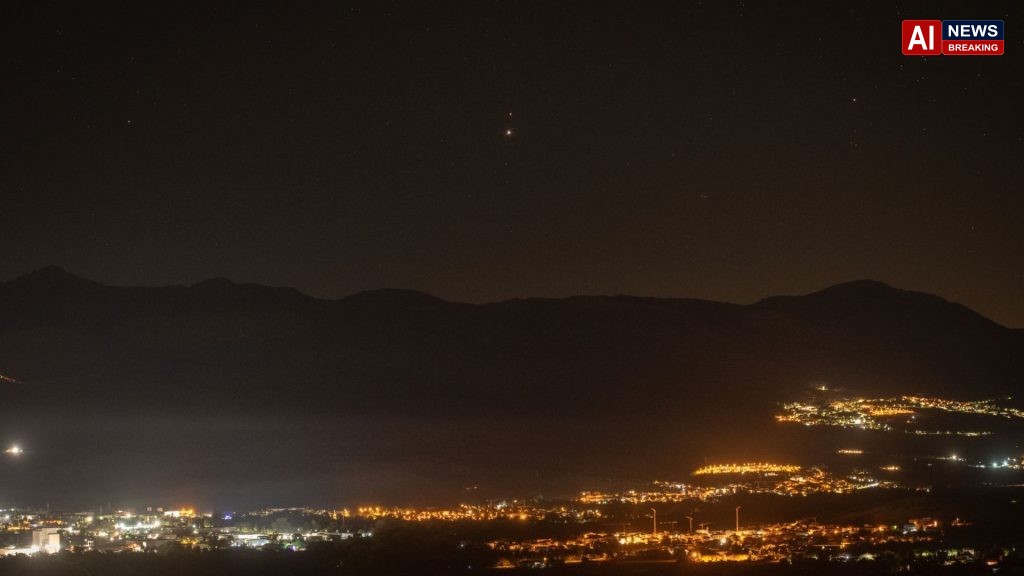
The night sky will host a rare planetary pairing that promises to delight both casual observers and seasoned astronomers alike. On the evenings of 15 and 16 November, Mars and Jupiter will draw within a hair‑breadth of each other as they rise together in the constellation Leo, a spectacle that will not be repeated until the summer of 2029. Though the two worlds remain separated by hundreds of millions of kilometres, their apparent proximity—just over one degree—creates a visual drama that underscores the intricate choreography of the solar system as seen from Earth.From most locations across the United States the planets will make their appearance shortly after midnight, when the eastern horizon begins to glow with the first hints of dawn..
The pair will emerge above the faint glow of the Milky Way, with the brilliant blue‑white star Regulus perched below them, anchoring the scene in Leo’s heart. Regulus, a main‑sequence star roughly 79 light‑years away, will serve as a useful guidepost for stargazers aiming their telescopes or binoculars toward the planetary conjunction. The planet’s rise time will vary slightly with latitude, but the general window of visibility will span roughly an hour before local sunrise, offering ample opportunity for observation.The apparent closeness of Mars and Jupiter is a perspective effect created by the alignment of the planets along similar lines of sight from Earth..
In reality the two giants sit at vastly different distances: Jupiter, the solar system’s behemoth, orbits at an average of 778 million kilometres from the Sun, while Mars travels a more modest 228 million kilometres. At the time of the November encounter, the two worlds will be separated by more than 368 million miles (about 592 million kilometres). Yet because they occupy nearly the same patch of sky, they will appear to be separated by just over one degree—roughly twice the width of a full Moon.This phenomenon, known in astronomical circles as a planetary conjunction, occurs with a regularity that is dictated by the orbital periods of the planets involved..
Jupiter completes an orbit around the Sun once every 11.86 Earth years, while Mars takes 1.88 years. As the inner planet catches up to the outer one in their respective paths, the two can appear to line up from the perspective of an Earth‑bound observer. For Mars and Jupiter, these close approaches typically happen every two to two and a half years, but the degree of closeness varies from one event to the next..
The November 2026 alignment is noteworthy not only for its visual proximity but also because it will be the last such near‑meeting for more than six years, making it a prime target for public outreach and amateur imaging.Astronomers and educators are already preparing resources to help the public make the most of the event. Planetarium shows, social‑media live streams, and guided observation sessions are being scheduled by institutions across the country. The American Astronomical Society has released a set of tips for safely viewing the conjunction, emphasizing the use of proper eye protection when observing any bright objects through telescopes, and reminding observers that while the planets are bright, the surrounding stars and the faint glow of the Milky Way can be best appreciated under dark‑sky conditions away from city lights.For those equipped with modest binoculars, the planets will appear as distinct discs, with Jupiter’s banded cloud layers offering a hint of its swirling atmosphere, and Mars presenting a reddish hue that hints at its iron‑rich surface..
More advanced amateur telescopes can resolve additional detail: the four largest moons of Jupiter—Io, Europa, Ganymede and Callisto—will appear as tiny points of light flanking the gas giant, while Mars may reveal surface features such as the polar ice caps if atmospheric conditions are favorable. Photographers aiming to capture the event should consider using a tracking mount to compensate for Earth’s rotation, as well as a moderate focal length to encompass both planets and Regulus within a single frame.The scientific significance of such conjunctions extends beyond their visual appeal. By observing the planets in close apparent proximity, astronomers can refine measurements of planetary positions, improve orbital models, and test predictions of celestial mechanics..
The event also offers a natural laboratory for comparing atmospheric phenomena on two very different worlds: Jupiter’s massive, turbulent storms versus Mars’ thin, dust‑laden sky. While professional observatories will not devote extensive time to a brief conjunction, the data gathered by a worldwide network of amateurs can contribute to long‑term monitoring programs that track changes in planetary atmospheres over years and decades.Historically, planetary conjunctions have captured human imagination for millennia, often being recorded in ancient chronicles as omens or celestial wonders. In modern times, they serve as reminders of the dynamic nature of our planetary neighborhood..
The November meeting of Mars and Jupiter follows a series of notable alignments, including the 2020 “Great Conjunction” of Jupiter and Saturn, which drew unprecedented public attention. Such events have sparked renewed interest in astronomy, leading to increased participation in citizen‑science projects and a surge in sales of telescopic equipment during the months surrounding the phenomenon.The timing of the November conjunction coincides with a period of relatively low solar activity, which can translate to clearer skies and reduced atmospheric turbulence—factors that enhance visual clarity for ground‑based observers. However, weather remains the ultimate wildcard..
Meteorological forecasts for early November suggest a mix of clear and partially cloudy nights across much of the United States, with the Pacific Northwest and parts of the Midwest experiencing a higher likelihood of cloud cover. Enthusiasts are advised to monitor local forecasts and, if possible, position themselves at higher elevations or in open fields where the horizon is unobstructed.In addition to the visual pairing, the conjunction offers a teachable moment about the scale of the cosmos. While the planets may appear to touch, the distance between them is comparable to the span between New York City and Los Angeles multiplied by several thousand..
This between apparent proximity and actual separation underscores the importance of perspective in astronomy—a lesson that can be reinforced through classroom activities that model orbital distances using scaled representations.As the night of 15 November approaches, the excitement among the astronomical community is palpable. Social media platforms are already buzzing with countdowns, sky‑watching tips, and shared photographs from previous conjunctions. For many, the chance to look up and see two of the solar system’s most iconic planets sharing the same patch of sky is a reminder of humanity’s enduring fascination with the heavens..
Whether viewed through a backyard telescope, a pair of binoculars, or simply with the unaided eye, the Mars‑Jupiter rendezvous promises a fleeting but unforgettable glimpse of planetary motion in action.When the two worlds finally set below the western horizon in the early hours of 16 November.
Updated: November 14, 2026
On the nights of 15‑16 November, Mars and Jupiter will line up in Leo, appearing a degree apart just after midnight for observers across the United States. The rare conjunction—next not to repeat until 2029—offers a prime opportunity for amateur astronomers to capture the gas giant’s bands and the red planet’s surface, while educators plan planetarium shows and online streams to share the event with the public.
The Mars‑Jupiter pairing reminds us that the cosmos is a theatre of illusion—our eyes trick us into thinking these distant giants are neighbours, while in reality they are separated by a distance that dwarfs even the Milky Way. This fleeting visual trick invites us to marvel at the






