
 Pakistan’s leaders hail first astronaut aboard Chinese craft: ‘Proud one of us has gone into space’
 British tourist travels 29 hours from Mumbai to Amritsar for ₹5,461, rates Indian Railways 10/10 | Viral video
 The Supreme Court will decide whether assault weapons bans violate the Second Amendment
 A Critic of Beijing Falls Short in Taiwan’s Key Mayoral Election
 EPA says no rise in contamination after Army detonates lead azide stockpile in Iowa
Jawaharlal Nehru through an intelligence prism
**
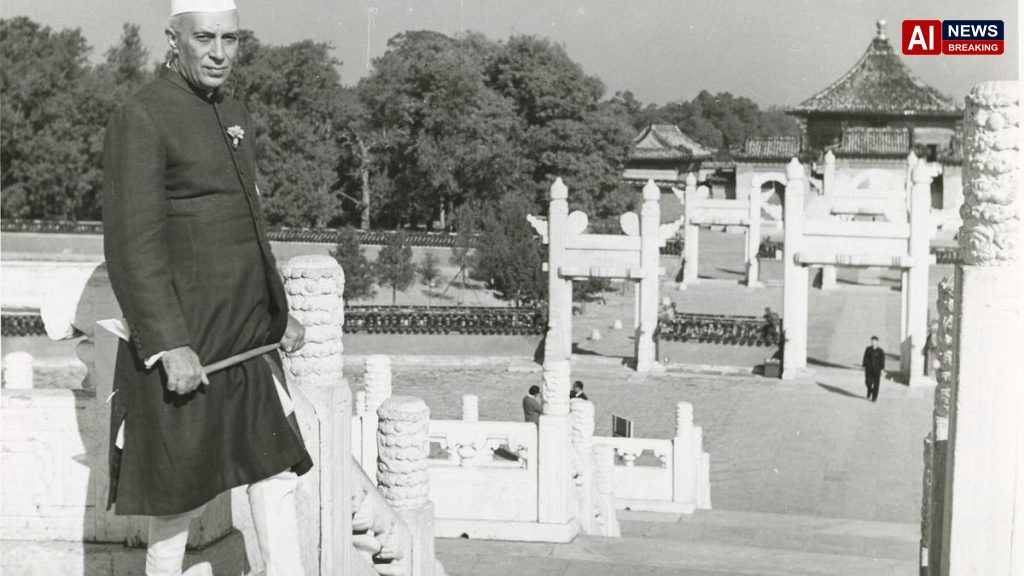
Jawaharlal Nehru through an intelligence prism - AI News Breaking
jawaharlal nehru through intelligence:
Jawaharlal Nehru’s foreign‑policy legacy has long been judged through the prism of his relationship with the People’s Republic of China, a relationship that many commentators portray as naïve and overly idealistic. The image of a visionary leader, enthralled by Mao’s revolutionary rhetoric and convinced that the two newly independent Asian giants would forge a lasting partnership, has become a staple of post‑colonial historiography. Yet recent scholarly work drawing on the memoirs of Bhola Nath Mullik, the head of India’s Intelligence Bureau from 1949 to 1964, offers a markedly different portrait..
Far from being a sentimentalist, Nehru appears in Mullik’s recollections as a cautious statesman, constantly fed with detailed, sometimes stark, assessments of Chinese intentions and capabilities.Mullik, a career officer who rose through the ranks of the colonial police before assuming the top intelligence post in independent India, kept a meticulous diary of his interactions with the prime minister and his inner circle. In the early 1950s, when the Chinese Communist Party proclaimed the establishment of the PRC, Mullik’s reports warned of a regime that combined ideological zeal with a pragmatic drive for territorial consolidation. He relayed to Nehru the Chinese military’s rapid modernization, the Soviet‑supplied artillery and aircraft being deployed along the Himalayan frontier, and the strategic importance Beijing placed on controlling the Tibetan plateau..
Rather than dismissing these warnings, Nehru is recorded as probing the implications, asking Mullik to clarify the extent of the threat and to suggest possible diplomatic levers.One of the most revealing episodes comes from the summer of 1954, when the Indian delegation traveled to Beijing for the first official state visit. Mullik’s memoirs note that Nehru, while publicly embracing the “Hindi-Chini bhai‑bhai” slogan, privately expressed concern over the lack of transparency in the Chinese side’s border demarcation proposals. The intelligence chief recalled Nehru asking, “If we sign a pact today, what safeguards will we have against future revisions of the line?” Mullik’s answer, based on his own field reports, was that the Chinese leadership had already begun mapping the disputed Aksai Chin region for a future road network..
This exchange, documented in the diary, contradicts the popular narrative that Nehru entered the negotiations without any real knowledge of Chinese ambitions.The subsequent years saw a series of diplomatic overtures that, according to Mullik, were underpinned by a steady stream of intelligence briefings. In 1956, when India and China signed the Panchsheel Agreement, Mullik’s notes record that the intelligence bureau had flagged the construction of a road linking Xinjiang to the border areas of Ladakh as a potential strategic lever. Nehru, aware of this, allegedly instructed his foreign ministry to press for a joint survey of the frontier, a move designed to embed Indian observers in any Chinese engineering projects..
Although the joint survey never materialised, the fact that Nehru entertained such a proposal indicates a level of scepticism that runs counter to the simplistic image of a leader blinded by idealism.The most critical test of Nehru’s prudence came after the 1959 Tibetan uprising, when the Dalai Lama fled to India and a massive influx of refugees entered the border states. Mullik’s files, as referenced in his memoir, reveal that the intelligence community warned Nehru that Beijing might view the asylum as a direct affront to its sovereignty and could exploit the situation to press territorial claims. Nehru’s response, as Mullik recorded, was to convene an inter‑ministerial committee that included the defense, external affairs, and intelligence ministries to devise a coordinated response..
The prime minister’s insistence on a “balanced approach” – offering humanitarian assistance while avoiding any overt political endorsement of the Tibetan government‑in‑exile – reflects a nuanced calculus rather than a blind adherence to ideological solidarity.By the early 1960s, the border dispute had hardened into a tangible flashpoint. Mullik’s diary entries from 1961 describe a series of clandestine patrols and aerial reconnaissance missions that uncovered Chinese fortifications along the Aksai Chin corridor. He wrote that Nehru, upon receiving the intelligence, ordered a “controlled escalation” of Indian patrols to assert presence without provoking open conflict..
This policy, later termed “forward policy” by Indian officials, was later criticised for its role in the 1962 war, but Mullik’s account suggests that Nehru was responding to concrete, on‑the‑ground intelligence rather than acting on unfounded optimism.The 1962 conflict itself provides the starkest contrast between the myth of Nehru’s naiveté and the reality documented by his chief intelligence officer. Mullik’s memoir recounts that, weeks before the Chinese offensive, the intelligence bureau had raised alarms about the logistical challenges Beijing would face in sustaining a high‑altitude campaign. Yet, the prime minister, after consulting with his military advisors, chose to maintain the forward deployment, believing that a strong Indian presence would deter Chinese advances..
Mullik’s later reflections admit that this decision was “a gamble rooted in political conviction rather than intelligence certainty.” The defeat that followed, while a severe blow to Indian prestige, does not erase the fact that Nehru had been consistently fed a stream of sober, sometimes alarming, assessments about China’s capabilities.In the aftermath of the war, Mullik’s writings highlight a shift in Nehru’s attitude. The prime minister, once a champion of Asian solidarity, became markedly more circumspect. He ordered a comprehensive review of intelligence gathering mechanisms, expanded the bureau’s remit in the Himalayan region, and sought deeper coordination with the armed forces..
This pivot, according to Mullik, was not the result of a sudden epiphany but the culmination of years of intelligence briefings that had gradually eroded the early optimism that characterized Nehru’s initial outreach to Beijing.The legacy of Nehru’s China policy, therefore, cannot be reduced to a single narrative of gullibility. While the idealism that coloured his public speeches is undeniable, the confidential exchanges recorded by Bhola Nath Mullik demonstrate that the prime minister was regularly confronted with hard‑won intelligence about Chinese strategic intentions. He absorbed these reports, weighed them against his broader vision of a non‑aligned, peaceful Asian order, and made policy choices that reflected a blend of principle and pragmatism..
Whether those choices ultimately succeeded is a matter of historical debate, but the evidence.
Updated: November 16, 2026
Mullik’s diaries strip away Nehru’s mythic naiveté, revealing a leader who constantly wrestled stark intelligence with his idealist vision—showing that India’s 1962 misstep was as much a political gamble as a failure of foresight.
This suggests that post‑colon






