Pakistan’s leaders hail first astronaut aboard Chinese craft: ‘Proud one of us has gone into space’
 British tourist travels 29 hours from Mumbai to Amritsar for ₹5,461, rates Indian Railways 10/10 | Viral video
 The Supreme Court will decide whether assault weapons bans violate the Second Amendment
 A Critic of Beijing Falls Short in Taiwan’s Key Mayoral Election
 EPA says no rise in contamination after Army detonates lead azide stockpile in Iowa
Searching for the Last Stoats of Waiheke Island
**
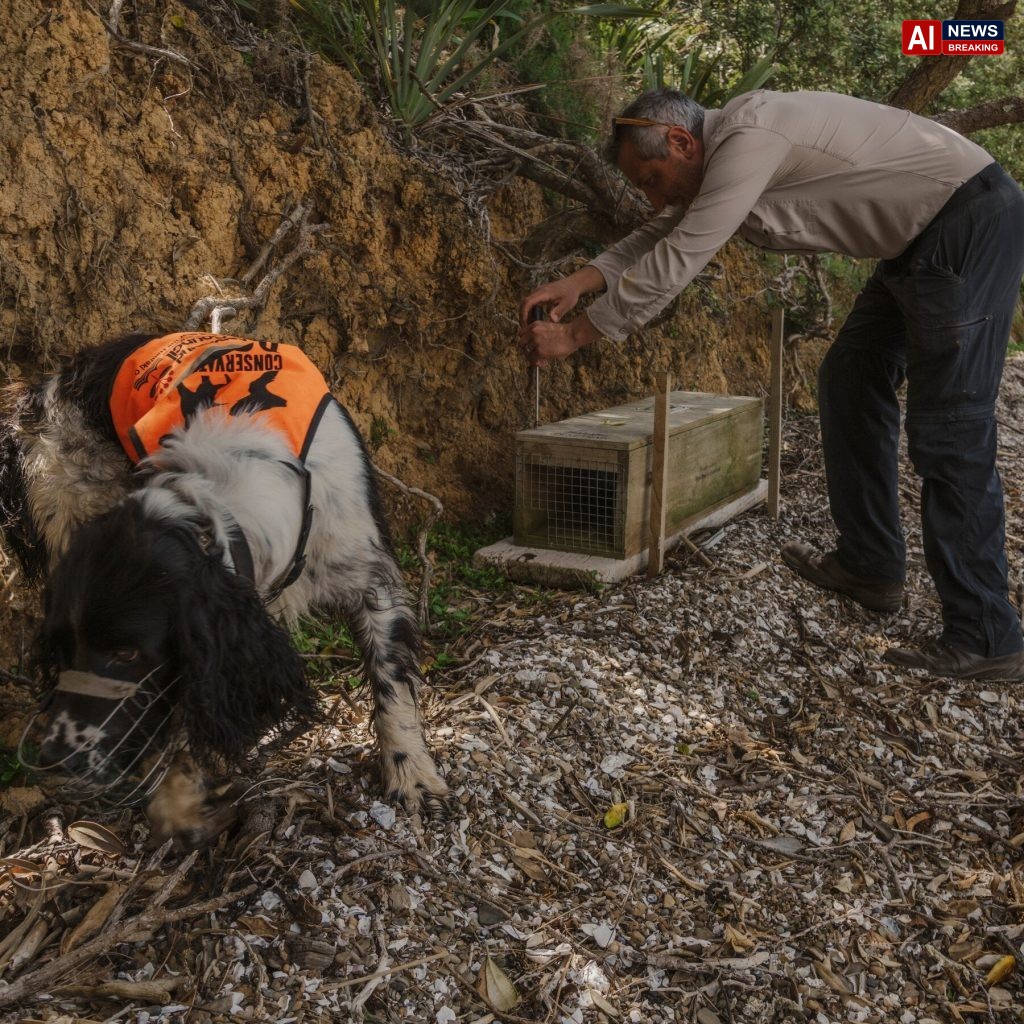
Searching for the Last Stoats of Waiheke Island - AI News Breaking
searching last stoats waiheke:
The small, leafy island of Waiheke, just a short ferry ride from Auckland’s bustling waterfront, has long been celebrated for its vineyards, beaches and art galleries, but beneath the charm lies a quieter ecological battle. Over the past decade, scientists and conservation volunteers have been monitoring a single invasive predator – the stoat – whose arrival in the 1990s triggered a cascade of declines among native birds, reptiles and invertebrates across New Zealand. On the mainland, large-scale pest‑control programmes have shown mixed results, but Waiheke’s relatively compact size and high human population present a unique opportunity to test whether an urban island can become entirely free of this mammalian threat.The first stoats were detected on Waicombe in 1995, most likely having travelled on a cargo vessel or in a shipment of horticultural goods..
As solitary hunters, they are adept at slipping through dense undergrowth and can survive on a diet of rodents, ground‑nesting birds and even lizards. Their impact was swift: the island’s native bellbird and the endangered North Island robin saw breeding success plummet, while the iconic wētā, a large nocturnal orthopteran, disappeared from several surveyed sites. By 2003, wildlife officials classified Waiheke as a “high‑risk” area, prompting the Department of Conservation (DOC) to initiate targeted trapping campaigns in collaboration with local landowners.In 2015, the DOC launched a pilot project that combined traditional kill‑traps with a novel “self‑resetting” trap design intended to reduce by‑catch of non‑target species..
Over two years, volunteers set more than 1,200 traps across 30 hectares of public parkland, private reserves and agricultural land. The data collected showed a 38 per cent reduction in stoat sightings, but the effort also highlighted the logistical challenges of maintaining a continuous trap network on an island where residential gardens, vineyards and tourism venues intermingle. Residents expressed concerns about trap placement near pathways and the potential for accidental capture of pets, leading to a series of community meetings that reshaped the project’s outreach strategy.A turning point arrived in 2019 when the University of Auckland’s School of Biological Sciences secured funding for a comprehensive “Island Eradication Feasibility Study”..
Researchers employed motion‑sensing cameras, hair‑snare DNA analysis and scent‑lure bait stations to map stoat activity with unprecedented precision. The resulting heat map revealed three primary corridors: a narrow strip along the eastern coastal ridge, a central agricultural belt, and a cluster near the main ferry terminal. By pinpointing these hotspots, the team could allocate resources more efficiently, focusing intensive trapping on the most active zones while scaling back in areas where stoat presence was sporadic.Parallel to the scientific work, a grassroots initiative called “Friends of Waiheke Wildlife” emerged, bringing together vineyard owners, iwi representatives and local schools..
The group organised workshops on stoat identification, safe trap handling and the importance of native biodiversity, aiming to embed pest control within the island’s cultural fabric. Their efforts helped to overcome earlier resistance, with several large vineyards agreeing to host permanent trap lines along their perimeter fences. In return, the vineyards benefited from reduced rodent damage, creating a mutually reinforcing incentive structure that many conservationists see as essential for any long‑term eradication programme.In early 2022, the DOC announced the launch of “Project Island Clean”, a coordinated, island‑wide eradication campaign scheduled to run over twelve months..
The plan integrates three core components: a dense grid of self‑resetting traps, the strategic use of a biodegradable poison known as Brodifacoum applied in bait stations, and a public‑awareness drive featuring signage, social media updates and school curriculum modules. While the use of poison remains contentious, regulators have stipulated strict dosage limits and mandatory monitoring of non‑target species, drawing on lessons learned from mainland operations where secondary poisoning has caused setbacks.Initial results from the first quarter of the operation are encouraging. Traps have recorded an average of 0.7 stoat captures per night, a figure that represents a significant decline from the 2.3 per night recorded during the pilot phase a decade earlier..
Moreover, camera traps placed in previously stoat‑free sanctuary zones have begun to capture footage of the North Island robin returning to nest sites, and researchers have documented the first breeding pair of the critically endangered tiny ground‑frog, Leiopelma archeyi, emerging from a wetland restoration area. These biological indicators suggest that predator pressure is easing, allowing native species to re‑establish.Nevertheless, challenges remain. The island’s proximity to the mainland means that stoat reinvasion is a constant risk, especially via ferry cargo or inadvertent transport on vehicles..
To mitigate this, DOC officials are exploring a “buffer zone” strategy, whereby regular monitoring stations are installed at the ferry terminal and major road entries to detect any new incursions promptly. Additionally, climate variability has introduced uncertainty; milder winters could boost stoat breeding cycles, potentially offsetting gains made by trapping.The broader significance of Waiheke’s attempt extends beyond its borders. If the island can achieve and maintain a stoat‑free status, it would become the first urban environment in New Zealand to do so, offering a template for other populated islands and coastal communities facing similar invasive‑species dilemmas..
Internationally, the project aligns with the United Nations’ Global Biodiversity Framework, which calls for the elimination of invasive mammals on islands as a priority for preserving endemic wildlife. Success on Waiheke could therefore contribute to New Zealand’s commitment to protect 90 per cent of its threatened species by 2030.As the final months of the eradication campaign unfold, the community watches with cautious optimism. The combination of scientific rigor, adaptive management and local stewardship appears to be narrowing the gap between ambition and reality..
Whether Waiheke will ultimately write a new chapter as the nation’s first urban island without stoats remains to be seen, but the concerted effort already illustrates how targeted, collaborative action can reshape the relationship between human development and the natural world, offering a hopeful narrative for conservation in an increasingly urbanized age..
Updated: November 16, 2026
The success on Waiheke shows that even a densely populated island can reverse invasive dominance when science, community buy‑in and adaptive tactics meet—proof that urban biodiversity can thrive if people see conservation as a shared benefit, not a bureaucratic burden. The project’s gains hint that a stoat‑free future is not just