
 Pakistan’s leaders hail first astronaut aboard Chinese craft: ‘Proud one of us has gone into space’
 British tourist travels 29 hours from Mumbai to Amritsar for ₹5,461, rates Indian Railways 10/10 | Viral video
 The Supreme Court will decide whether assault weapons bans violate the Second Amendment
 A Critic of Beijing Falls Short in Taiwan’s Key Mayoral Election
 EPA says no rise in contamination after Army detonates lead azide stockpile in Iowa
India, Egypt discuss steps to boost trade, address non-tariff barriers
**
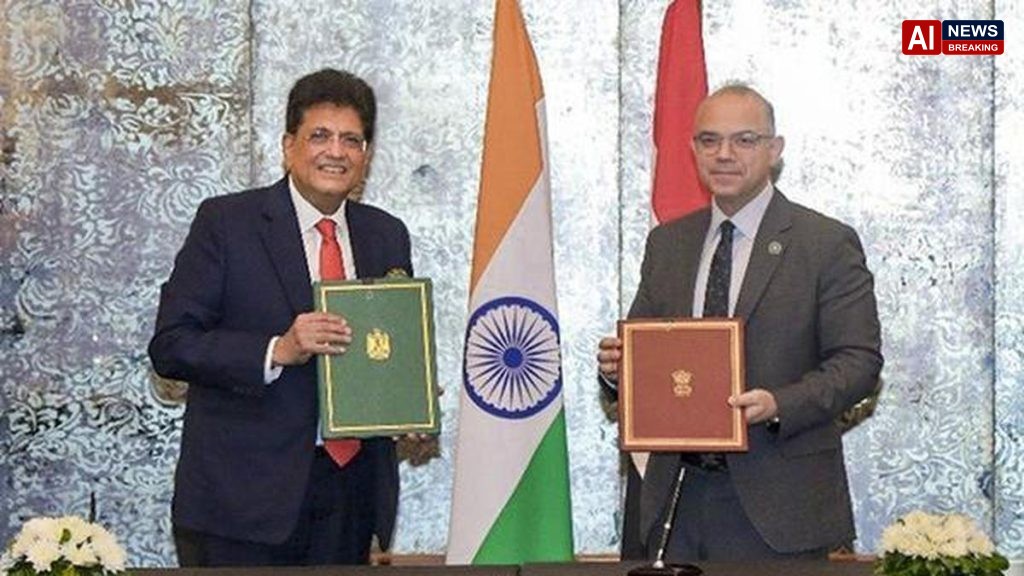
India, Egypt discuss steps to boost trade, address non-tariff barriers - AI News Breaking
india egypt discuss steps:
India and Egypt have agreed to deepen their economic partnership by establishing a Joint Working Group that will draft the terms of reference for a prospective preferential trade arrangement (PTA) or free‑trade agreement (FTA). The move follows a series of high‑level talks in New Delhi, where both sides highlighted the need to overcome long‑standing non‑tariff barriers and to create a more predictable framework for trade and investment. Officials from the ministries of commerce, industry and foreign affairs convened in a bilateral meeting on Tuesday, signalling a renewed commitment to translate diplomatic goodwill into concrete commercial gains.The Joint Working Group, to be co‑chaired by senior officials from the Ministry of Commerce and Industry in New Delhi and the Ministry of Trade and Industry in Cairo, will be tasked with mapping out the scope of the agreement, identifying priority sectors and outlining mechanisms for dispute resolution..
Sources close to the negotiations said the agenda will include agriculture, textiles, pharmaceuticals, information technology services and renewable‑energy equipment – sectors where both economies have complementary strengths. India, the world’s third‑largest exporter of pharmaceuticals and a leading supplier of IT services, seeks greater access to Egypt’s growing market, while Cairo aims to tap India’s expanding consumer base and benefit from its competitive manufacturing capabilities.One of the central challenges the two nations hope to address is the prevalence of non‑tariff barriers that have hampered trade flows for years. Egyptian importers have frequently cited lengthy customs procedures, opaque certification requirements and inconsistent standards as obstacles to sourcing Indian goods..
Conversely, Indian exporters have reported difficulties obtaining reliable market intelligence and navigating Egypt’s complex regulatory landscape, particularly in the agricultural sector where phytosanitary standards often differ from those applied in India. By instituting a joint framework that standardises procedures and enhances transparency, both governments hope to reduce transaction costs and improve the speed of cross‑border trade.Trade data underscores the potential upside of a closer partnership. In the 2022‑23 fiscal year, bilateral trade between the two countries stood at roughly $4.3 billion, with India exporting $3.2 billion worth of goods, primarily pharmaceuticals, textiles and engineering products, while Egypt’s imports from India accounted for about 75 percent of its total Indian trade..
Egyptian exports to India, dominated by cotton, fruit, and mineral products, amounted to just over $1 billion. Analysts note that the current trade imbalance, while reflective of existing market dynamics, could be narrowed through targeted concessions and the removal of procedural hurdles, especially if the PTA or FTA includes provisions for capacity‑building and technical assistance.Investment linkages also feature prominently on the agenda. Indian firms have shown growing interest in Egypt’s renewable‑energy sector, attracted by the country’s ambitious solar and wind targets under its “Egypt Vision 2030” development plan..
In turn, Egyptian construction conglomerates are eyeing India’s infrastructure pipeline, which promises opportunities in roads, ports and urban development projects. The Joint Working Group is expected to explore mechanisms for joint ventures, technology transfer and the creation of a bilateral investment protection framework that would give investors greater confidence in the legal and regulatory environment of both nations.The timing of the agreement coincides with broader geopolitical shifts that have prompted both countries to diversify their trade partners. India’s “Act East” policy and its push for greater engagement with African economies have placed Egypt, a key gateway to the continent, at the forefront of its strategic outreach..
For Cairo, strengthening ties with Asian economies is a pillar of President Abdel Fattah al‑Sisi’s economic reform agenda, which seeks to reduce dependence on traditional European markets and to attract foreign direct investment to fuel job creation. Both governments see the bilateral PTA or FTA as a stepping‑stone toward deeper integration with regional supply chains and as a hedge against global trade uncertainties.In addition to formal trade liberalisation, the two sides have pledged to cooperate on standards harmonisation and mutual recognition of conformity assessments. This could involve joint laboratory testing, the sharing of best practices on food safety and the alignment of product certification processes..
Such technical cooperation is expected to reduce duplication of effort for exporters and to streamline market entry, especially for small and medium‑sized enterprises that often lack the resources to navigate complex regulatory regimes.Civil society groups and business chambers have welcomed the initiative, noting that a well‑structured agreement could unlock new opportunities for exporters and manufacturers on both sides. The Confederation of Indian Industry (CII) and the Federation of Egyptian Industries (FEI) have already begun consultations with their respective governments, urging that the final text include clear rules of origin, safeguard clauses and provisions for capacity‑building in customs administration. Meanwhile, consumer advocacy organisations have called for the agreement to incorporate environmental and labour standards, ensuring that trade growth does not come at the expense of sustainability or workers’ rights.While optimism is high, experts caution that negotiations will need to navigate domestic political sensitivities, particularly around tariff reductions in sectors that are politically sensitive or heavily protected..
In India, agricultural producers have historically been wary of opening markets to foreign competition, and in Egypt, concerns persist about the impact of increased imports on local manufacturers. The Joint Working Group is expected to adopt a phased approach, starting with liberalisation in less contentious sectors before moving to more sensitive areas. Such a calibrated strategy aims to build trust and demonstrate tangible benefits early in the process, thereby sustaining momentum for the broader agreement.The next milestone is slated for the second half of 2025, when the Joint Working Group will present a draft framework to senior officials in both capitals..
If the proposal garners political support, formal negotiations on the PTA or FTA could commence in early 2026, with the possibility of signing a final agreement by the end of the decade. Should the two nations succeed in forging a comprehensive, rules‑based trade pact, it could serve as a model for South‑South cooperation, highlighting how emerging economies can collaboratively address trade barriers, foster investment and build resilient supply chains in an increasingly multipolar global economy..
Updated: November 16, 2026
India and Egypt have set up a joint working group to shape a preferential trade pact aimed at slashing non‑tariff barriers and expanding cooperation in sectors such as pharmaceuticals, textiles, IT services and renewable energy. The initiative, timed with both countries’ strategic shift toward diversified partners, seeks to boost bilateral trade, attract investment and lay the groundwork for a broader South‑South trade model.
If India and Egypt crack their non‑tariff barriers, the pact could become the blueprint for a new wave of South‑South trade deals that reshapes supply chains away from traditional Western hubs.
Beyond numbers, the agreement signals a strategic pivot: both capitals are betting on standards‑harmonisation and joint






