
 Pakistan’s leaders hail first astronaut aboard Chinese craft: ‘Proud one of us has gone into space’
 British tourist travels 29 hours from Mumbai to Amritsar for ₹5,461, rates Indian Railways 10/10 | Viral video
 The Supreme Court will decide whether assault weapons bans violate the Second Amendment
 A Critic of Beijing Falls Short in Taiwan’s Key Mayoral Election
 EPA says no rise in contamination after Army detonates lead azide stockpile in Iowa
DVAC report alleges Duraimurugan colluded in illegal sand mining.
**
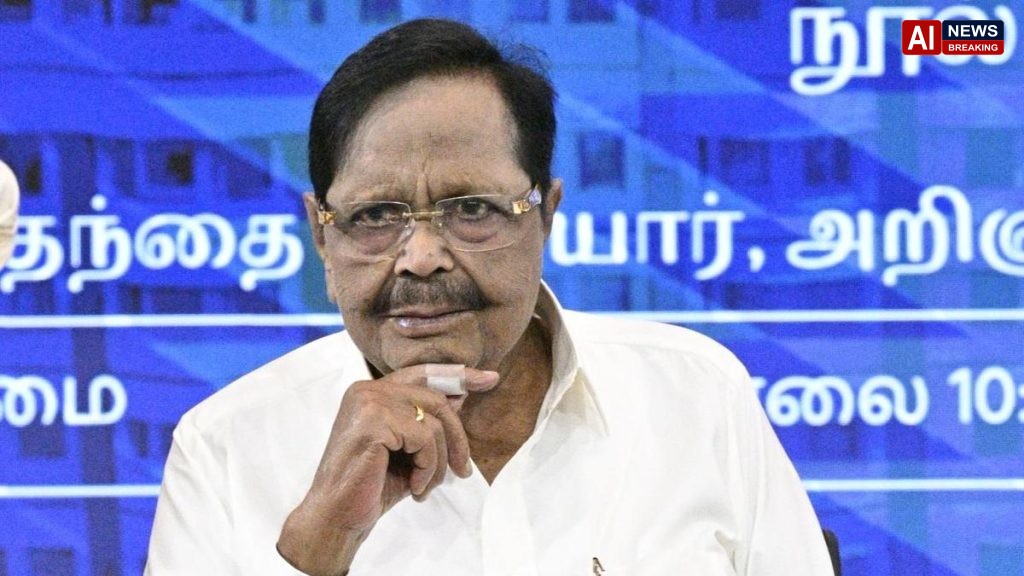
DVAC report alleges Duraimurugan colluded in illegal sand mining. - AI News Breaking
Illegal sand mining in Tamil Nadu: Duraimurugan and other accused were aware of environmental impact, says DVAC A special investigation team appointed by the Madras High Court has submitted a detailed report to the state’s Directorate of Vigilance and Anti‑Corruption (DVAC), alleging that former Water Resources minister Duraimurugan, senior officials of the department and a consortium of private contractors conspired to facilitate illegal sand extraction across several river basins in Tamil Nadu. The report, which was tabled last week, claims the accused acted with full knowledge of the ecological damage their activities would cause, and deliberately concealed the scale of extraction from both the government and the public. The findings have revived calls for a comprehensive review of the state’s sand mining licensing framework, which critics say has been riddled with opacity and patronage for years..
According to the FIR lodged against the accused, the scheme began in early 2018 when the Water Resources Department, under Duraimurugan’s leadership, allegedly issued a series of provisional permits to a network of contractors without the requisite environmental clearances. The report states that the permits were “back‑dated” to create an illusion of compliance with the Tamil Nadu Sand Mining (Regulation) Act, 2015. It further alleges that internal memos exchanged between senior officials instructed field officers to overlook illegal extraction sites and to report inflated sand yields to justify the continued issuance of permits..
These actions, the report asserts, amounted to a systematic fraud that siphoned off public revenue while endangering river ecosystems. The environmental impact, as outlined in the DVAC dossier, is severe. Independent hydrologists cited in the document warn that the unchecked removal of sand from the Cauvery, Vaigai and Ponnaiyar basins has lowered riverbeds, increased bank erosion and heightened the risk of flash floods during monsoon seasons..
Local agricultural communities, already grappling with water scarcity, have reported a decline in groundwater recharge rates, attributing the trend to the loss of natural sand filters. The report also links the illegal mining to the disappearance of several native fish species, noting that the altered river morphology disrupts spawning grounds and reduces biodiversity. Contractors implicated in the case, identified as members of a loosely organized consortium, allegedly paid substantial “facilitation fees” to officials to expedite the approval process..
The FIR alleges that these payments, disguised as consultancy charges, were routed through shell companies to obscure their origin. Financial investigators claim that over ₹2 billion (approximately US$24 million) was transferred to accounts controlled by senior department officers between 2018 and 2021. The money, the report says, was used to fund political campaigns, secure personal assets and, in some instances, to bribe local police officers tasked with monitoring illegal extraction sites..
The DVAC’s findings also highlight a pattern of selective enforcement that favoured certain contractors while penalising others who attempted to operate within legal parameters. Internal audit trails reveal that inspection teams were routinely redirected away from high‑volume extraction points, and that site logs were manipulated to show compliance with stipulated extraction limits. Whistleblowers within the department, who have requested anonymity, claim that they faced intimidation and threats of termination when they raised concerns about the irregularities..
Several of these insiders have now approached the courts seeking protection under the Whistleblower Protection Act. Legal experts say the case underscores a broader governance failure in Tamil Nadu’s natural resource management. “What we are seeing is not an isolated incident of rogue officials but a systemic breakdown where political patronage, bureaucratic inertia and profit motives intersected,” says Prof..
R. S. Mohan of the Indian Institute of Public Administration. He adds that the existing regulatory framework, while robust on paper, suffers from inadequate enforcement mechanisms and a lack of independent oversight bodies capable of conducting real‑time audits of sand mining activities. The state government, represented by the Chief Minister’s office, has responded cautiously, stating that it respects the findings of the DVAC but will await the outcome of any judicial proceedings before taking further action..
In a press briefing, the Water Resources Department’s current ary emphasized that the department is “committed to restoring the ecological balance of our rivers” and announced a temporary suspension of all new sand mining licences pending a comprehensive review. The announcement, however, has been met with skepticism by environmental NGOs, who argue that past suspensions have been short‑lived and lacked substantive enforcement. Opposition parties have seized upon the report to demand a full parliamentary inquiry..
In the Tamil Nadu Legislative Assembly, the main opposition coalition tabled a motion calling for the resignation of any officials found complicit and for the establishment of an independent commission to investigate the alleged nexus between political figures and sand mining contractors. The motion, which is scheduled for debate next week, also urges the central government to intervene, citing concerns that the environmental degradation could have inter‑state ramifications, especially for downstream Karnataka, which relies heavily on the Cauvery’s flow. Civil society groups have organized protests in major towns along the affected river basins, demanding accountability and immediate action to halt illegal extraction..
In Madurai, a rally attended by over 5,000 residents featured speeches from local farmers, whose fields have reportedly suffered from reduced soil moisture. Participants displayed banners reading “Stop the sand scam” and “Restore our rivers”, underscoring the growing public anger. Similar demonstrations have taken place in Coimbatore and Tiruchirappalli, where activists have called for transparent allocation of sand mining rights through competitive bidding and for the introduction of satellite‑based monitoring to deter future violations..
The report exposes a collusive “sand‑scam” that has turned rivers into profit pits, draining ecosystems and local livelihoods. If unchecked, this will erode public trust in governance, turning Tamil Nadu’s natural resources into a bargaining chip for those with political clout rather than






