
 Pakistan’s leaders hail first astronaut aboard Chinese craft: ‘Proud one of us has gone into space’
 British tourist travels 29 hours from Mumbai to Amritsar for ₹5,461, rates Indian Railways 10/10 | Viral video
 The Supreme Court will decide whether assault weapons bans violate the Second Amendment
 A Critic of Beijing Falls Short in Taiwan’s Key Mayoral Election
 EPA says no rise in contamination after Army detonates lead azide stockpile in Iowa
PM Modi leads foundation stone-laying ceremony for Philippines’ oldest gurudwara’s redevelopment
**
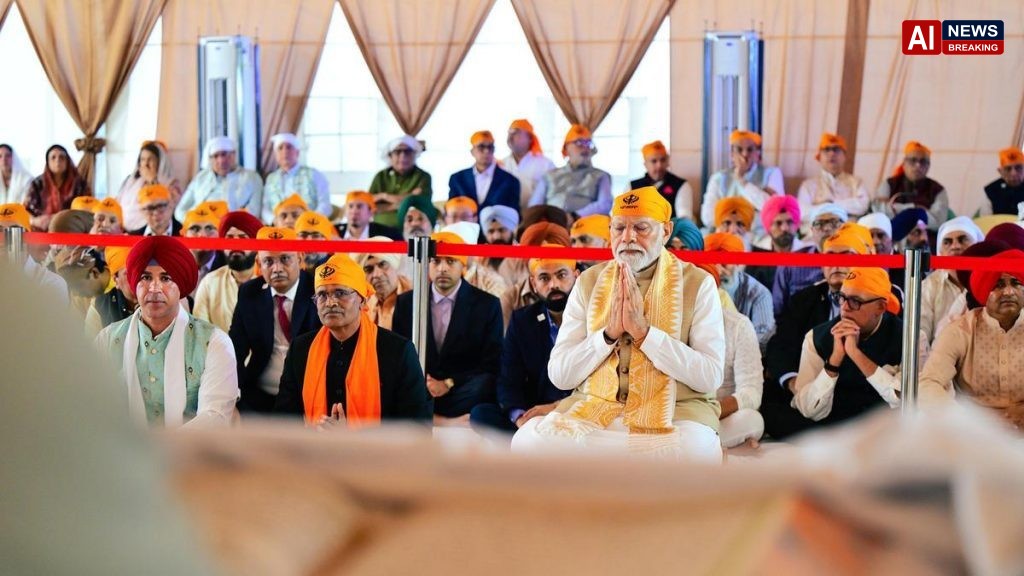
PM Modi leads foundation stone-laying ceremony for Philippines’ oldest gurudwara’s redevelopment - AI News Breaking
modi leads foundation stonelaying:
Prime Minister Narendra Modi’s three‑day state visit to the Philippines concluded with a solemn foundation‑stone‑laying ceremony for the redevelopment of the Gurudwara Khalsa Diwan in Manila, the oldest Sikh place of worship in the country. The event, held on a bright Monday morning at the historic site on Taft Avenue, was attended by senior Philippine officials, members of the Sikh diaspora, and representatives of the Indian embassy, underscoring the deepening cultural and diplomatic ties between New Delhi and Manila. In his remarks, Modi said he felt “very blessed” to be present at the century‑old sanctuary, describing the occasion as a testament to the enduring friendship that spans geography, faith, and history.The Gurudwara, originally established in 1915 by early Sikh migrants who arrived in the archipelago during the British colonial era, has long served as a spiritual and communal hub for the Sikh minority, which today numbers around 30,000 in the Philippines..
Over the decades, the modest wooden structure endured the ravages of time, tropical weather, and the occasional fire, yet it remained a focal point for religious observances, charitable activities, and inter‑faith dialogue. The current redevelopment plan, funded jointly by the Indian government and private donors from the Sikh diaspora, aims to replace the aging edifice with a modern complex that respects the original architectural motifs while providing upgraded facilities for worship, community gatherings, and educational programmes.Modi’s presence at the ceremony was part of a broader itinerary that included meetings with President Ferdinand Marcos Jr, discussions on trade and defence cooperation, and visits to key economic zones. The Prime Minister highlighted the shared values of pluralism and tolerance that both nations uphold, noting that the Gurudwara’s renovation is symbolic of the inclusive spirit that both India and the Philippines champion..
“Our peoples have always been linked by the threads of mutual respect and cultural exchange,” he said, “and today we reaffirm that commitment through this sacred space.”The Philippine side, represented by ary of Foreign Affairs Enrique Manalo and Manila’s Mayor‑Councilor for Cultural Affairs, expressed gratitude for India’s support in preserving a heritage site that belongs not only to the Sikh community but to the broader tapestry of Philippine history. Manalo remarked that the Gurudwara stands as a living reminder of the contributions made by early Indian migrants to the nation’s social fabric, particularly in fields such as trade, medicine, and the arts. He emphasized that the redevelopment project aligns with Manila’s broader agenda of safeguarding minority heritage sites and fostering inter‑religious harmony.During the ceremony, a ceremonial shovel was presented to Modi by the chief priest of the Gurudwara, Bhai Harbans Singh, who recited a traditional Ardas (prayer) invoking blessings for the project’s success..
The Prime Minister, in turn, placed the first stone and delivered a brief address in which he invoked the teachings of Guru Nanak, emphasizing the Sikh principle of “Sarbat da Bhala” – the welfare of all. He underscored that the new complex would not only serve as a place of worship but also as a centre for social service, echoing the Sikh tradition of “seva” (selfless service) through a planned community kitchen and health‑clinic outreach programmes.The redevelopment blueprint, unveiled by a joint India‑Philippines task force, outlines a multi‑phase construction schedule expected to be completed within three years. Phase one will focus on structural reinforcement and the erection of a new prayer hall capable of accommodating up to 500 congregants, while preserving the original façade that features a distinctive blend of colonial and Sikh architectural elements..
Subsequent phases will incorporate a library stocked with Sikh scriptures, a museum chronicling the migration narratives of early Sikh settlers, and spaces for language and cultural classes aimed at fostering greater understanding among Filipino youths.Funding for the project totals approximately 150 million rupees (about 2.3 million US dollars), with a significant portion contributed by the Indian Ministry of External Affairs under its “Cultural Heritage Initiative,” a program designed to support the preservation of Indian diaspora landmarks worldwide. Private contributions have also poured in from Sikh business leaders based in Singapore, the United Kingdom, and the United States, reflecting the global nature of the community’s support network. In addition to financial resources, technical expertise will be supplied by Indian architects and conservation specialists familiar with heritage restoration, ensuring that the new complex meets both safety standards and aesthetic authenticity.The ceremony also featured a cultural performance by a Filipino‑Sikh youth troupe, which presented a fusion of bhangra dance and traditional Filipino folk music, symbolising the harmonious blending of the two cultures..
Audience members, including local journalists and diplomats, noted the palpable sense of pride and optimism that pervaded the gathering. “It is heartening to see such a historic site receive the attention it deserves,” said Maria Luz Ramos, a cultural historian at the University of the Philippines. “The Gurudwara’s revival will not only strengthen the Sikh community’s identity but also enrich Manila’s multicultural landscape.”Analysts view the event as part of a strategic soft‑power outreach by India, complementing its hard‑line diplomatic and security engagements in Southeast Asia..
By investing in cultural landmarks, New Delhi seeks to deepen people‑to‑people connections, a tactic that can yield long‑term benefits in trade negotiations and regional cooperation frameworks such as the Indo‑Pacific Economic Corridor. The Philippines, for its part, stands to gain from enhanced tourism prospects, as the renovated Gurudwara is expected to attract visitors interested in religious tourism and heritage trails, thereby contributing to local economic development.As the foundation stone was laid and the crowd dispersed, the atmosphere was one of hopeful anticipation. The Gurudwara Khalsa Diwan, set to rise anew from its historic roots, will soon become a beacon of faith, service, and cultural exchange, embodying the collaborative spirit that defined the Prime Minister’s visit..
Modi’s concluding remark, that “the light of our shared values will continue to shine across oceans and generations,” resonated with attendees, encapsulating the broader narrative of friendship and mutual respect that underpins India‑Philippines relations today..
India’s prime minister wrapped up his Philippines visit by laying the foundation stone for a joint‑funded overhaul of Manila’s century‑old Gurudwara Khalsa Diwan, a project aimed at modernising the Sikh shrine while preserving its historic façade. The ceremony highlighted expanding cultural ties and soft‑power diplomacy between New Delhi and Manila, with the rebuilt complex slated to serve as a worship space, community hub and heritage attraction.
India’s heritage‑funded Gurudwara makeover signals a calibrated soft‑power push, turning diaspora sites into diplomatic bridges that could tilt future trade and security pacts in its favor across the Indo‑Pacific.
For Manila, the project offers a dual payoff: bolstering minority rights while cultivating a niche tourism niche that intertwines cultural preservation with economic upside.






