
 Pakistan’s leaders hail first astronaut aboard Chinese craft: ‘Proud one of us has gone into space’
 British tourist travels 29 hours from Mumbai to Amritsar for ₹5,461, rates Indian Railways 10/10 | Viral video
 The Supreme Court will decide whether assault weapons bans violate the Second Amendment
 A Critic of Beijing Falls Short in Taiwan’s Key Mayoral Election
 EPA says no rise in contamination after Army detonates lead azide stockpile in Iowa
SIR: No application records for over 1.13 lakh new enrolments in Bengaluru’s final voter rolls
**
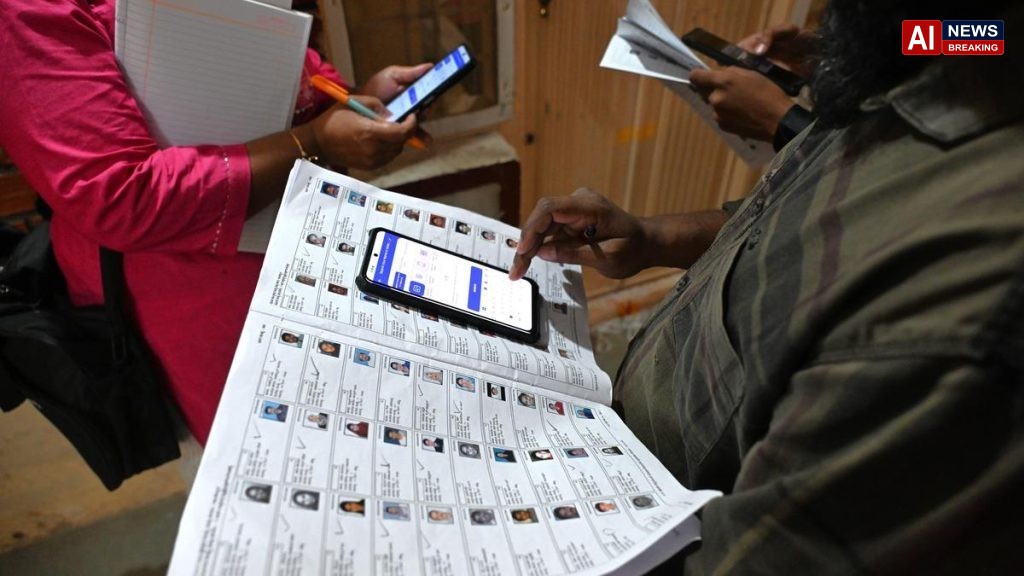
SIR: No application records for over 1.13 lakh new enrolments in Bengaluru’s final voter rolls - AI News Breaking
application records lakh enrolments:
A recent audit of the voter registration rolls for Bengaluru’s 28 assembly constituencies has revealed a significant gap between the number of people added to the final list and the official enrollment documents that support those entries. The study, carried out by the Election Commission’s compliance unit, found that more than four‑tenths of the newly added names on the city’s electoral register cannot be traced back to a Form 6 or a Form 8 – the two standard documents used to record a voter’s enrollment.The final voter rolls, which are published ahead of the next assembly elections, are expected to reflect the most up‑to‑date population of eligible voters. In Bengaluru, the most recent update saw 113,000 new names added..
However, when the compliance team attempted to verify each of those entries against the enrollment forms on file, they were only able to confirm the authenticity of 56 % of them. The remaining 44 % – roughly 49,000 names – had no matching record in the database.The two forms that are typically required for voter registration are Form 6, which is used for individuals who are first added to the electoral roll, and Form 8, which is used for changes to the details of existing voters, such as a change of address. Both forms carry the voter’s signature, photograph, and demographic details, and are then scanned and entered into the electoral database..
When a new name appears on the final roll without a corresponding form, it indicates that the voter’s information entered into the system may not have been properly authenticated.The audit report cites several reasons for the missing documentation. One factor is the high volume of applications that come in during the registration period, which can overwhelm the staff at local electoral offices. Another is the use of digital registration tools that allow voters to submit their details online..
While the online platform is intended to streamline the process, it may sometimes skip the requirement for a physical signature or photograph, especially when the system is still being rolled out in certain areas. The report also notes that in some rural constituencies, a lack of trained staff and limited access to biometric verification equipment can lead to incomplete records.In response to the findings, the Election Commission has ordered an immediate review of the registration procedures across the city. The commission will send additional training to staff at the 28 constituency offices, with a focus on ensuring that every enrollment is backed by a valid Form 6 or Form 8..
It will also deploy mobile verification units equipped with biometric scanners to cross‑check the details of voters who were registered through the online portal.The implications of the audit are significant for the democratic process. Voter rolls that contain unverified names risk undermining confidence in the electoral system. They can also create logistical challenges on election day, when polling booths have to handle a larger-than-expected number of voters..
If voters are not properly registered, they may be denied the right to cast a ballot, or their votes could be disqualified for lack of a proper record.The commission’s director general of elections, who asked not to be named, said that the audit is part of a broader effort to improve the accuracy of voter rolls across India. “We have seen similar issues in other states, where the number of unverified entries has led to disputes over the validity of election results,” he explained. “Our priority is to ensure that every voter on the roll has a clear, traceable record that matches the data in the central database.”The audit also highlighted regional variations in the rate of unverified enrollments..
In the northern constituencies of the city, where the population density is higher, the percentage of unmatched entries was above 50 %. In contrast, the southern parts of Bengaluru, which have a mix of older residential areas and newer housing developments, showed a lower mismatch rate of around 30 %. Experts say that these differences may reflect the differing levels of digital penetration and administrative capacity in each area.Political observers have welcomed the audit, seeing it as a necessary check on the electoral system..
“Accuracy in voter rolls is fundamental to the integrity of any election,” said Dr. Rajesh Kumar, a professor of political science at the University of Mysore. “If a significant portion of the rolls cannot be verified, it about the fairness of the process and could potentially disenfranchise legitimate voters.”The report also called attention to the need for better integration between state and central databases..
Currently, the state electoral office maintains its own system for recording Form 6 and Form 8 submissions, while the central Election Commission stores the final rolls. When these two systems are not fully synchronized, it can lead to gaps in the data that are only discovered during audits. The commission plans to implement a real‑time data sharing protocol between the state and central offices to prevent future discrepancies.In addition to administrative reforms, the audit suggests that voter education will play a key role in reducing mismatches..
Citizens who are unaware of the requirement to submit a physical form may rely solely on digital registration, which can be misinterpreted as sufficient by some officials. The Election Commission will launch an outreach campaign aimed at informing voters about the importance of submitting a valid Form 6 or Form 8 and the consequences of not doing so.The audit’s findings come at a time of heightened political activity in Bengaluru. The city is slated to hold its next assembly elections in early 2026, and the stakes are high for the major parties..
With the electorate growing rapidly, especially in the tech‑hub districts, ensuring a clean and reliable voter roll has become a critical priority for all stakeholders.The commission’s decision to conduct a thorough review and implement corrective measures will be closely monitored by civil society groups, political parties, and the general public. While the audit has a troubling lapse in the registration process, it also presents an opportunity to strengthen the electoral infrastructure in Bengaluru and, by extension, in other parts of the country. The goal remains clear: to provide a voter roll that is both comprehensive and fully authenticated, thereby safeguarding the democratic process for every citizen in the city..
Updated: November 17, 2026
The audit exposes a blind spot in Bengaluru’s push for digital voter registration—unverified names risk turning a tech‑savvy electorate into a maze of administrative loopholes. By tightening data sync and insisting on physical verification, the commission could transform the city’s electoral integrity from a fragile patchwork






