
 Pakistan’s leaders hail first astronaut aboard Chinese craft: ‘Proud one of us has gone into space’
 British tourist travels 29 hours from Mumbai to Amritsar for ₹5,461, rates Indian Railways 10/10 | Viral video
 The Supreme Court will decide whether assault weapons bans violate the Second Amendment
 A Critic of Beijing Falls Short in Taiwan’s Key Mayoral Election
 EPA says no rise in contamination after Army detonates lead azide stockpile in Iowa
Won’t allow hiring of outsiders, hire locals: J&K CM Omar Abdullah to companies
At the inauguration of ₹30 crore worth of development works in Jammu, Samba and Kathua, CM Omar Abdullah urged companies with government contracts to prioritize local workers, promising nearly 1,500 jobs and new training programmes to boost skilled labour in the region.
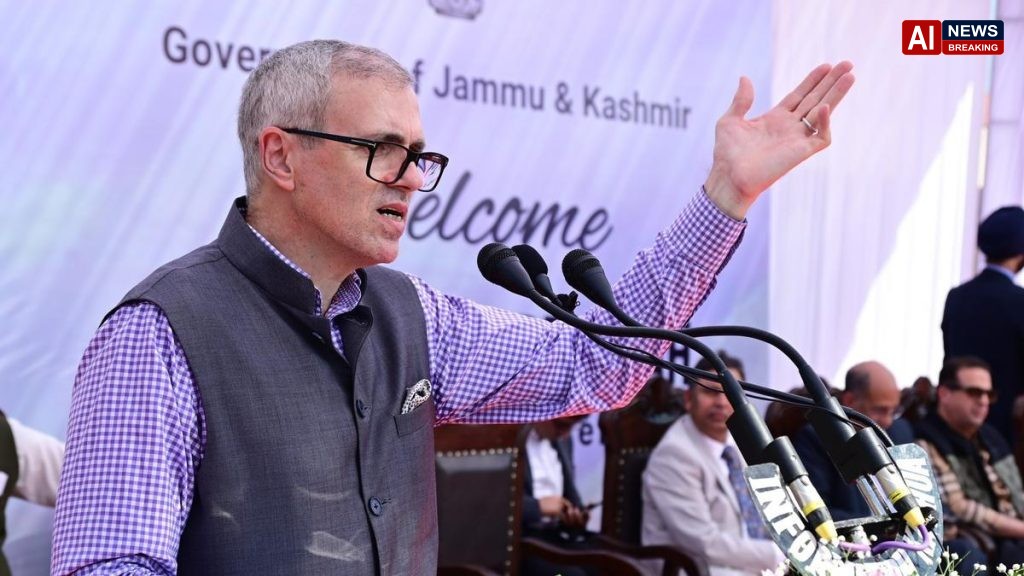
Won’t allow hiring of outsiders, hire locals: J&K CM Omar Abdullah to companies - AI News Breaking
wont allow hiring outsiders:
Jammu and Kashmir Chief Minister Omar Abdullah used the inauguration of a series of development projects worth roughly ₹30 crore in the districts of Jammu, Samba and Kathua to articulate a policy stance that could reshape the region’s employment landscape. Speaking to a gathering of local officials, contractors and community leaders, the chief minister asserted that state‑run and private enterprises receiving government contracts should prioritise hiring from within the local population rather than outsourcing jobs to outsiders. “Our people have the right to benefit from the development that is being carried out in their own districts,” Abdullah said, emphasizing that the move was intended to boost local economies, curb migration and foster a sense of ownership among residents.The projects inaugurated on Thursday included the construction of a new water treatment plant in Jammu, a road‑widening scheme in Samba and the refurbishment of a primary health centre in Kathua..
Collectively, they are expected to generate close to 1,500 direct jobs during the construction phase, with additional employment opportunities anticipated once the facilities become operational. Abdullah highlighted that the funding, sourced from both state and central schemes, represented a tangible commitment to the region’s post‑conflict reconstruction. By linking financial investment to local hiring, he argued, the government could ensure that the benefits of development are felt by those who have lived through years of instability.The chief minister’s pronouncement arrives at a time when the state is grappling with a delicate balance between attracting external expertise and protecting indigenous labour markets..
Since the abrogation of Article 370 in 2019, Jammu and Kashmir has seen an influx of firms from other parts of India, attracted by new investment incentives and a relaxed regulatory environment. Critics have warned that such inflows could marginalise local workers, who often lack the formal qualifications or certifications demanded by larger contractors. Abdullah’s directive, therefore, can be read as a political response to mounting pressure from trade unions and regional political groups that have called for greater protection of local employment.Industry bodies have offered a mixed reaction..
The Confederation of Indian Industry’s (CII) regional chapter welcomed the emphasis on skill development, noting that “local hiring is only effective if accompanied by robust training programmes”. It urged the state government to pair the hiring mandate with vocational courses tailored to the specific needs of the projects, such as construction safety, water‑treatment technology and basic healthcare administration. In contrast, the Federation of Indian Chambers of Commerce and Industry (FICCI) expressed concern that overly stringent localisation clauses could deter private investment, potentially slowing the pace of infrastructure development that the state urgently requires.Local business owners, many of whom have been vying for government contracts, view the announcement as a potential level‑playing field..
“We have the knowledge of the terrain, the language and the community dynamics,” said Ahmed Shah, a contractor from Samba who has previously worked on road projects in the area. Shah added that while his firm has a modest workforce, the new policy could enable it to expand and compete more effectively against larger, out‑of‑state companies. However, he cautioned that the implementation details would be crucial, particularly regarding the verification of candidates’ residency status and the timeline for meeting local‑employment quotas.The policy also about the capacity of the local labour pool to meet the technical demands of the projects..
A recent report by the Jammu and Kashmir Institute of Development Studies indicated that while the region boasts a substantial base of unskilled labour, there is a notable deficit in skilled tradespeople, especially in sectors such as civil engineering, project management and specialised healthcare services. To address this gap, the chief minister announced the launch of a series of short‑term training modules, to be delivered in partnership with local polytechnics and NGOs, aimed at upskilling youth and women who have traditionally been under‑represented in the construction workforce.Human rights advocates have welcomed the focus on local empowerment but have urged the government to ensure that the hiring policy does not become a tool for exclusionary practices. “Employment should be merit‑based, with safeguards against discrimination on the basis of caste, religion or gender,” said Priya Rani, a spokesperson for the Jammu and Kashmir Human Rights Forum..
She highlighted the risk that “local” could be interpreted narrowly, potentially sidelining migrant workers who have contributed to the region’s economy for decades. Rani called for transparent criteria and an independent monitoring body to oversee compliance with the new guidelines.In the broader political context, Abdullah’s stance can be seen as an attempt to consolidate his administration’s credibility ahead of the upcoming local elections. By positioning himself as a champion of indigenous interests, the chief minister seeks to counter narratives that the post‑abrogation period has been dominated by external actors and central government directives..
Analysts note that the timing of the announcement—coinciding with high‑visibility infrastructure launches—maximises its symbolic impact, reinforcing the message that development is not merely a top‑down process but one that should directly benefit the people of Jammu, Samba and Kathua.Economists caution that while the principle of local hiring is commendable, its execution must be carefully calibrated to avoid unintended market distortions. Over‑reliance on quotas may lead to tokenism, where unqualified individuals are placed in roles for which they are ill‑prepared, potentially compromising project quality and safety. Conversely, a well‑designed framework that integrates skill development, transparent tendering and periodic audits could serve as a model for other Indian states grappling with similar challenges of balancing development with social equity.As the inauguration ceremony concluded, Abdullah underscored his administration’s commitment to “building not just structures, but futures for our youth”..
He urged contractors to view the hiring directive not as a restriction, but as an opportunity to cultivate a skilled, locally rooted workforce that can sustain the region’s growth long after the current projects are completed. The next few months will test the practicality of the policy, with stakeholders from government, industry and civil society watching closely to see whether the promise of locally driven development can be translated into tangible employment outcomes across Jammu and Kashmir..
Updated: November 18, 2026
Abdullah’s local‑hiring pledge turns infrastructure spending into a political litmus test, forcing the state to prove that post‑370 growth can be both inclusive and locally anchored.
If the promised training and transparent monitoring fall short, the policy risks becoming a quota‑driven façade that fuels resentment rather






