Pakistan’s leaders hail first astronaut aboard Chinese craft: ‘Proud one of us has gone into space’
 British tourist travels 29 hours from Mumbai to Amritsar for ₹5,461, rates Indian Railways 10/10 | Viral video
 The Supreme Court will decide whether assault weapons bans violate the Second Amendment
 A Critic of Beijing Falls Short in Taiwan’s Key Mayoral Election
 EPA says no rise in contamination after Army detonates lead azide stockpile in Iowa
Rubio warns rushed patching risks infrastructure failures
**
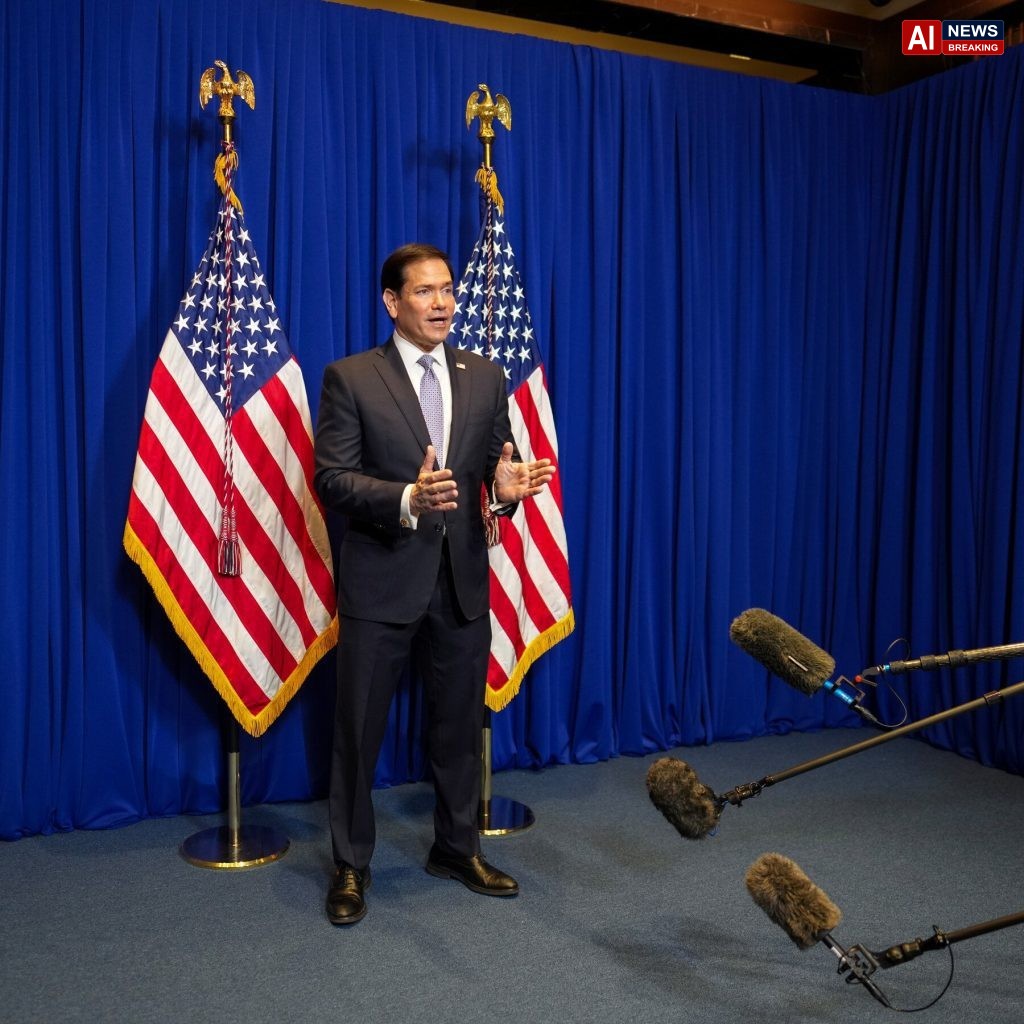
Rubio warns rushed patching risks infrastructure failures - AI News Breaking
ary of State Marco Rubio warned on Tuesday that the frantic pace at which organisations are attempting to patch computer systems after artificial‑intelligence tools expose hidden flaws could be a key factor behind a spate of high‑profile failures in sectors as varied as air‑traffic control, banking and federal administration. Speaking at a cybersecurity summit in Washington, the former senator, now senior adviser on technology policy, said the industry’s “race to secure” is creating a climate where hurried updates are deployed without sufficient testing, leaving critical infrastructure vulnerable to unforeseen side effects.Rubio’s comments come after a series of incidents that have raised eyebrows across the nation. Last month, a major airline’s air‑traffic management software suffered a cascade of glitches that forced the temporary grounding of several flights on the East Coast, prompting the Federal Aviation Administration to issue an advisory on system reliability..
In a separate episode, a regional bank experienced a sudden outage of its online banking platform, leaving thousands of customers unable to access accounts during a crucial payroll period. Meanwhile, a federal agency responsible for processing tax returns reported a backlog of more than 200,000 cases after a routine security patch caused an unexpected incompatibility with legacy database software.“Every time we hear about a failure, the narrative jumps straight to the hackers or the software itself,” Rubio said, gesturing to a slide that displayed a timeline of recent outages. “What we’re not seeing is how the pressure to patch, to apply fixes the moment a vulnerability is disclosed, is eroding the very stability we are trying to protect.” He argued that the accelerated cycle of vulnerability disclosure, largely driven by AI‑enhanced scanning tools, is outpacing the capacity of many organisations to conduct thorough regression testing before rolling out changes.Artificial intelligence has indeed transformed the way security researchers locate weaknesses..
Machine‑learning models can comb through millions of lines of code in a fraction of the time it once took human analysts, flagging patterns that suggest exploitable bugs. This speed has led to a surge in publicly disclosed vulnerabilities, with the number of CVE (Common Vulnerabilities and Exposures) entries reported in the last twelve months hitting a record high, according to data from the MITRE Corporation. While the increased visibility is a boon for defenders, Rubio warned that it also creates a “vulnerability avalanche” that forces IT teams into a reactive posture.Industry experts echo some of Rubio’s concerns..
Lena Patel, a professor of computer science at the University of Maryland who specialises in software reliability, told the summit that the “patch fatigue” phenomenon is becoming a real operational risk. “When you have dozens of critical patches arriving each week, the temptation is to apply them immediately, especially when a vulnerability is labelled as ‘critical’ by the vendor,” Patel explained. “But without a robust staging environment, you can inadvertently break inter‑dependencies that have been stable for years.” She cited a 2023 study that found a 27 percent increase in post‑patch system failures in organisations that applied updates within 24 hours of release, compared with those that followed a measured, risk‑based schedule.The federal government has been grappling with the balance between rapid response and system integrity for some time..
The Department of Homeland Security’s Cybersecurity and Infrastructure Security Agency (CISA) recently issued guidance urging agencies to adopt a “patch prioritisation matrix” that weighs the severity of the vulnerability against the criticality of the affected system and the availability of test environments. However, Rubio argued that the guidance is insufficiently enforced and that many agencies lack the resources to build the necessary testing infrastructure. “We have agencies still running on operating systems that are a decade old,” he said..
“Ask them to test every patch in a sandbox before deployment, and you’re looking at months of delay.”Financial institutions, too, are feeling the strain. The Federal Reserve’s recent report on operational resilience highlighted that banks are investing heavily in automated patch management tools, yet the same report flagged a rise in “unintended consequences” such as transaction processing delays and data corruption incidents. A senior executive at a large multinational bank, speaking on condition of anonymity, confirmed that the institution’s security team had to roll back three patches in the past six months after they triggered errors in the core banking system..
“We’re caught between compliance deadlines and the reality that our legacy platforms simply can’t handle the velocity of today’s patch cycles,” the executive said.Air‑traffic control, a sector where system downtime can have immediate safety implications, is especially sensitive to software changes. The Federal Aviation Administration’s Office of Safety Management noted that the recent grounding incident was linked to a misconfiguration introduced during a hurried firmware upgrade to a radar processing unit. The agency’s chief safety officer, Karen Liu, admitted that the upgrade schedule was compressed to meet a regulatory deadline for addressing a newly disclosed vulnerability in the radar’s communication protocol..
“In hindsight, we should have allocated more time for integration testing,” Liu said, adding that the incident has spurred a review of the agency’s patch deployment policies.Rubio’s remarks have reignited a debate that has been simmering in cybersecurity circles for years: should the industry shift from a “patch‑first” mentality to a more nuanced, risk‑based approach? Proponents of the latter argue that organisations need to adopt “strategic remediation,” focusing on the most damaging threats while allowing lower‑risk vulnerabilities to be addressed on a longer timeline. Critics counter that any delay, however brief, gives malicious actors a window to exploit unpatched flaws, especially when AI tools can automate exploit development at unprecedented speeds.Legislators are beginning to take note..
A bipartisan group of senators introduced a bill last week that would require federal agencies to report the average time between vulnerability disclosure and patch deployment, along with any adverse outcomes linked to rushed updates. The legislation also proposes funding for the creation of shared testing environments, where agencies could trial patches in a controlled setting before rolling them out network‑wide. Rubio praised the initiative, calling it “a step toward a more disciplined, data‑driven patch strategy that recognises the trade‑offs between speed and stability.”The private sector is also exploring alternatives..
Some large technology firms are piloting “incremental patching” techniques that break down large updates into smaller, modular components, allowing for more granular testing and quicker rollback if a problem arises. Others are investing in “digital twins,” virtual replicas of their production environments, to simulate the impact of patches before they touch live systems. While these approaches promise to reduce the incidence of post‑patch failures, they require significant upfront investment and specialised expertise that many smaller organisations lack.As the discussion unfolds, Rubio concluded by urging a cultural shift within both government and industry..
“We need to move away from.
Updated: November 18, 2026
The AI‑driven flood of disclosed bugs is forcing firms into a “patch‑now‑or‑risk‑exploit” sprint, but the real danger isn’t the hackers—it’s the hidden fragility introduced by rushed code changes. A shift toward risk‑based remediation and sandboxed testing