
 Pakistan’s leaders hail first astronaut aboard Chinese craft: ‘Proud one of us has gone into space’
 British tourist travels 29 hours from Mumbai to Amritsar for ₹5,461, rates Indian Railways 10/10 | Viral video
 The Supreme Court will decide whether assault weapons bans violate the Second Amendment
 A Critic of Beijing Falls Short in Taiwan’s Key Mayoral Election
 EPA says no rise in contamination after Army detonates lead azide stockpile in Iowa
The Latest: Trump arrives in China, seeking to reinforce US’s status as world’s leading tech power
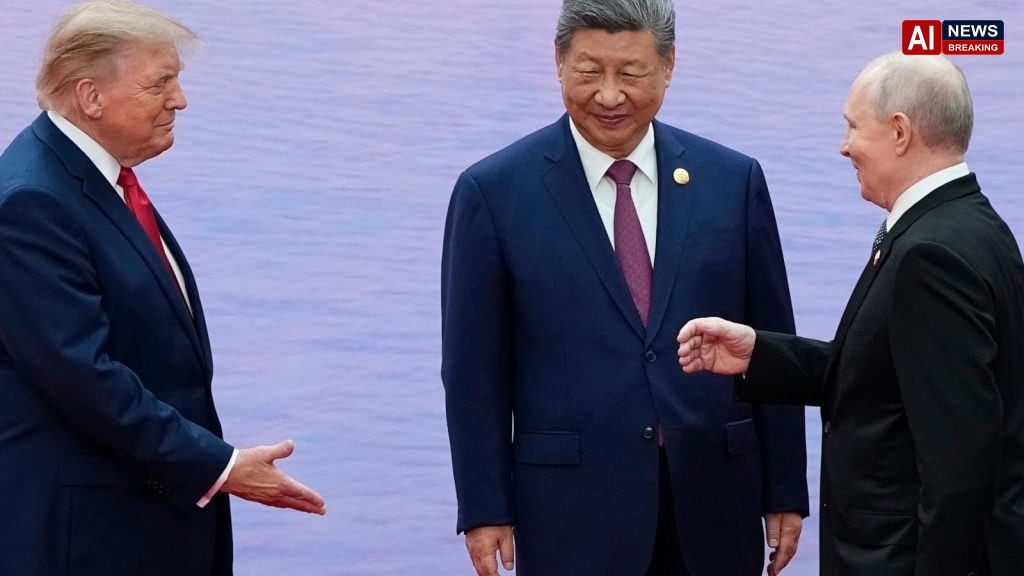
The Latest: Trump arrives in China, seeking to reinforce US's status as world’s leading tech power - AI News Breaking
trump arrives china seeking:
Title The Latest: Trump arrives in China, seeking to reinforce US’s status as world’s leading tech power — 1. President Donald Trump touched down at Beijing Capital International Airport on Tuesday, an event that has already begun to stir headlines across the globe. With a modest entourage of advisors and technology experts, the former president’s arrival marks a rare diplomatic initiative after months of stalled US‑China trade talks..
Trump, who has repeatedly emphasized the need for America to reclaim its technological edge, is reportedly set to meet with senior officials from the Chinese Ministry of Commerce and several leading tech firms headquartered in Shanghai and Shenzhen. His visit, while unofficial in diplomatic terms, is being watched closely by both allies and competitors alike. In a press conference held at the airport’s VIP lounge, Trump outlined his primary objective: to secure a bilateral framework that would enable American companies to access China’s vast consumer market without compromising national security..
“We need to make sure that America remains the world’s leading tech power,” he told reporters, citing the growing dominance of Chinese firms such as Huawei and Tencent. Trump added that the United States must invest in domestic research and development while also ensuring that intellectual property protections are robust enough to deter espionage. The former president’s message echoes a familiar refrain that has dominated his political career..
The timing of Trump’s trip is notable. Earlier this week, the U.S. Trade Representative announced new tariffs on a range of Chinese goods, prompting Beijing to respond with counter‑measures..
In a backdrop of escalating tensions, Trump’s presence in China could serve as a symbolic gesture of willingness to negotiate. He is expected to attend a meeting with the Chinese Communist Party’s Party Committee for Science and Technology, a group that has been instrumental in shaping China’s ambitious “Made in China 2025” program. By engaging with these leaders, Trump hopes to push for an agreement that balances free trade with stringent security protocols..
Analysts say the former president’s visit could reshape the future of the semiconductor industry. The United States has been restricting the export of advanced chip‑making equipment to China, citing national security concerns. Trump intends to negotiate with Chinese officials on the possibility of easing some of these restrictions for companies that comply with rigorous security vetting..
“We’re not looking to freeze the industry; we’re looking to safeguard it,” he told reporters. If successful, the deal could unlock billions of dollars in Chinese demand for US‑made components and help American firms maintain a competitive advantage in a sector that has become the linchpin of global technology. During a private dinner with Beijing’s top economic planners, Trump pressed for greater transparency on how China’s state‑owned enterprises invest overseas..
He cited concerns that such investments often come with strings attached, including expectations of technology transfer and preferential treatment for Chinese firms. The Chinese delegation, however, emphasized their commitment to a “fair and equal” partnership. “We have a very open market; we welcome all partners,” a spokesperson said..
While the dialogue was cordial, the underlying dispute over technology sovereignty remains a thorny issue that could prove difficult to resolve. The former president’s campaign promises of revitalising the American manufacturing sector are on full display at the heart of his agenda. Trump has repeatedly claimed that America’s economic future hinges on the ability to manufacture high‑tech goods domestically..
He has also promised to cut bureaucratic red tape that has, according to critics, stifled innovation. By engaging China, Trump hopes to create a symbiotic relationship in which US firms can manufacture in China under strict controls, while Chinese firms gain access to advanced US technology under mutually beneficial terms. Trump’s trip has also brought the issue of supply chain security to the fore..
Over the past decade, the United States has become increasingly dependent on imported components, many of which come from China. In a series of remarks, Trump highlighted the need for “strategic independence” in critical technologies such as 5G, artificial intelligence, and quantum computing. He called on the Biden administration to adopt policies that protect domestic supply chains, including incentives for companies that invest in domestic production..
The former president’s emphasis on resilience reflects a broader shift in US policy that has been amplified by the pandemic and geopolitical rivalry. During a televised briefing in Washington, Trump’s chief technology advisor, Dr. Aisha Khan, elaborated on the technical aspects of the proposed negotiations..
She noted that the US has already begun investing in semiconductor fabs in Arizona and Texas, with the aim of reducing reliance on Asian manufacturers. “We’re looking for a win‑win solution,” Khan said. “If Chinese partners are willing to meet our security standards, we can open new channels for cooperation.” The advisor also mentioned potential collaboration on renewable energy technologies, citing a joint interest in reducing global carbon emissions..
The visit has been greeted with mixed reactions by industry insiders. Some executives in Silicon Valley view Trump’s presence as a potential boon, believing that a deal could provide much-needed certainty for long‑term investment plans. Others, however, are wary of the political uncertainties that could arise from a high‑profile visit..
“We need a stable, predictable environment to plan our R&D pipelines,” said Laura Chen, CEO of a mid‑size chip manufacturer. “Trump’s approach may bring short‑term gains but could jeopardise our long‑term strategy.” 10. The Chinese side has indicated that it remains open to dialogue, but insists that any agreement must be built upon mutual respect and a recognition of national sovereignty..
A senior official from the Ministry of Commerce stated, “China values the relationship with the United States, but we will not.
Updated: November 18, 2026
Insight: Trump’s Beijing stop signals a tactical shift from hard‑line trade wars to a “win‑win” diplomacy, hoping to lure U.S. firms back into China’s market under strict security strings. If the deal materializes, it could reset the semiconductor race, but it also risks entangling American






