
 Pakistan’s leaders hail first astronaut aboard Chinese craft: ‘Proud one of us has gone into space’
 British tourist travels 29 hours from Mumbai to Amritsar for ₹5,461, rates Indian Railways 10/10 | Viral video
 The Supreme Court will decide whether assault weapons bans violate the Second Amendment
 A Critic of Beijing Falls Short in Taiwan’s Key Mayoral Election
 EPA says no rise in contamination after Army detonates lead azide stockpile in Iowa
Grand jury indicts Illinois man on terrorism and weapons charges in foiled Hindu temple shooting
**
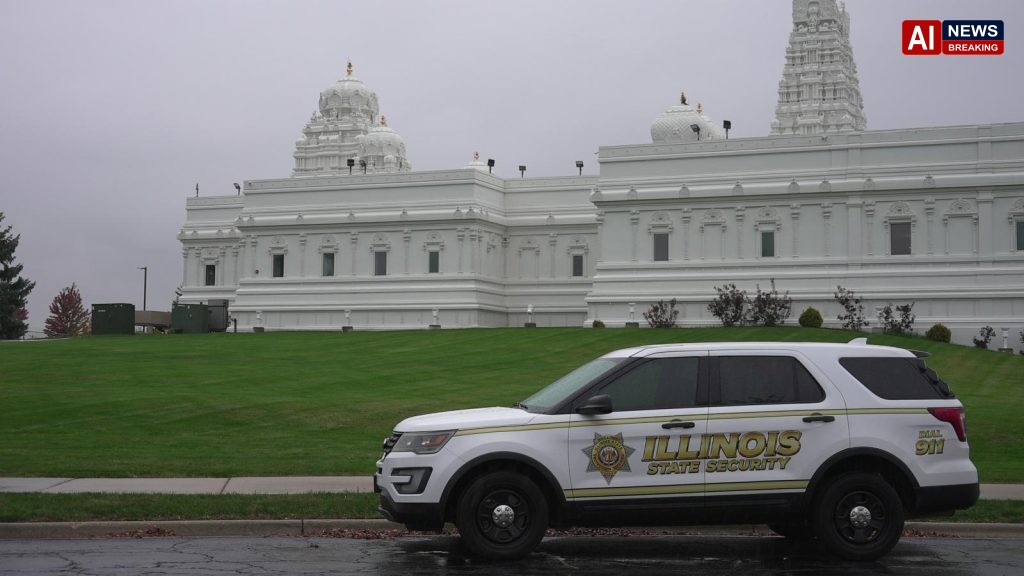
Grand jury indicts Illinois man on terrorism and weapons charges in foiled Hindu temple shooting - AI News Breaking
A 19‑year‑old Illinois resident has been formally charged with terrorism and weapons offenses after prosecutors said he had plotted to fire on a Hindu temple in the Chicago area. The indictment was issued by a federal grand jury on Thursday, adding new accusations to an earlier case that had already involved a 2023 arrest for an alleged plot to shoot at a church in the city’s south side.The defendant, identified only as a resident of Cook County, was arrested in August after an undercover operation uncovered a notebook, several firearms and ammunition that suggested a plan to target a place of worship. Prosecutors say the victim of the plot was a Hindu temple that serves more than 400 congregants each week..
While no shots were fired and no injuries reported, authorities say the plan was serious enough to trigger a wide‑scale investigation.According to the indictment, the suspect travelled between multiple locations over a period of several weeks, meeting with at least two co‑conspirators. The documents seized in his home show a map of the temple, along with notes indicating a “maximum impact” strategy. He was also found in possession of a Glock pistol, a rifle chambered in 7.62×39mm and a homemade device that prosecutors describe as a “concealed improvised explosive.”Federal prosecutors argue that the planned attack falls under the federal terrorism statutes, which cover violent or non‑violent acts that threaten the safety of a civilian population or that target religious, ethnic or cultural institutions..
The indictment lists 17 counts: six under the federal terrorism statute, five for possession of unregistered firearms, three for unlawful possession of a weapon of mass destruction and three for conspiracy to commit violent crime. The defendant faces up to 20 years in prison for each terrorism count and a cumulative sentence that could reach 160 years.The case is part of a broader effort by the Department of Justice to tackle domestic extremist activity. In the last two years, prosecutors have targeted a number of individuals who have plotted to attack churches, synagogues and other religious venues across the country..
The department has made clear that it considers attacks on places of worship, which are protected by constitutional guarantees, to be a serious threat to public safety.The Hindu temple that would have been the target is located in the suburb of Skokie, about twenty miles northwest of downtown Chicago. The temple, a non‑profit organization with a history of community outreach, welcomed 200 people for its weekly Sunday service last month. The congregation, composed mainly of immigrant families from India and Nepal, has a reputation for interfaith dialogue and charity work.An officer with the Illinois State Police, who asked not to be named, said the investigation began after a tip that the suspect had been collecting ammunition in a “dangerous” pattern..
The tip led to a raid on the defendant’s apartment on August 15, during which officers found the weapons and a notebook detailing a possible attack. “We have no evidence that anyone was harmed, but we took the matter seriously and acted promptly,” the officer said.The defendant’s family has stated that he is a first‑time offender and that he has a history of mental health issues. His mother, who lives in a suburb of Chicago, said that her son was “very angry” about recent political developments and had expressed a desire to “take action.” She added that he had been seeking help from a therapist in the months before his arrest.The indictment also cites a separate incident that occurred in the spring of 2023, when the defendant allegedly approached a church on the south side of Chicago with a rifle..
Witnesses reported that the suspect was “very nervous” and that he had spoken about wanting to “make a statement.” The police officer on the scene, who also requested anonymity, said the suspect was taken into custody without incident. That earlier case, which remains pending, involved a charge of unlawful possession of a firearm.The indictment was drafted by the United States Attorney’s Office for the Northern District of Illinois, which has a history of handling complex terrorism cases. The office noted that the suspect’s plan was “pre‑meditated” and that the documents he left behind indicated a deliberate intent to inflict mass casualties..
“The evidence shows that the defendant’s actions were not a spontaneous outburst, but a calculated effort to target a vulnerable group,” the indictment states.The charges carry significant implications for the defendant’s future. Under federal law, a conviction on any of the terrorism counts can lead to life imprisonment, and the cumulative penalties can add up to decades of incarceration. The case will likely be heard in the United States District Court for the Northern District of Illinois, where the prosecution will need to prove that the defendant intended to cause widespread fear or intimidation..
The defense may argue that the defendant’s mental state and lack of a prior criminal record mitigate the seriousness of the allegations.The reaction from the Hindu community has been one of shock and anger. A spokesperson for the temple said the congregation is “devastated” by the news that their place of worship was singled out. “We are grateful that no one was harmed, but we are deeply concerned about the safety of our community,” the spokesperson said..
The temple also issued a statement calling for solidarity among all faiths against extremist violence.The broader context of the case is a rise in domestic terrorism incidents in the United States, with a particular focus on attacks aimed at religious minorities. The FBI’s 2023 report noted an increase in threats targeting Hindu and Sikh communities. Law enforcement officials say that the increased scrutiny is part of a national strategy to prevent attacks before they can be carried out.The legal process that follows the indictment is expected to be protracted..
The defendant will have a preliminary hearing, after which a trial date will be set. In the interim, he is being held in a Cook County jail with a bond set at $750,000. The prosecution has stated that it will seek a conviction on all charges if the evidence supports the claims.While the case has not yet gone to trial, the indictment itself serves as a warning to potential attackers that law enforcement is prepared to act decisively when a threat is identified..
It also highlights the challenges of balancing civil liberties with national security concerns, a tension that has been at the forefront of public debate in the aftermath of the 9/11 attacks and the subsequent War on Terror.The defendant’s case may also spark discussion about the role of mental health in criminal proceedings. The prosecution’s narrative frames the plot as a terrorist act, but the defense may argue that untreated mental illness played a crucial role in the planning. Courts have previously grappled with whether to treat individuals with severe psychological conditions as capable of criminal intent.In any event, the indictment represents a serious step in the criminal justice system’s response to domestic extremism.
Updated: November 18, 2026
A 19‑year‑old Cook County resident has been indicted on 17 federal counts after police uncovered a notebook, weapons and a homemade explosive that mapped a plan to shoot a Skokie Hindu temple. The case follows a 2023 arrest for a church‑shooting plot and underscores the DOJ’s push to pre‑empt domestic extremist attacks on places of worship.
This development highlights evolving dynamics and may have broader implications in the near term.






