
 Pakistan’s leaders hail first astronaut aboard Chinese craft: ‘Proud one of us has gone into space’
 British tourist travels 29 hours from Mumbai to Amritsar for ₹5,461, rates Indian Railways 10/10 | Viral video
 The Supreme Court will decide whether assault weapons bans violate the Second Amendment
 A Critic of Beijing Falls Short in Taiwan’s Key Mayoral Election
 EPA says no rise in contamination after Army detonates lead azide stockpile in Iowa
Sen. Tim Kaine says he will force votes on human rights consequences of US policies in Russia
**
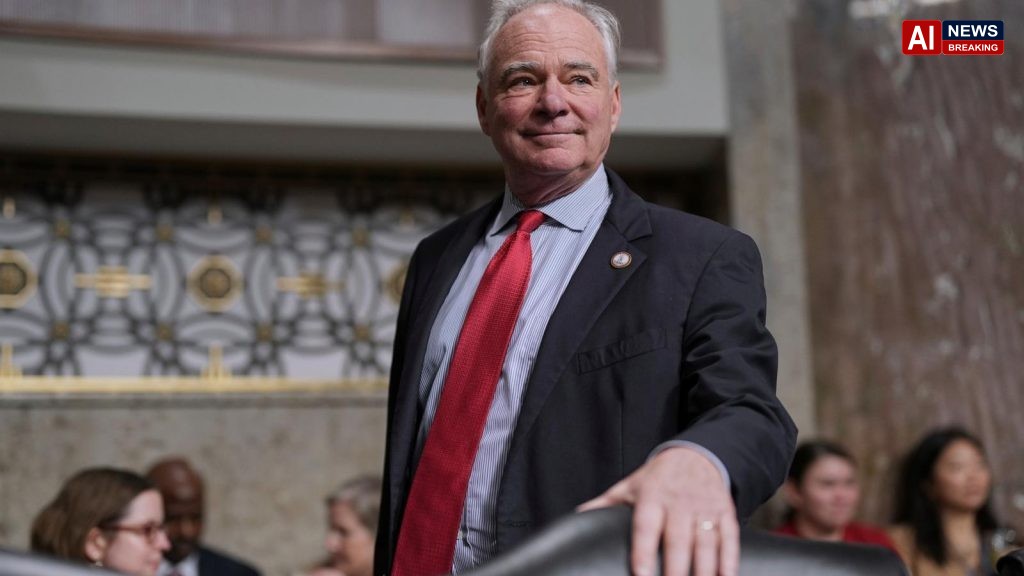
Sen. Tim Kaine says he will force votes on human rights consequences of US policies in Russia - AI News Breaking
kaine says will force:
Tim Kaine, a senior Democratic figure from Virginia, announced on Monday that he will move to force a vote on the Senate floor demanding that the Trump administration produce a comprehensive assessment of the human‑rights implications of its policies toward Russia. The proposal, which Kaine said reflects a growing bipartisan concern over the United States’ strategic calculus, would require the State Department and other relevant agencies to publish a detailed report outlining how sanctions, diplomatic engagements and covert operations affect the civil liberties and political freedoms of Russian citizens. Kaine framed the initiative as a safeguard against the “unintended consequences” of a foreign policy that, in his view, often prioritises geopolitical advantage over the welfare of ordinary people living under an increasingly authoritarian regime.The move comes at a time when Washington’s relationship with Moscow is marked by a mixture of confrontation and cautious dialogue..
Since the United States imposed a new wave of sanctions in response to alleged cyber‑attacks and interference in the 2024 U.S. elections, Russian officials have repeatedly accused Washington of meddling in its internal affairs. Critics of the sanctions argue that they have hardened the Kremlin’s stance and contributed to a climate of repression, while supporters claim they are a necessary tool to pressure Moscow into adhering to international norms..
Kaine’s request for a formal human‑rights impact study seeks to inject a new metric into the debate, one that would examine whether punitive measures are inadvertently bolstering the very authoritarian tendencies they aim to curb.In his floor speech, Kaine cited recent reports from non‑governmental organisations that documented a surge in arrests of journalists, activists and opposition figures in Russia following the latest sanction round. He pointed to the case of independent broadcaster Anna Petrova, who was detained on charges of “foreign influence” after interviewing a dissident abroad, as an example of how external pressure can be weaponised by the Kremlin to justify crackdowns. “When we impose economic pain on a regime, we must also ask how that pain is transferred to the people who are already living under a repressive state,” Kaine said..
“The United States has a moral responsibility to ensure that our policies do not become a catalyst for further oppression.”Republican leaders on the Senate floor have been largely silent on the proposal, though a handful of moderate voices have expressed tentative support. Senator Susan Collins of Maine, known for her willingness to cross party lines on foreign‑policy matters, indicated she would review the legislation and consider whether it aligns with the broader goal of protecting democratic values abroad. Meanwhile, Senate Majority Leader Mitch McConnell declined to comment, signalling that the measure is unlikely to receive a swift vote in a chamber still dominated by the GOP..
The timing, however, could prove advantageous for Kaine, who hopes the issue will gain traction as the 2024 mid‑term elections approach and lawmakers seek to demonstrate a commitment to human rights.The administration’s response has been measured but defiant. A spokesperson for the State Department said the agency already conducts “rigorous internal assessments” of the humanitarian impact of all major policy decisions, including sanctions against Russia. The official added that the department’s existing reporting mechanisms are “sufficiently transparent” and that an additional congressional mandate could duplicate efforts and compromise sensitive intelligence sources..
When pressed about the specific allegations that U.S. policies have emboldened Russian authorities to clamp down on dissent, the spokesperson urged lawmakers to consider the broader strategic context, noting that “the primary aim of our approach is to deter malign activity that threatens both American and allied security.”Human‑rights advocates have welcomed Kaine’s initiative as a potential breakthrough in a policy arena that often operates behind closed doors. The International Federation for Human Rights (FIDH) released a statement praising the senator’s “courageous call for accountability” and urging the Senate to pass the measure without delay..
According to FIDH, a formal impact study would not only illuminate the real‑world consequences of sanctions but also provide a data‑driven foundation for more targeted, humane policy options. “We have long argued that sanctions should be calibrated to minimise collateral damage to civilians,” said FIDH director Elena García. “A mandatory report would force the administration to confront the trade‑offs it makes and could lead to smarter, more responsible action.”Opponents of the proposal argue that the request could undermine the United States’ ability to respond swiftly to Russian aggression..
Former National Security Adviser Michael Flynn, speaking at a conservative think‑tank event, warned that “adding layers of bureaucratic review in the midst of a hostile relationship with Moscow will only embolden the Kremlin.” Flynn and other critics contend that the primary threat is not the indirect impact on Russian civil society but the direct danger posed by Russian cyber‑espionage, disinformation campaigns and potential military provocations. They assert that a pre‑occupation with human‑rights accounting could distract policymakers from the urgent need to maintain a robust deterrence posture.The legislative text, known as the Human Rights Accountability in Russia Act, would require the State Department, the Treasury, and the intelligence community to submit a joint report within 180 days of its enactment. The report must include quantitative data on arrests, media shutdowns, and other forms of repression that can be plausibly linked to U.S..
policy actions, as well as qualitative analysis of how those actions influence the Kremlin’s internal narrative. The bill also mandates an annual public briefing to Congress, offering lawmakers a structured forum to discuss findings and adjust policy accordingly. While the language is intentionally broad to accommodate classified inputs, the requirement for a public component aims to increase transparency for both domestic audiences and international observers.Analysts at the Brookings Institution suggest that the bill could set a precedent for how the United States evaluates its foreign‑policy tools more generally..
“If Congress can compel a systematic human‑rights impact assessment for Russia, it may soon demand similar reviews for China, Iran or other strategic competitors,” said Dr. Lila Patel, senior fellow for foreign policy. Patel warned that the move could lead to a more fragmented approach to sanctions, potentially weakening the overall efficacy of U.S..
However, she also noted that “a calibrated strategy that accounts for human costs might ultimately be more sustainable, reducing anti‑American sentiment that fuels recruitment for hostile actors.”The debate over the measure is also likely to intersect with ongoing discussions about the role of the United Nations and multilateral institutions in addressing human rights violations. Kaine has signalled that his office will seek to coordinate the Senate‑mandated report with the work of the UN Human Rights Council, hoping to align American findings with broader international standards. If successful, such coordination could bolster the credibility of U.S..
claims that it is acting responsibly on the world stage, countering Russian narratives that portray Washington as a hypocritical bully.
Updated: November 19, 2026
Kaine’s push forces Washington to confront a paradox: the very sanctions meant to check Moscow may be feeding the Kremlin’s narrative that America is a threat to its own citizens. If the bill passes, it could turn blunt economic pressure into a data‑driven tool, but it also risks splintering





