
 Pakistan’s leaders hail first astronaut aboard Chinese craft: ‘Proud one of us has gone into space’
 British tourist travels 29 hours from Mumbai to Amritsar for ₹5,461, rates Indian Railways 10/10 | Viral video
 The Supreme Court will decide whether assault weapons bans violate the Second Amendment
 A Critic of Beijing Falls Short in Taiwan’s Key Mayoral Election
 EPA says no rise in contamination after Army detonates lead azide stockpile in Iowa
Agricultural workers’ body seeks lease payments, plots for assigned landowners in Amaravati
**
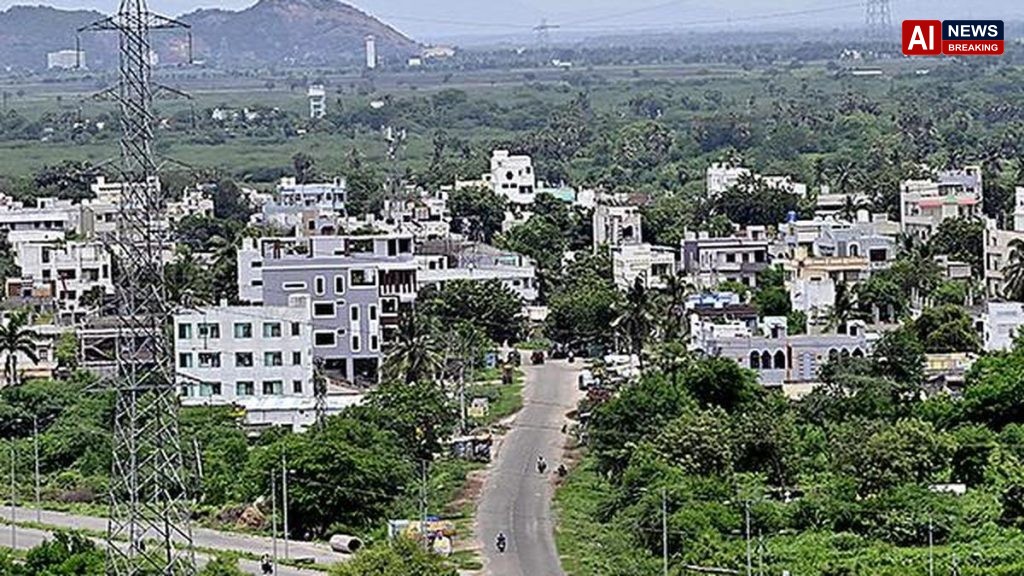
Agricultural workers’ body seeks lease payments, plots for assigned landowners in Amaravati - AI News Breaking
agricultural workers body seeks:
The Andhra Pradesh State Agricultural Workers’ Union has lodged a formal demand for lease payments and the allocation of plots to families whose land was subsumed in the creation of Amaravati, the state’s new capital. The union, representing thousands of farm labourers, contends that nearly 1,800 acres of agricultural land were appropriated for the capital’s development, with the majority of the ex‑propriated parcels belonging to Dalit and other socially vulnerable communities. In a statement released on Monday, the union said the affected families have been left without adequate compensation or alternative livelihood options, prompting the call for a structured lease‑payment scheme and the provision of new agricultural plots.The claim that 1,800 acres of land were taken over comes from data compiled by the union’s research wing, which cross‑referenced government acquisition records with land‑registry documents..
According to the union, more than 70 per cent of the seized area was owned or cultivated by smallholder farmers from scheduled castes and other marginalized groups. These families, the union argues, were not provided with market‑rate compensation at the time of acquisition, nor were they offered equivalent land to continue farming. Instead, many were relocated to temporary housing on the outskirts of the city, a move that has disrupted traditional agrarian practices and eroded community cohesion.The union’s demand for lease payments is anchored in the legal framework governing land acquisition in India, particularly the Right to Fair Compensation and Transparency in Land Acquisition, Rehabilitation and Resettlement Act, 2013..
While the act mandates that displaced persons receive compensation at a multiple of the market value, it also allows for the option of a lease arrangement where the original owners continue to derive income from the land. The union asserts that such a lease model would provide a steady revenue stream for the displaced families, enabling them to sustain their households while they adapt to the urban environment that has emerged around Amaravati.In addition to lease payments, the union is pressing the state government for the allocation of new agricultural plots, ideally within a reasonable distance from the families’ original villages. The union’s proposal outlines a phased approach: first, a detailed survey to identify suitable parcels of government or unused private land; second, the transfer of clear title to the beneficiaries; and third, the provision of agricultural inputs and technical assistance to ensure the viability of the newly assigned farms..
The union argues that without such measures, the displaced families risk falling into chronic poverty, a scenario that would run counter to the state’s broader development objectives.State officials have responded with a mixed message. A spokesperson for the Amaravati Capital Region Development Authority (ACRDA) acknowledged the concerns raised by the union, stating that the authority is “committed to equitable rehabilitation and has initiated several schemes to support displaced families.” However, the spokesperson also noted that the capital’s master plan, approved in 2015, had earmarked a specific portion of land for compensation and resettlement, and that the process of land redistribution is “complex and time‑consuming.” The ACRDA said it would convene a multi‑stakeholder meeting within the next month to review the union’s demands and explore feasible solutions.Legal experts caution that the path to resolution may be fraught with procedural hurdles. Professor Anjali Rao of the National Law School, New Delhi, explained that while the 2013 Act provides a clear framework for compensation, its implementation often hinges on state‑level policy decisions and the political will to allocate resources..
“If the government chooses to honor lease arrangements, it must first identify suitable lands that are not already earmarked for other development projects,” she said. “Moreover, any new land allocation must be transparent to avoid allegations of favoritism or corruption.”The union’s grievances are not limited to financial compensation. Interviews conducted with affected families reveal a broader sense of loss that encompasses cultural and social dimensions..
Many of the displaced households have deep ties to their ancestral fields, where generations have cultivated rice, millets and pulses using traditional methods. The abrupt transition to urban peripheries has disrupted communal rituals tied to sowing and harvest cycles, and has strained the inter‑generational transmission of agricultural knowledge. “Our identity is linked to the land,” said Ramesh Kumar, a 54‑year‑old farmer from the village of Pedakakani..
“When we were moved, we lost more than a field; we lost the place where our children learned to plant and reap.”Human rights organisations have taken note of the situation, with the Centre for Social Justice filing a petition in the Andhra Pradesh High Court seeking a directive for the state to implement a comprehensive rehabilitation package. The petition cites the disproportionate impact on Dalit families and argues that the state’s current measures fall short of constitutional guarantees of equality and non‑discrimination. In a recent hearing, the court adjourned the case pending a detailed report from the government on the status of land allocation and compensation.The broader political context adds another layer to the dispute..
Amaravati was conceived as a flagship project of the YSR Congress Party, intended to showcase the state’s ambition and attract investment. However, changing political fortunes have led to shifts in policy priorities, with successive administrations reassessing the capital’s scale and scope. Critics argue that the frequent policy reversals have created uncertainty for those directly affected by the project’s initial land acquisitions..
“When political priorities change, the most vulnerable bear the brunt,” said Dr. Suresh Patil, a political analyst at the Indian Institute of Management, Bangalore.As the union prepares for further negotiations, it has called on civil society groups, academia and the media to amplify its demands and monitor the government’s response. The union’s leadership has also signalled readiness to organize peaceful protests should the state fail to meet its expectations within a reasonable timeframe..
Meanwhile, the state government faces a delicate balancing act: advancing the vision of a modern, world‑class capital while addressing the legitimate grievances of the agricultural workers whose lands were the foundation of that vision. The outcome of this impasse will likely shape not only the future of Amaravati’s development but also set a precedent for how large‑scale infrastructure projects engage with and compensate marginalized communities in India..
Updated: November 20, 2026
The Amaravati saga reveals how “development” can become a veneer for entrenched caste inequities, turning displaced Dalit farms into political capital while the promised lease model risks becoming a token gesture rather than a sustainable lifeline.
If the state fails to translate legal rights into transparent land‑reallocation, it






