
 Pakistan’s leaders hail first astronaut aboard Chinese craft: ‘Proud one of us has gone into space’
 British tourist travels 29 hours from Mumbai to Amritsar for ₹5,461, rates Indian Railways 10/10 | Viral video
 The Supreme Court will decide whether assault weapons bans violate the Second Amendment
 A Critic of Beijing Falls Short in Taiwan’s Key Mayoral Election
 EPA says no rise in contamination after Army detonates lead azide stockpile in Iowa
Trump Advisor Steven Paul Hopes U.S. Tax Credit Will Be ‘Active’ in January, Tariffs Are Old News: ‘Now It’s All Hands on Deck Federal Credit’
**
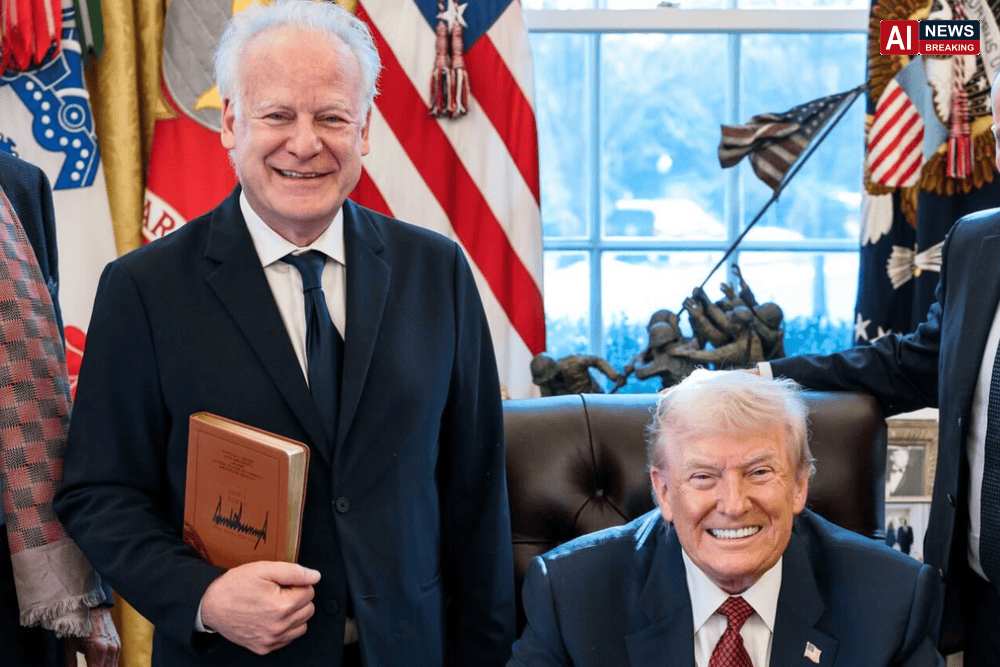
Trump Advisor Steven Paul Hopes U.S. Tax Credit Will Be ‘Active’ in January, Tariffs Are Old News: ‘Now It’s All Hands on Deck Federal Credit’ - AI News Breaking
Steven Paul, a senior adviser to former President Donald Trump who has been spearheading a campaign for a new federal tax credit aimed at the film and television industry, told reporters at the Doha Industry Days – the business arm of the Doha Film Festival – that he expects the measure to be “active in some form” by January 2027. The announcement came after a lengthy press conference in which Paul, accompanied by special ambassador to Hollywood Jon Voight, outlined the proposed credit’s objectives and addressed the broader context of U.S. trade policy, including the fading relevance of tariffs that were once a hallmark of the Trump administration.The credit, which would provide a refundable tax incentive to productions that meet certain domestic‑employment and spending criteria, is designed to counteract the migration of major studios to offshore locations that have become increasingly attractive due to lower labour costs and generous foreign subsidies..
Paul argued that without a competitive federal incentive, the United States risks losing both jobs and cultural capital to countries such as Canada, the United Kingdom and Ireland, where regional tax schemes already draw significant portions of Hollywood’s budget. “We need to level the playing field,” he said, “so that American storytellers can compete globally without having to sacrifice American talent.”In the months leading up to the Doha event, Paul and a coalition of industry groups, including the Motion Picture Association and several guilds, have lobbied intensely on Capitol Hill. Their efforts have focused on garnering bipartisan support, emphasizing that the credit would not only preserve jobs but also generate revenue through increased production spending..
According to data released by the Department of Treasury, every dollar of tax credit awarded in the film sector has historically produced between $4 and $5 in economic activity, a multiplier that Paul highlighted as a compelling argument for lawmakers wary of fiscal deficits.The proposed credit would differ from existing state‑level incentives by offering a uniform, federal baseline that could be stacked with regional programs, thereby amplifying their effect. Under the draft legislation, qualifying productions would receive a credit equal to 20 percent of qualified domestic expenditures, up to a cap of $10 million per project. The credit would be refundable, meaning that even producers who do not owe federal taxes could benefit, a feature that Paul said is critical for independent filmmakers who often operate with thin margins..
“This isn’t about big studios alone,” he remarked. “It’s about giving smaller voices the same chance to tell their stories on a global stage.”While the credit has generated enthusiasm among industry stakeholders, it has also drawn scrutiny from fiscal conservatives who warn of potential abuse and revenue loss. Critics argue that a refundable credit could become a loophole for profit‑shifting, and that the cap may be insufficient to attract the largest productions..
In response, Paul pledged that the final bill would include stringent reporting requirements, third‑party audits, and a sunset clause that would force Congress to reassess the program after ten years. He also noted that the credit would be subject to a “use‑it‑or‑lose‑it” provision, preventing producers from hoarding credits for future projects.The conversation at Doha also turned to the broader trade environment that has shaped the film industry over the past decade. Jon Voight, who has served as a cultural liaison between Hollywood and U.S..
diplomatic missions, reflected on the waning relevance of tariffs that once protected domestic manufacturers and, by extension, some aspects of media production. “When we first introduced the tariffs on steel and aluminum, there was a belief they would safeguard jobs across the board,” Voight said. “In reality, the impact on film was marginal, and the administrative burden grew..
Now, the focus has shifted to strategic incentives that directly address the creative economy.”Voight’s remarks underscored a shift in policy thinking from protectionist measures to targeted economic stimuli. Since the Trump administration’s 2018 tariffs, the U.S. has seen a modest increase in production activity domestically, but much of the growth has been attributed to state incentives rather than federal policy..
Analysts note that the absence of a cohesive federal framework has resulted in a patchwork of incentives, leading to competition among states and, at times, a “race to the bottom” in terms of tax generosity. The proposed federal credit aims to standardise the approach, reducing inter‑state rivalry while still allowing local programmes to supplement the national baseline.During the session, Paul addressed concerns about potential duplication of benefits for productions already receiving state credits. He explained that the federal credit would be calculated after state incentives have been applied, ensuring that the total benefit does not exceed the stipulated cap..
This methodology, he said, mirrors successful models employed in Canada’s federal‑provincial partnership, where a national credit works in tandem with regional schemes to maximise impact without inflating costs. “We’ve learned from our neighbours,” Paul asserted, “and we’re adapting best practices to fit the American context.”The timeline for the credit’s enactment remains tentative. Paul indicated that the legislation is expected to be introduced in the Senate early next year, followed by a series of hearings and negotiations with the House Ways and Means Committee..
Assuming a smooth passage, the credit could be codified in the fiscal year that begins on October 1, 2026, with operational provisions taking effect in January 2027. He stressed that the “all‑hands‑on‑deck” approach he described involves not only legislators but also industry leaders, tax experts, and state officials who will need to coordinate implementation. “It’s a collaborative effort,” he said, “and the sooner we move, the quicker the benefits flow to the economy.”Reactions from international partners were cautiously optimistic..
Representatives from the United Kingdom’s Department for Digital, Culture, Media & Sport noted that a robust U.S. credit could foster more co‑production agreements, which have become a staple of trans‑Atlantic collaboration. “When both sides have strong incentive structures, it encourages sharing of talent, technology, and financing,” said a senior UK official..
Similar sentiments were echoed by officials from Canada’s Ministry of Economic Development, who highlighted that a competitive U.S. credit could stimulate healthy competition, driving innovation in production techniques and sustainability practices.The Doha Industry Days audience, comprising producers, financiers, and location managers from across the Middle East, asked pointed questions about the credit’s scope and its implications for overseas shooting. Paul responded that while the credit prioritises domestic spending, it does not preclude international locations where they are essential for narrative authenticity..
However, he reiterated that any foreign expenditure would need to be justified and that the primary goal is to ensure that a substantial portion of the budget remains within the United States. “We want to protect the heart of our industry while still embracing the global nature.
If the bill lands, Hollywood could finally stop feeling like a nomad—keeping money and talent in U.S. soil while still courting global locations. Yet the real test will be whether Congress can tame the “tax‑shark” fears without turning the credit into a loophole that favors the biggest studios






