
 Pakistan’s leaders hail first astronaut aboard Chinese craft: ‘Proud one of us has gone into space’
 British tourist travels 29 hours from Mumbai to Amritsar for ₹5,461, rates Indian Railways 10/10 | Viral video
 The Supreme Court will decide whether assault weapons bans violate the Second Amendment
 A Critic of Beijing Falls Short in Taiwan’s Key Mayoral Election
 EPA says no rise in contamination after Army detonates lead azide stockpile in Iowa
BepiColombo enters orbit around Mercury
**
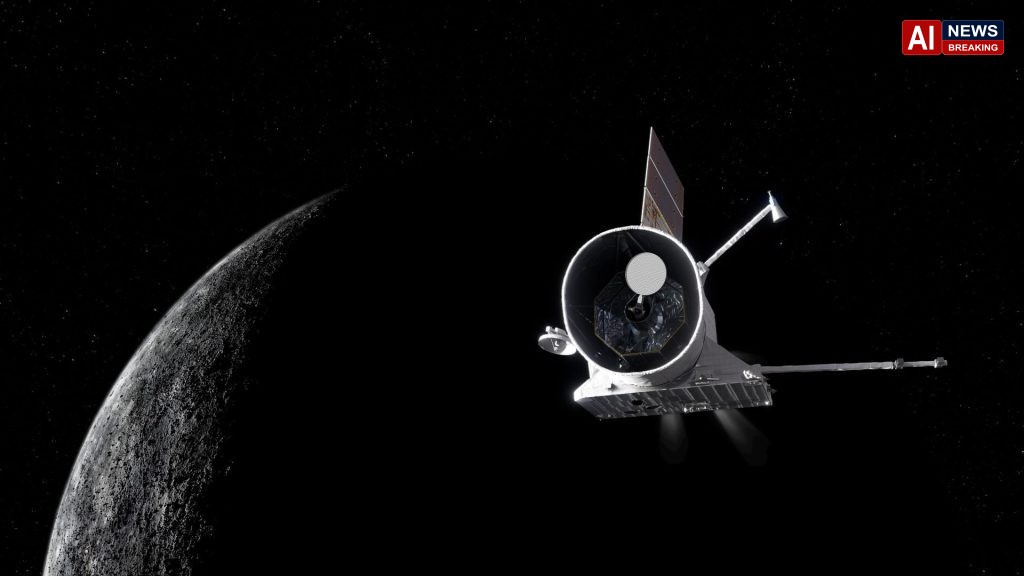
BepiColombo enters orbit around Mercury - AI News Breaking
The BepiColombo spacecraft has entered orbit around Mercury, marking the first time a robotic probe has become a permanent satellite of the planet since the Mariner 10 fly‑bys in the early 1970s. The orbit insertion manoeuvre, which began at 1:24 p.m. local time on Thursday, involved a 37‑minute burn that changed the trajectory of the twin‑spacecraft complex from a high‑energy trajectory to a stable, elliptical orbit that will allow continuous study of Mercury’s environment for the next decade.The joint mission, a partnership between the European Space Agency (ESA) and the Japan Aerospace Exploration Agency (JAXA), was launched from Kourou in French Guiana on 20 October 2018 aboard an Ariane 5 rocket..
It carried two main science platforms, the Mercury Planetary Orbiter (MPO) and the Mercury Magnetospheric Orbiter (MMO), as well as a small Mercury Transfer Module (MTM) that provides power and propulsion during the interplanetary cruise. The spacecraft have travelled over 1.2 billion kilometres and made more than a dozen gravity‑assist fly‑bys of Earth, Venus and Mercury itself before finally reaching the innermost planet.Mercury is notoriously difficult to reach because of its proximity to the Sun. The planet’s strong solar gravity requires a series of carefully timed fly‑bys to gradually lower the spacecraft’s speed enough for capture..
BepiColombo’s trajectory, which includes 17 Venus fly‑bys and a single Mercury fly‑by for orbit insertion, is one of the most complex ever flown by a spacecraft. The mission team had to account for the intense solar radiation, extreme temperature swings and the gravitational pull of all the planets it passed. The spacecraft’s heat shield and radiators were designed to survive temperatures that can reach 450 °C while it approached the Sun at a speed of nearly 45 km per second.The dual‑craft configuration of BepiColombo gives it a unique scientific advantage..
The MPO carries a suite of instruments that map the planet’s surface and interior, including a laser altimeter, a visible and infrared mapping spectrometer and a radio science experiment that will measure the mass and density of Mercury with unprecedented precision. The MMO, or Mio as it is often called by the JAXA team, is dedicated to studying the planet’s magnetic field and the interaction between the solar wind and Mercury’s exosphere. Together, the two spacecraft will provide the first comprehensive picture of how the smallest planet in the solar system evolved and how it is affected by its star.“Today we celebrate a historic moment,” said ESA’s director of planetary science, Dr..
Ivo Kretzschmar, who is observing the event from the European Space Operations Centre in Darmstadt. “BepiColombo’s arrival at Mercury will open a new window into the processes that shaped our planetary system and will help us understand the extreme environments that exist close to a star.” He added that the mission’s long duration means the spacecraft will be able to monitor changes in Mercury’s magnetic field and exosphere over time, offering insights that could be applied to the study of exoplanets orbiting close to their stars.The orbit insertion was performed by firing the spacecraft’s main propulsion engine from the Mercury Transfer Module, a small but powerful module that provides the final thrust needed to capture BepiColombo in Mercury’s gravity well. The burn lasted 37 minutes and reduced the spacecraft’s velocity by around 5 km per second, a substantial fraction of its approach speed..
Following the burn, the MPO and MMO separated from the MTM and began their independent operations. Both spacecraft will now use a combination of onboard propellant and thrusters to fine‑tune their orbits and maintain the required altitude for science observations.The scientific payload of BepiColombo will conduct a wide range of experiments during its primary mission phase of four years and a subsequent extended mission of up to five more years. The MPO will conduct high‑resolution imaging and topographic mapping, while the MMO will perform radio occultation studies and measure the composition of Mercury’s exosphere..
Together, the instruments will allow scientists to investigate questions such as how Mercury’s magnetic field was generated, why its surface is heavily cratered yet has large scarps indicating tectonic activity, and how the planet’s atmosphere interacts with the solar wind.JAXA’s Dr. Shigehiko Kuroda, who is the principal investigator for the MMO, highlighted the international cooperation involved in the mission. “The success of BepiColombo depends on the seamless integration of European and Japanese technology, as well as the hard work of thousands of engineers and scientists across both agencies,” he said..
“This partnership sets a benchmark for future planetary missions and demonstrates the benefits of sharing expertise and resources.”The arrival of BepiColombo has already begun to generate excitement in the scientific community, with researchers at universities across Europe, Japan, and the United States already preparing to analyse the first data sets. The mission’s data will be shared through ESA’s planetary data archive and JAXA’s scientific data centre, ensuring that the global community can contribute to the interpretation of Mercury’s complex environment.As the spacecraft settle into their orbits, mission control will begin the commissioning phase, checking the health and performance of all systems and calibrating the scientific instruments. Once the commissioning is complete, BepiColombo will commence its primary science observations, which will include a detailed survey of Mercury’s surface and a comprehensive study of the planet’s magnetic environment..
The data returned will not only deepen our understanding of the innermost planet but also shed light on the processes that shape planetary bodies in extreme environments..
Updated: November 21, 2026
BepiColombo’s capture is a triumph of precision navigation, turning a daring, multi‑planet dance into a long‑term laboratory for star‑planet interactions.
Its dual‑craft design promises a rare, year‑long view of Mercury’s magnetic heart—insights that could re






