
 Pakistan’s leaders hail first astronaut aboard Chinese craft: ‘Proud one of us has gone into space’
 British tourist travels 29 hours from Mumbai to Amritsar for ₹5,461, rates Indian Railways 10/10 | Viral video
 The Supreme Court will decide whether assault weapons bans violate the Second Amendment
 A Critic of Beijing Falls Short in Taiwan’s Key Mayoral Election
 EPA says no rise in contamination after Army detonates lead azide stockpile in Iowa
3 Dead and Many More Trapped in Indonesian Mine After Heavy Rainfall
**
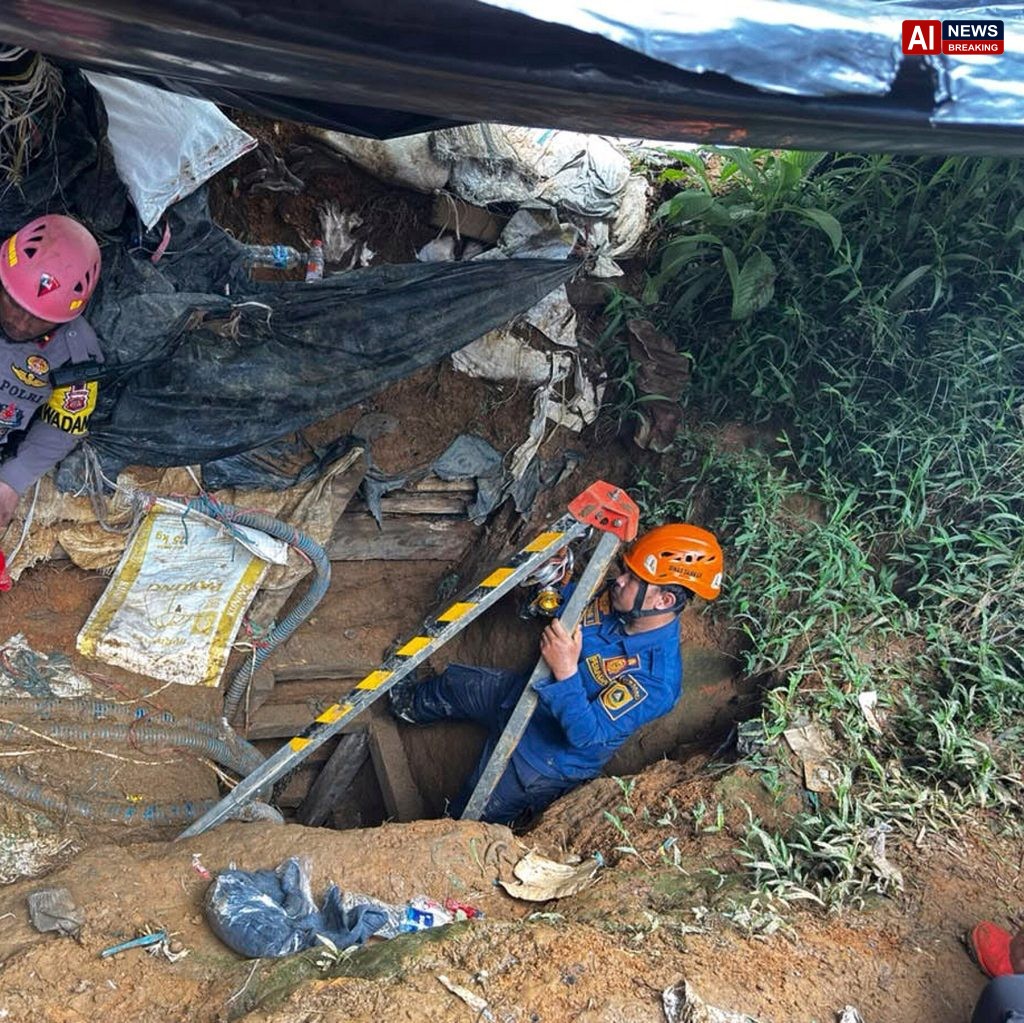
3 Dead and Many More Trapped in Indonesian Mine After Heavy Rainfall - AI News Breaking
dead many more trapped:
Heavy rain across Indonesia’s eastern province of East Nusa Tenggara has turned a remote, unregulated gold mining operation into a disaster site, leaving three men dead and a further twenty‑three workers believed to be trapped inside a flooded shaft. The collapse, which authorities say began late on Monday when rainwater surged into the narrow entrance of the mine, has prompted a multi‑agency rescue effort involving the national disaster agency, local police, the navy and a team of volunteers from the region’s mining community.The mine, located near the village of Sumba Barat, is not listed on any official register and operates without the permits required under Indonesian mining law. It is one of dozens of informal extraction sites that have sprung up in the islands’ mountainous terrain, where gold‑bearing quartz veins attract small‑scale prospectors seeking a livelihood in an area plagued by unemployment and limited infrastructure..
Officials have long warned that such operations pose a serious risk to workers, who often lack basic safety equipment, ventilation, and reliable support structures, but they remain difficult to monitor due to the remote locations and the clandestine nature of the work.According to the National Search and Rescue Agency (Basarnas), the rain that fell over the weekend was among the heaviest recorded in the region in the past decade, with water levels in nearby rivers rising by more than two metres. The sudden influx of water is believed to have overwhelmed the mine’s drainage system, causing the shaft to fill within hours. Survivors who managed to escape described a scene of rushing water and mud, with the narrow tunnel quickly becoming a lethal choke point..
“It was dark, the water was cold, and the walls were collapsing around us,” one miner, who asked to remain anonymous for fear of reprisals, told a journalist after being rescued. “We could hear the screams of our friends, but there was nothing we could do.”Emergency responders arrived at the site late on Monday, but the combination of swollen streams, unstable ground and the illegal status of the operation hampered initial efforts. The navy dispatched a small boat to transport equipment along the coastal road, while the police set up a perimeter to keep onlookers at a safe distance..
Basarnas sent a team of divers and engineers to assess the possibility of reaching those still inside. “We are dealing with a complex environment,” said Lieutenant Colonel Arif Nugroho, the commander of the rescue unit. “The shaft is narrow, the water is fast‑moving, and the structural integrity of the tunnel is compromised..
Every minute we lose is a minute that reduces the chance of survival for those still underground.”Local authorities have begun to piece together a list of workers who were present at the mine on Monday. Mine owners, who are believed to be a network of local entrepreneurs, have not come forward publicly, and many of the workers are migrants from other parts of the country who travel to the islands for seasonal work. The government’s labour ministry estimates that up to 1,500 informal miners operate in East Nusa Tenggara, most of them undocumented..
Families of the missing have gathered at the village hall, clutching photographs and praying for a swift resolution. “My son left home three months ago, hoping to send money back,” said Ibu Siti, a mother of two who has been waiting for news since the flood. “Now we do not know if he is alive or dead.”The three fatalities confirmed by the provincial health department were identified as men in their thirties, all of whom had been working in the deeper sections of the shaft..
Autopsies revealed that the cause of death was drowning, compounded by hypothermia. “The water temperature was low, and the victims were trapped for an extended period,” said Dr. Rani Hartono, a forensic pathologist who examined the bodies..
“The circumstances suggest they were unable to reach the surface before the water rose beyond their capacity to breathe.”In an effort to locate the remaining workers, rescue teams have employed a combination of sonar scanning and manual probing. Divers equipped with underwater lights have entered the flooded tunnel, guided by a rope system laid down by earlier volunteers. The operation is being carried out in shifts to mitigate the risk of exhaustion and further accidents..
“We are proceeding with extreme caution,” said one of the lead divers, who requested anonymity. “The tunnel is narrow, visibility is near zero, and we have to watch for sudden collapses.” So far, the divers have reported hearing faint tapping sounds from deeper sections, but have not yet been able to confirm the presence of living individuals.The incident has reignited a longstanding debate in Indonesia over the regulation of artisanal and small‑scale mining (ASM). While the sector contributes an estimated $5 billion a year to the national economy, it also accounts for a disproportionate share of mining‑related accidents, environmental degradation and illegal activity..
The Ministry of Energy and Mineral Resources has pledged to strengthen oversight, but critics argue that enforcement remains uneven, especially in remote provinces where local authorities lack the resources to conduct regular inspections. “This tragedy is a symptom of a systemic failure,” said Dr. Budi Santoso, a professor of mining law at the University of Indonesia..
“We need a coordinated approach that balances the economic needs of miners with robust safety standards and environmental safeguards.”In the short term, the provincial governor has ordered an immediate suspension of all unlicensed mining activities in the area while the investigation proceeds. A task force comprising representatives from the police, the mining ministry and local community leaders will be convened to assess the extent of illegal operations and to develop a plan for regularising legitimate small‑scale miners. The task force will also examine the feasibility of providing formal training, safety equipment and legal avenues for miners to operate within a regulated framework..
“We cannot simply shut down these sites without offering alternatives,” said Governor Nadiem Mataram. “Our goal is to prevent future disasters while protecting the livelihoods of those who depend on this work.”International observers have noted that Indonesia’s challenges mirror those faced by other developing nations with large informal mining sectors. A 2022 report by the International Labour Organization highlighted that more than 10 million workers worldwide are employed in informal mining, often under hazardous conditions..
The report called for greater investment in safety training, community monitoring and the integration of informal miners into formal economies. In response, the Indonesian government has signalled its intention to seek technical assistance from UN agencies to improve mine safety standards and to develop a national database of miners, which could aid in both emergency response and policy formulation.As the rescue operation continues, families remain hopeful that at least some of the twenty‑three trapped workers will be found alive. The community has organized a relief fund to support those who.
Updated: November 25, 2026
Heavy rain flooded an illegal gold mine in East Nusa Tenggara, killing three workers and trapping dozens, prompting a multi‑agency rescue effort hampered by the remote, unregulated site. The disaster has revived calls for stricter oversight and formalisation of Indonesia’s vast informal mining sector.
The tragedy shows that Indonesia’s “hidden” gold rush is a pressure valve for rural poverty, but when climate extremes strike, informal mines become ticking time‑bombs that the state’s limited reach can’t defuse.
Unless the government couples crackdowns with viable, subsidized alternatives—training, equipment and legal






