Europe warns of Russia’s hybrid attacks but struggles to counter them
  Former chief election commissioner calls SIR scheme illegal.
  A Corruption Scandal Is Reshaping Brazil’s Presidential Election
  US citizen injured in Illinois after ICE agents mistook him for fugitive, tried to arrest him
  At 10 years old, Smithsonian’s Black museum is undaunted amid pressure from Trump administration
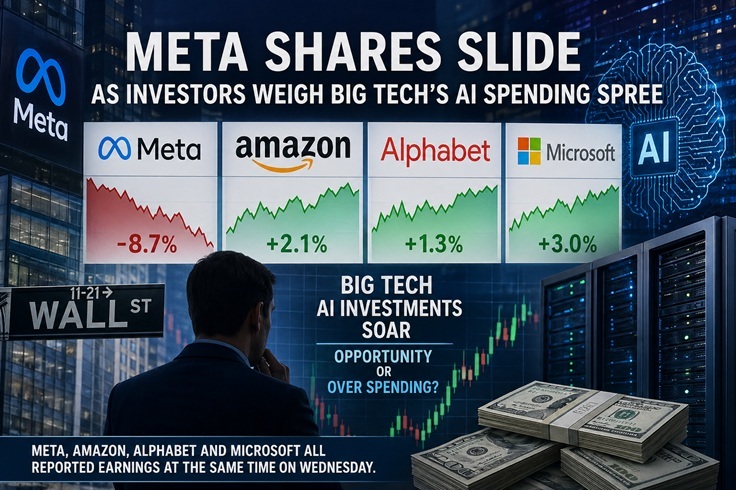
 Meta Shares Slide as Big Tech Earnings Highlight Massive AI Spending by Amazon, Alphabet, and Microsoft
meta shares slide tech:
Shares of Meta Platforms Inc. declined sharply after the company released its latest quarterly earnings, even as it reported results alongside fellow technology giants Amazon, Alphabet, and Microsoft. The synchronized earnings announcements from these four Big Tech heavyweights have intensified investor scrutiny over one central theme: the scale, sustainability, and return on investment of their rapidly expanding artificial intelligence (AI) spending.
The market reaction reflects a growing tension between optimism about AI’s transformative potential and concern over the enormous capital expenditures required to stay competitive in this high-stakes technological race.
A Defining Moment for Big Tech
Wednesday’s earnings releases marked a rare convergence, with Meta, Amazon, Alphabet (Google’s parent company), and Microsoft all reporting financial results within hours of each other. Collectively, these companies represent trillions of dollars in market capitalization and serve as bellwethers for both the technology sector and broader equity markets.
At the center of their narratives was AI—more specifically, the aggressive investments being made in infrastructure, talent, and product development to dominate what many consider the next major computing paradigm.
While revenues and profits remained strong across the board, investor focus has shifted toward future margins, cost structures, and the timeline for monetizing AI initiatives.
Meta’s Earnings: Strong Performance, Weak Market Reaction
Meta reported solid quarterly results, with revenue growth driven largely by its core advertising business, which continues to benefit from improved ad targeting powered by machine learning algorithms. User engagement across platforms such as Facebook, Instagram, and WhatsApp also remained robust.
However, despite these positives, Meta’s stock fell after the earnings announcement. The primary reason: its escalating AI-related expenditures.
AI Spending Surge
Meta has been investing heavily in AI infrastructure, particularly in:
- Data centers optimized for AI workloads
- Custom silicon and GPUs
- Large language models (LLMs) and generative AI tools
- Integration of AI into its advertising and content ecosystems
CEO Mark Zuckerberg emphasized that AI is now central to Meta’s long-term strategy, describing it as a foundational technology that will reshape user experiences, advertising efficiency, and even the company’s metaverse ambitions.
Yet investors appear wary of the scale of these investments. Capital expenditures have surged, and guidance suggests continued increases in the coming quarters.
Reality Labs Still a Concern
Compounding investor concerns is Meta’s Reality Labs division, which focuses on virtual reality (VR) and augmented reality (AR). The unit continues to post significant losses, raising questions about capital allocation priorities.
With AI spending rising simultaneously, some analysts argue that Meta is stretching its resources across too many ambitious fronts.
Amazon: AI Driving Cloud Growth but Raising Costs
Amazon’s earnings told a somewhat similar story, though with a different market reaction.
The company’s cloud computing arm, Amazon Web Services (AWS), remains a key profit driver and is increasingly positioned as a backbone for AI development. Demand for AI-related cloud services has surged, with enterprises seeking computing power for training and deploying models.
AWS and AI Demand
Amazon highlighted:
- Strong growth in AI workloads on AWS
- Increased demand for machine learning services
- Expansion of AI tools for developers
However, like Meta, Amazon is also ramping up capital expenditures, particularly in building and upgrading data centers to support AI applications.
Retail vs. Tech Investment Balance
Amazon faces the added complexity of balancing its traditional e-commerce business with its growing technology investments. While AI enhances logistics, recommendations, and customer experience, the upfront costs remain substantial.
Investors appear more tolerant of Amazon’s spending, largely because AWS provides a clearer monetization pathway compared to Meta’s AI initiatives.
Alphabet: AI Integration Across Google Ecosystem
Alphabet’s results showcased how deeply AI is being integrated across its product suite, from search to YouTube to cloud services.
Search and AI Transformation
Google’s core search business is undergoing a major transformation, with AI-generated responses increasingly becoming part of the user experience. While this enhances functionality, it also raises questions about:
- Advertising formats and revenue models
- User behavior changes
- Cost per query due to AI processing
Google Cloud Growth
Google Cloud has emerged as a strong growth segment, driven in part by AI demand. Like AWS, it benefits from enterprises seeking scalable AI infrastructure.
Investor Sentiment
Alphabet’s stock reaction was relatively stable, reflecting confidence in its ability to monetize AI through its existing ecosystem. However, concerns about rising costs and competitive pressure from Microsoft remain.
Microsoft: Leading the AI Monetization Narrative
Among the four companies, Microsoft appears to be the most successful in convincing investors of its AI strategy.
Partnership with OpenAI
Microsoft’s partnership with OpenAI has positioned it at the forefront of generative AI. The integration of AI into products like:
- Azure (cloud platform)
- Microsoft 365 (Copilot features)
- GitHub (AI coding assistants)
has created clear revenue streams tied to AI capabilities.
Azure Growth
Azure continues to show strong growth, with AI workloads contributing significantly. Microsoft has been explicit about how AI is driving incremental revenue, helping justify its rising capital expenditures.
Market Confidence
Investors have largely rewarded Microsoft’s approach, viewing its AI investments as disciplined and strategically aligned with monetizable products.
The Core Issue: AI Spending vs. Returns
Across all four companies, a common theme emerges: massive spending on AI infrastructure and development.
Why AI Is So Expensive
AI requires:
- High-performance computing hardware (GPUs, TPUs)
- Vast data storage and processing capabilities
- Energy-intensive data centers
- Specialized talent
These factors contribute to a sharp increase in capital expenditures (CapEx), which directly impacts profitability in the short term.
Investor Concerns
Key questions being asked include:
- How long will it take for AI investments to generate meaningful returns?
- Will margins decline due to higher operating costs?
- Is the current level of spending sustainable?
- Are companies overestimating AI demand?
Meta’s stock decline suggests that investors are becoming more selective, rewarding companies with clearer monetization strategies while penalizing those with less defined pathways.
Market Dynamics and Competitive Pressure
The AI race among Big Tech companies is not occurring in isolation. Competition is fierce, with each company striving to establish dominance.
Key Competitive Factors
- Infrastructure scale: Ability to build and operate massive data centers
- Model performance: Development of advanced AI models
- Ecosystem integration: Embedding AI into existing products
- Developer adoption: Attracting developers to platforms
No company can afford to fall behind, which partly explains the aggressive spending.
Broader Market Implications
The combined influence of Meta, Amazon, Alphabet, and Microsoft means their spending decisions have ripple effects across the global economy.
Impact on Semiconductor Industry
Companies like NVIDIA and AMD benefit directly from increased demand for AI chips.
Energy Consumption
AI data centers consume significant energy, raising concerns about sustainability and operational costs.
Enterprise Adoption
Businesses across industries are investing in AI, often relying on Big Tech infrastructure, further driving demand.
Analyst Perspectives
Market analysts are divided:
- Bullish View: AI represents a once-in-a-generation opportunity, justifying high upfront investment
- Cautious View: Spending may outpace returns, leading to margin compression
- Skeptical View: AI hype could result in overinvestment and eventual correction
Meta’s stock decline aligns more closely with the cautious or skeptical perspectives.
What This Means for Investors
For investors, the current environment requires a more nuanced approach.
Key Metrics to Watch
- Capital expenditure trends
- AI-related revenue growth
- Margin changes
- Adoption rates of AI products
Companies that can demonstrate a clear link between AI spending and revenue growth are likely to outperform.
Future Outlook
The trajectory of AI investment will likely define the next decade of the technology sector.
Short-Term
- Continued high spending
- Volatile stock reactions
- Increased scrutiny from investors
Long-Term
- Potential for significant productivity gains
- New revenue streams
- Reshaping of entire industries
The key variable remains execution—how effectively companies can turn investment into innovation and innovation into profit.
AI Insights
Meta’s share decline, despite solid earnings, underscores a pivotal shift in investor sentiment. The market is no longer satisfied with growth alone; it demands clarity on how AI investments will translate into sustainable returns.
As Amazon, Alphabet, and Microsoft continue to pour billions into AI, the pressure is mounting to prove that this spending spree is not just a technological arms race, but a financially sound strategy.
The coming quarters will be critical in determining whether Big Tech can strike the right balance between ambition and accountability in the age of artificial intelligence.