
 Pakistan’s leaders hail first astronaut aboard Chinese craft: ‘Proud one of us has gone into space’
 British tourist travels 29 hours from Mumbai to Amritsar for ₹5,461, rates Indian Railways 10/10 | Viral video
 The Supreme Court will decide whether assault weapons bans violate the Second Amendment
 A Critic of Beijing Falls Short in Taiwan’s Key Mayoral Election
 EPA says no rise in contamination after Army detonates lead azide stockpile in Iowa
Author publishes Kashmir folk tales
**
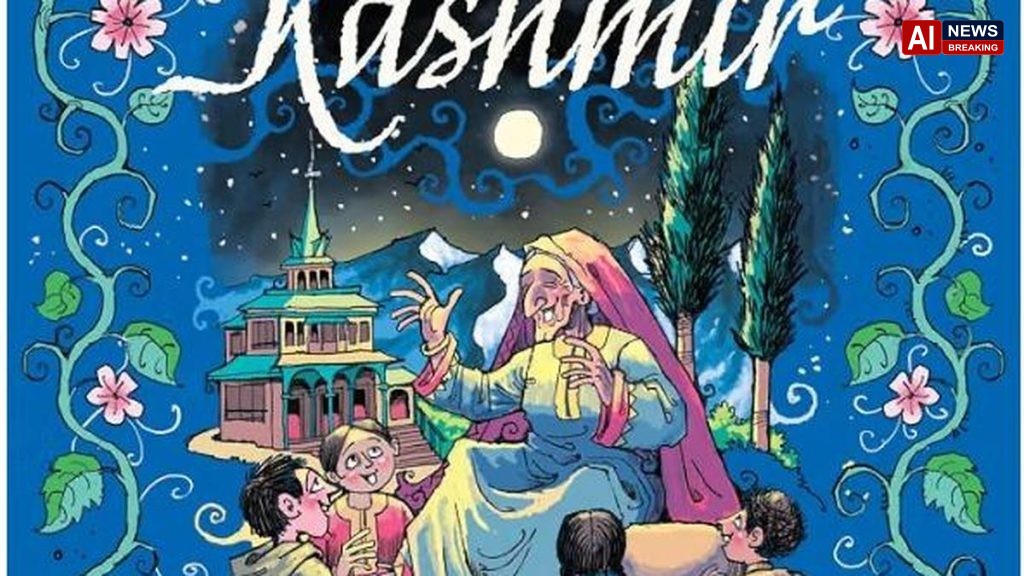
Vinita Zutshi brings Kashmir’s forgotten folktales to young readers - AI News Breaking
Vinita Zutshi, a writer and oral‑history practitioner based in Delhi, has spent the last five years travelling across the valleys of the former princely state of Jammu and Kashmir, gathering stories that have survived in the homes of grandparents, in the hushed corners of tea houses and in the echoing chants of community festivals. The result is a newly published volume entitled Kashmir’s Forgotten Tales, a collection of eighteen folktales that revive a fading oral tradition and present it to young readers in a format that respects both the source material and the sensibilities of contemporary children’s literature.The project began as a personal quest to reconnect with a cultural heritage that the author herself had only glimpsed in fragments of family anecdotes. “When I was a child, my mother would occasionally narrate a story about the mischievous ‘Miyaz’ or the brave shepherd who could converse with mountain goats,” Zutshi recalls..
“Those moments sparked a curiosity that grew into a determination to capture the full breadth of our storytelling landscape before it disappeared under the weight of conflict and modernization.” Her research combined ethnographic fieldwork with archival digging; she recorded conversations with village elders in Urdu, Kashmiri, and Pahari, and cross‑referenced them with manuscripts stored in the state library of Srinagar.The eighteen stories in the book are not arranged chronologically but thematically, each illustrating a different facet of Kashmiri life. From the tale of Roshni and the Nightingale, which explores the bond between a young girl and a bird that heralds the arrival of spring, to The Stone‑Hearted Giant that allegorises the resilience of the Kashmiri people in the face of natural calamities, the narratives are woven with motifs of nature, hospitality, and moral instruction. Zutshi has taken care to retain original idioms and cultural references, providing a glossary at the end of the book to aid young readers unfamiliar with terms such as “shikar” (hunt) or “kashmiri rosh” (a traditional lamp).In adapting oral tales for print, the author confronted a delicate balance between fidelity and accessibility..
Oral storytelling in Kashmir traditionally relies on improvisation, rhythmic repetition and audience interaction, elements that do not translate directly to the page. To preserve the performative quality, Zutshi incorporated rhythmic prose, repeated refrains and vivid sound‑effects that invite readers to read aloud. “I wanted the child to feel the cadence of a storyteller’s voice, even when they are alone with the book,” she explains..
Illustrations by emerging Kashmiri artist Aamir Khan complement the text, using water‑colour washes that echo the region’s famous pashmina hues while depicting everyday scenes—women weaving carpets, children flying kites over Dal Lake, and shepherds guiding flocks across terraced fields.The timing of the publication is significant. Since the early 1990s, sustained political unrest has disrupted the transmission of oral culture, as families have been displaced and schools have focused on national curricula that marginalise regional narratives. Cultural organisations have warned that many of the region’s intangible heritage forms, including folk narratives, are at risk of extinction..
By presenting these stories in a format that can be incorporated into school reading programmes, Kashmir’s Forgotten Tales offers a conduit for cultural preservation that aligns with educational objectives. The book has already been endorsed by the Kashmiri Ministry of Culture, which plans to distribute copies to primary schools across the valley.Educators who have previewed the manuscript note its potential to foster empathy and intercultural understanding among children from diverse backgrounds. “When students read about the clever fox who outwits a greedy landlord, they are simultaneously to themes of justice and to the linguistic texture of Kashmiri life,” says Priya Nair, a senior teacher at a Delhi International School..
“It opens a window onto a region that is often reduced to headlines about conflict, allowing young readers to appreciate its rich folklore and the universal values embedded within.”Critical reception in literary circles has highlighted the author’s meticulous research methodology. Farooq Ahmad, a folklorist at the University of Kashmir, praises the book’s “rigorous documentation of oral variants” and its contribution to the field of South Asian narrative studies. He notes that several of the tales have multiple versions across different valleys, and Zutshi’s decision to include footnotes explaining these variations adds scholarly depth without compromising narrative flow..
“Such transparency is rare in children’s literature and sets a benchmark for future adaptations of oral traditions,” he comments.The author’s own reflections on the process reveal a personal transformation as much as a cultural one. While collecting stories, she encountered families who had lost members to the region’s decades‑long strife, and she witnessed firsthand how storytelling served as a coping mechanism. “In the evenings, after the day’s work, families would gather around a low‑fire and the elders would begin to speak..
Even in the midst of hardship, the stories carried hope, humor and a sense of continuity,” Zutshi recounts. This observation informed the inclusion of a final essay in the book, wherein she discusses the therapeutic role of folklore and advocates for its integration into community healing initiatives.The book’s launch event, held at the National Museum of Indian Literature in New Delhi, featured a live narration by Zutshi herself, accompanied by a troupe of Kashmiri folk musicians. The audience, comprising scholars, educators, and children, responded with audible delight as the storyteller’s voice rose and fell in rhythm with the accompanying sarangi..
The event underscored the central premise of the project: that stories are living entities that thrive when shared aloud, whether in a village courtyard or a metropolitan auditorium.As the first edition sells out within weeks, plans are already underway for translations into Hindi, Urdu and English, as well as an audiobook version narrated by the author. Zutshi hopes that each new language will act as a bridge, allowing the tales to travel beyond the Himalayan foothills and into the homes of children worldwide. “Our aim is not merely to archive a bygone tradition, but to breathe new life into it, ensuring that the voices of Kashmiri ancestors continue to speak to future generations,” she affirms..
In doing so, she not only safeguards a cultural treasure but also reaffirms the timeless power of storytelling to connect, educate and heal..
Updated: November 20, 2026
Reviving Kashmir’s oral canon within school curricula transforms a war‑scarred identity into a unifying narrative, suggesting that cultural literacy can become a subtle form of peacebuilding.
If the model of rhythmic, annotated children’s editions catches on, it could reshape heritage preservation across conflict zones, turning endangered folklore into a trans‑generational bridge rather than a relic.






