
 Pakistan’s leaders hail first astronaut aboard Chinese craft: ‘Proud one of us has gone into space’
 British tourist travels 29 hours from Mumbai to Amritsar for ₹5,461, rates Indian Railways 10/10 | Viral video
 The Supreme Court will decide whether assault weapons bans violate the Second Amendment
 A Critic of Beijing Falls Short in Taiwan’s Key Mayoral Election
 EPA says no rise in contamination after Army detonates lead azide stockpile in Iowa
BJP seeks action against Italian political leader over remarks at Bharat Summit
**
BJP seeks action against Italian political leader over remarks at Bharat Summit - AI News Breaking
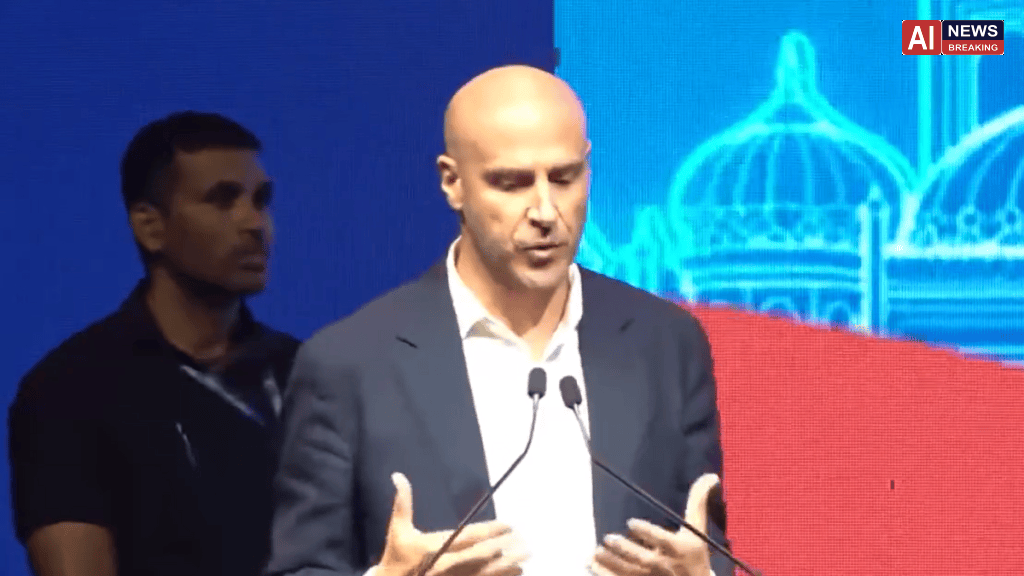
The Bharatiya Janata Party (BJP) has lodged a formal complaint with the Indian Ministry of External Affairs, seeking action against Giacomo Filibeck, a senior figure linked to the Party of European Socialists (PES). The complaint stems from remarks made by Filibeck during the recently concluded Bharat Summit in New Delhi, an event that gathered political leaders, business figures and diaspora representatives to discuss India’s economic and strategic outlook. The BJP alleges that Filibeck’s statements crossed the line from diplomatic commentary to direct political interference, echoing slogans traditionally used by opposition parties in India.According to Ramchander Rao, the BJP’s state president for Telangana, Filibeck addressed the summit audience on the third day, saying that “the future of India rests not on one leader but on a collective democratic process that must be safeguarded from personality cults.” Rao interpreted the wording as a thinly‑veiled criticism of Prime Minister Narendra Modi, noting that similar language has been used by opposition parties in the run‑up to the 2024 general election..
Rao added that the remarks were not merely a policy observation but a “political slogan” that resonated with anti‑Modi sentiment across the country.The BJP’s grievance cites specific phrases that appeared to mirror the opposition’s campaign chant “Modi ko vote do, desh ko banao,” a slogan that has been widely circulated in rallies and social media. Rao pointed out that Filibeck’s reference to “personality cults” invoked the same narrative that Indian opposition parties have employed to question the Prime Minister’s style of governance. The party’s complaint argues that such language, delivered by a foreign political representative on an official platform, could be construed as an attempt to influence India’s internal political discourse.Filibeck, a former Member of the European Parliament and currently a senior adviser to the PES, has a record of commenting on democratic processes worldwide..
In his speech he highlighted the importance of “transparent institutions and accountable leadership” while praising India’s economic growth over the past decade. He also referred to the “need for a balanced dialogue between civil society and the state” and suggested that “every democracy benefits from a healthy debate on power concentration.” The BJP’s statement claims that these points, though couched in generic democratic language, were timed to coincide with heightened political tension in India.The Ministry of External Affairs has not yet issued a response to the BJP’s request. A spokesperson for the ministry declined to comment on the specifics of the complaint, citing standard diplomatic protocol..
However, the ministry confirmed that it is reviewing all communications from foreign delegations that take place on Indian soil, especially those that could be perceived as political commentary. The ministry’s usual practice involves consulting with the Ministry of Home Affairs and, where appropriate, the Ministry of External Affairs’ legal department before taking any formal action.The incident has sparked a broader debate about the role of foreign politicians in domestic political discussions. Critics of the BJP’s move argue that inviting international perspectives is part of the summit’s purpose, which aims to showcase India’s openness to global dialogue..
They contend that calling for punitive measures against a foreign guest risks sending a chilling signal to other international speakers who may wish to address issues of governance, human rights or economic policy. Legal experts note that India’s foreign policy framework allows for the expulsion of foreign nationals who engage in “activities prejudicial to the sovereignty and integrity of India,” but the threshold for such action is high and usually reserved for overt espionage or subversive activities.Supporters of the BJP’s stance, however, maintain that the line between diplomatic engagement and political interference is thin, especially when a foreign figure uses a high‑profile platform to echo opposition slogans. They cite precedent in which foreign diplomats have been declared persona non grata after making statements deemed hostile to the host nation’s internal affairs..
Rao emphasized that the BJP’s request is not about silencing legitimate criticism but about preserving the sanctity of Indian political processes from external manipulation.The Party of European Socialists has defended Filibeck’s remarks as “consistent with the PES’s commitment to democratic values and open dialogue.” A spokesperson for the PES said that Filibeck was invited as a “subject‑matter expert” on European‑Asian trade relations and that his speech was vetted by the summit’s organizing committee. The statement stressed that the remarks were intended to foster constructive conversation and not to target any individual leader. The PES also expressed confidence that the matter would be resolved through diplomatic channels rather than through punitive measures.Political analysts suggest that the episode may have implications for the upcoming election cycle..
The BJP’s narrative frames the issue as an example of foreign interference, a theme it has employed in previous campaigns to rally nationalist sentiment. Meanwhile, opposition parties have welcomed the discourse, arguing that foreign commentary can provide valuable external perspectives on governance and that attempts to suppress such voices could backfire. Meera Singh notes that “the public’s reaction will depend on whether they view this as a defence of sovereignty or as an overreach that stifles legitimate debate.”As the debate continues, the Indian government faces the delicate task of balancing diplomatic openness with the protection of its internal political environment..
The outcome of the BJP’s complaint could set a precedent for how foreign political actors are treated at future high‑profile events in India. Whether the Ministry of External Affairs opts for a formal censure, a private warning or no action at all remains to be seen, but the incident has already highlighted the increasing scrutiny placed on the intersection of international dialogue and domestic politics..
Updated: November 16, 2026
Insight: India’s decision to police a foreign expert’s diplomatic phrasing could transform open‑summit forums into guarded stages, chilling the very global discourse the government touts as a soft‑power asset.
If the BJP’s “foreign‑interference” narrative gains traction, it may weaponize nationalism to mute dissent, reshaping electoral battlegrounds where external validation becomes a liability rather than a legitimacy booster.





