
 Pakistan’s leaders hail first astronaut aboard Chinese craft: ‘Proud one of us has gone into space’
 British tourist travels 29 hours from Mumbai to Amritsar for ₹5,461, rates Indian Railways 10/10 | Viral video
 The Supreme Court will decide whether assault weapons bans violate the Second Amendment
 A Critic of Beijing Falls Short in Taiwan’s Key Mayoral Election
 EPA says no rise in contamination after Army detonates lead azide stockpile in Iowa
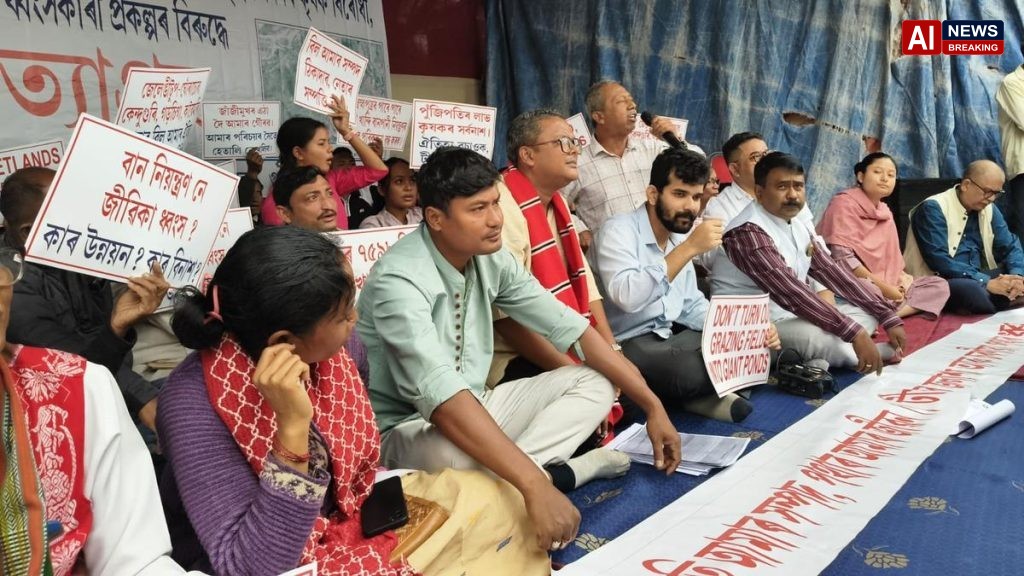
Cancel wetland excavation project in eastern Assam grazing grounds, CM urged
Cancel wetland excavation project in eastern Assam grazing grounds, CM urged - AI News Breaking
Title: Cancel wetland excavation project in eastern Assam grazing grounds, CM urged People from villages in Jorhat district’s Teok region staged a protest in Guwahati, demanding a halt to the ongoing project across 7,598 bighas of wetlands. The agitation, which began on Wednesday, has drawn attention to the delicate ecological balance of Assam’s floodplains and the livelihoods of thousands who depend on them. The movement is part of a wider debate on development versus conservation that has been simmering in the state’s political arena for months..
The demonstrators, numbering in the low thousands, marched from Teok to the state capital in a single day, carrying placards that read, “Protect the Wetlands, Save Our Future.” Their main grievance is that the state government’s proposed excavation, aimed at expanding irrigation and agricultural land, threatens to submerge critical wetland habitats that support a rich diversity of flora and fauna. The protest was organized by local farmer groups and environmental NGOs who fear the loss of these ecosystems could devastate the region’s biodiversity. Government officials said the project is part of a broader plan to boost agricultural productivity..
“We are investing in infrastructure that will secure food supplies for millions,” a spokesperson for the Assam Department of Agriculture explained. The plan involves dredging rivers and creating new canals, which, according to the government, will increase irrigation coverage from the current 45% to 60% of the state’s agricultural land. Critics argue that the cost to the environment far outweighs the potential gains in crop yield..
The wetland area in question spans 7,598 bighas, roughly 3,200 acres, and is classified as a Ramsar site, an international treaty on wetland conservation. The site hosts a variety of bird species, including the endangered spot-billed pelican, and supports local fisheries that provide a major source of income for coastal communities. Environmentalists warn that the excavation could alter water flow patterns, reduce groundwater recharge, and lead to soil salinization, which would permanently alter the region’s ecological character..
Chief Minister Himanta Biswa Sarma responded to the protests by calling for a “comprehensive review” of the project. In a televised address from Guwahati, he pledged to examine the environmental impact assessments (EIA) and promised that no decision would be made without “full consultation with stakeholders.” The CM also assured that the government would explore alternative solutions to improve irrigation without harming wetlands, citing examples from neighboring states. The opposition parties seized on the protest to question the government’s commitment to sustainable development..
Leader of the opposition, Dr. Ramesh Goswami, said the project was a “classic case of prioritising short‑term gains over long‑term welfare.” He urged the CM to honour the state’s environmental commitments and to engage with independent scientists to reassess the project’s feasibility. The opposition’s call for a “public hearing” has added political pressure on the ruling party, which has previously defended its development agenda..
Local farmers, however, have mixed feelings about the project. While some appreciate the promise of better irrigation, others fear that the wetland’s natural flood‑control mechanisms will be disrupted, leading to more frequent and severe floods. “We need water for our crops, but we also depend on the wetlands for fish,” said Biju Kumar, a 52‑year‑old farmer from Teok..
He added that the government’s promises of compensation have yet to materialise, leaving many in uncertainty about their future livelihoods. In response to the escalating tensions, the Assam Forest Department announced that it will conduct a rapid environmental audit of the project site. The audit will examine hydrological changes, potential habitat loss, and the impact on local wildlife populations..
The department’s director, Ms. Anjali Singh, emphasised that the audit would be conducted independently, with oversight from the national Ministry of Environment. “We are committed to ensuring that development does not compromise our ecological heritage,” she said..
The protest has attracted national media attention, with several news outlets covering the rally live. Social media campaigns using the hashtag #SaveAssamWetlands have gained traction, with influencers and local celebrities voicing their support for the cause. The viral trend has prompted the central government’s Ministry of Environment and Forests to issue a brief statement urging all stakeholders to “engage in constructive dialogue and respect the sanctity of wetlands.” Despite the growing backlash, the government remains adamant about proceeding with the excavation, citing the need to secure the state’s food security..
However, the CM’s promise of a review has temporarily stalled the project, allowing environmental groups to gather more data and strengthen their case. The next week is likely to see further negotiations, with the possibility of a court‑ordered injunction if the government proceeds without addressing the environmental concerns. The situation in Assam reflects a broader global challenge: balancing development with conservation..
Experts argue that wetlands serve as natural flood‑control systems, water purifiers, and habitats for countless species. Failure to protect them can have cascading effects on human communities and economies. The outcome of the Teok wetland dispute may set a precedent for how similar projects are evaluated in other parts of India and the world..
In conclusion, the protest in Guwahati is a clear signal that people are increasingly willing to defend their natural heritage against potentially harmful development. As the Assam government faces mounting pressure, the final decision will hinge on its ability to reconcile the needs of agricultural expansion with the urgent requirement to preserve vital ecosystems. The coming days will determine whether the wetland will remain a sanctuary for wildlife and a lifeline for local communities, or become another casualty of unchecked progress..
Updated: November 18, 2026
Hundreds of farmers and environmentalists marched from Teok to Guwahati, demanding that the Assam government halt a 7,598‑bigha wetland excavation slated to boost irrigation. The Chief Minister has pledged a review and independent audit, while opposition parties and NGOs urge a reassessment to safeguard the Ramsar‑designated ecosystem and local livelihoods.
The rally signals a tipping point: when farmers realize that irrigating more land can mean drowning the very wetlands that keep floods at bay, their voices become a bargaining chip that forces the government to reconsider. If Assam lets the excavation go forward, it risks turning a biodiversity hotspot into a floodplain nightmare, underm






