Pakistan’s leaders hail first astronaut aboard Chinese craft: ‘Proud one of us has gone into space’
 British tourist travels 29 hours from Mumbai to Amritsar for ₹5,461, rates Indian Railways 10/10 | Viral video
 The Supreme Court will decide whether assault weapons bans violate the Second Amendment
 A Critic of Beijing Falls Short in Taiwan’s Key Mayoral Election
 EPA says no rise in contamination after Army detonates lead azide stockpile in Iowa
Cargo ship strikes bridge between New Jersey and Philadelphia, lawmaker says, causing major backups
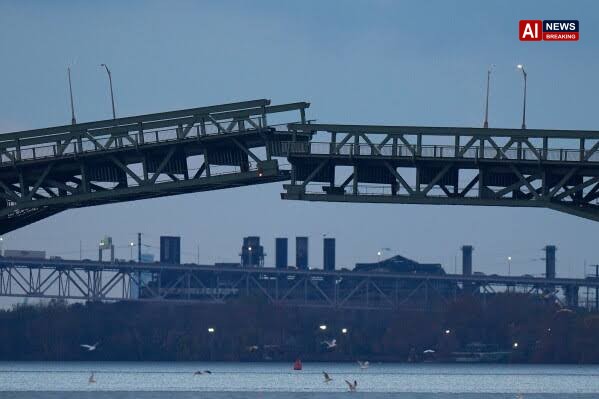
Cargo ship strikes bridge between New Jersey and Philadelphia, lawmaker says, causing major backups - AI News Breaking
A container vessel navigating the Delaware River on Thursday evening collided with the historic Delaware River–Turnpike Toll Bridge, officials said, triggering a cascade of disruptions that stretched from the industrial heart of New Jersey to the streets of Philadelphia. The incident, confirmed by a Pennsylvania state legislator who was monitoring the situation from his office, involved a cargo ship measuring roughly 300 feet in length and laden with mixed freight destined for ports along the Eastern Seaboard. According to initial reports, the ship’s bow struck the central span of the bridge just after 6 p.m., causing visible damage to the steel trusses and prompting an immediate closure of the crossing to vehicular traffic.Emergency responders from both states converged on the scene within minutes, and a coordinated effort was launched to assess the structural integrity of the bridge and to secure the river for a thorough investigation..
The Delaware River Port Authority, which oversees the toll bridge, announced that all lanes would remain shut until engineers could determine whether the damage was confined to superficial dents or required extensive repairs. In the meantime, the bridge’s automated traffic management system redirected vehicles to alternate routes, prompting a surge of congestion on the nearby I‑295 and I‑95 corridors, where commuters reported backups extending for miles.State officials from New Jersey’s Department of Transportation confirmed that the bridge, built in the 1950s and a critical conduit for both local commuters and commercial trucks, is a vital link in a network that moves an estimated 30,000 vehicles daily. “The safety of the traveling public is our utmost priority,” said a spokesperson for the department, adding that structural engineers from the American Society of Civil Engineers had been dispatched to conduct an on‑site inspection..
Their preliminary findings indicated that the impact had compromised several tension members in the central span, raising concerns about the bridge’s load‑bearing capacity under normal traffic conditions.The cargo ship’s captain, who was later identified as a veteran mariner with the Great Atlantic Shipping Company, maintained that the vessel was following standard navigation protocols when an unexpected cross‑current pushed it off its intended course. “We were making a routine transit through the channel when the river’s flow intensified,” the captain told investigators during a press briefing. “Our crew engaged the vessel’s bow thrusters to correct the heading, but the current proved stronger than anticipated, resulting in the collision.” He expressed regret for the disruption and affirmed that no crew members were injured in the incident.Local law enforcement agencies, including the Pennsylvania State Police and the New Jersey State Police, have opened a joint inquiry into the circumstances surrounding the crash..
Investigators are reviewing radar data, vessel tracking logs, and weather reports to piece together a timeline of events leading up to the impact. In addition, the United States Coast Guard has taken over the maritime safety aspect of the operation, deploying a cutter to the site to oversee the removal of the vessel from the river and to ensure that no hazardous materials were spilled during the collision.The aftermath of the crash has already begun to ripple through regional logistics chains. Several freight companies that rely on the bridge for timely deliveries reported that their trucks were forced to reroute, adding up to an hour’s delay per trip..
“Our drivers were stuck for over two hours on I‑295, and the added mileage has increased fuel costs and delivery windows,” said a spokesperson for a major trucking firm operating out of Newark. The delay has also impacted the movement of perishable goods, prompting some shippers to seek alternative ports or to expedite shipments via rail where possible.Commuters on both sides of the river voiced frustration on social media as traffic snarls persisted into the night. Residents of Camden, New Jersey, and South Philadelphia posted photos of endless lines of brake lights stretching beyond the horizon, while ride‑share drivers reported a steep surge in demand as passengers sought faster ways to circumvent the gridlock..
“I’ve never seen the bridge this empty,” remarked a local driver who has used the toll crossing for over a decade. “It’s a reminder of how much we depend on that single piece of infrastructure.”Economic analysts warned that prolonged closure of the bridge could have broader implications for the region’s productivity. The Delaware River corridor, a key artery for commerce, contributes billions of dollars annually to the local economies of both states..
Prolonged disruptions could affect everything from small‑business supply chains to large‑scale manufacturing operations that depend on just‑in‑time deliveries. “If the bridge remains out of service for more than a few days, we could see a measurable dip in regional freight volumes,” noted an economist at a Philadelphia research institute, adding that the impact would likely be felt most acutely in sectors such as automotive parts and consumer electronics.The Pennsylvania lawmaker who first brought the incident to public attention, Representative Maria Torres, urged both state governments to expedite repairs and to conduct a comprehensive review of navigation safety protocols on the river. In a statement released on social media, Torres said, “Our bridge is more than a structure; it’s a lifeline for families, businesses, and emergency services..
We must ensure that lessons are learned and that preventive measures are put in place to avoid a repeat of this avoidable tragedy.” She called for a bipartisan task force to examine the coordination between maritime and transportation authorities, emphasizing the need for real‑time data sharing during adverse weather conditions.As the evening wore on, the cargo ship was finally maneuvered to a safe anchorage downstream, where salvage teams began preparations for off‑loading its cargo and conducting a detailed inspection of the hull. Engineers from the bridge authority, equipped with drones and high‑resolution imaging equipment, continued their assessment, focusing on the extent of deformation in the steel girders. Preliminary estimates suggested that repairs could take anywhere from several days to a few weeks, depending on the severity of the structural damage uncovered..
In the meantime, officials have urged drivers to plan alternate routes and to stay informed through traffic alerts broadcast by state transportation departments.The incident has reignited a long‑standing debate about the aging infrastructure that underpins the United States’ transportation network. While federal funding allocations for bridge rehabilitation have increased in recent years, many experts argue that the pace of repairs still lags behind the growing demands placed on these structures. As the Delaware River–Turnpike Toll Bridge undergoes scrutiny, policymakers from both New Jersey and Pennsylvania are expected to convene in the coming weeks to discuss potential accelerated funding mechanisms and to evaluate whether additional safety measures—such as enhanced river current monitoring systems—should be mandated for vessels navigating this busy waterway..
A 300‑foot cargo ship struck the central span of the Delaware River–Turnpike Toll Bridge after a strong cross‑current pushed it off course, prompting an immediate shutdown of the bridge and a joint investigation by state and federal agencies. The closure has snarled traffic on I‑295 and I‑95, delayed freight deliveries and raised concerns about the aging bridge’s structural integrity and regional supply‑chain resilience.
The crash spotlights how a single, aging conduit can instantly throttle an entire regional supply chain, turning a routine freight run into a costly logistical bottleneck. It also forces policymakers to confront the hidden interdependence of maritime and road networks, likely accelerating calls for real‑time river‑flow monitoring and faster