
 The Supreme Court will decide whether assault weapons bans violate the Second Amendment
 A Critic of Beijing Falls Short in Taiwan’s Key Mayoral Election
 EPA says no rise in contamination after Army detonates lead azide stockpile in Iowa
 Israeli Strike Kills 2 Workers at Gaza Clinic, Doctors Without Borders Says
 McQueen Pre-Fall 2027
Colombia signs peace accord with FARC.
**
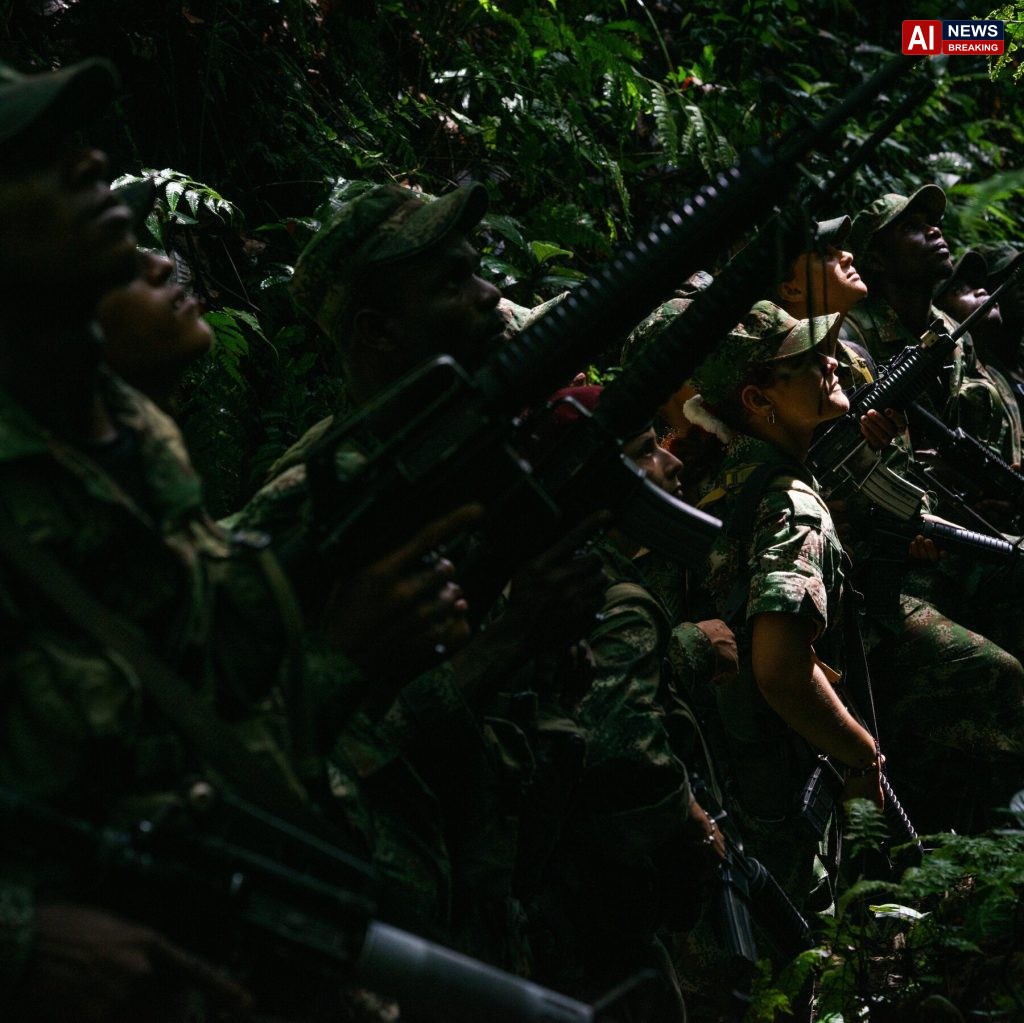
Colombia Marks 10 Years Since FARC Peace Deal: In Photos - AI News Breaking
The Colombian flag, with its bright yellow, blue and red bands, is seen unfurled in Bogotá’s Plaza de Bolivar on the day the 2016 peace accord was signed by President Juan Manuel Santos and the Revolutionary Armed Forces of Colombia (FARC). The image captures the solemnity of the moment and the hopeful glow of the early morning sun, reflecting a milestone that many hoped would finally end a conflict that had claimed more than 3 000 lives and displaced millions over five decades. Ten years later, the country is still wrestling with the promises of that agreement, and the image is a reminder of how far it has come and how much further it must go.The photo shows a row of government officials in formal dress standing beside the presidential seal, while a small group of FARC commanders in civilian attire pose in front of a backdrop bearing the words “Peace” in both Spanish and English..
The contrast between the two sides is evident: the officials’ uniforms are crisp and neat, whereas the former rebels are dressed in simple, utilitarian clothing that hints at their past. The photograph is a visual representation of the historic bridging of a divide that had seemed insurmountable. The scene, captured by a local journalist, is a reminder that peace is a negotiation, not a one‑off event.The 2016 accord itself was the culmination of a five‑year process that began in 2011 under the Obama administration, when the United States provided a neutral venue for talks in Panama City..
In those negotiations, FARC was forced to give up its weapons and political ideology in exchange for a package of reparations, rural development, and a framework for reintegration. The agreement also established a special court for victims, a transitional justice mechanism, and a political party for the former rebels. These elements were intended to lay the groundwork for a post‑conflict society in which former combatants could participate in democratic life.A photo taken in the city of Quibdó, the capital of Chocó department, shows a group of FARC former fighters in a community meeting with local leaders..
They sit on a wooden table covered with maps, agricultural tools and a small model of a village. The image illustrates the FARC’s promise of rural development and the importance of community engagement in the peace process. In the background, a mural depicting the lush forests of Colombia’s Pacific coast is visible, symbolising the natural heritage that the group had long threatened to destroy..
The photograph underscores a central theme of the accord: that peace requires investment in the land and its people.The same year, a series of photographs captured the arrival of the first reintegration program graduates in the city of Santa Marta. The images show young men and women wearing certificates and a pair of sneakers, standing on the steps of a newly constructed school. The school’s façade is painted in bright orange, a colour chosen by the Colombian government to represent hope and progress..
The photo conveys a sense of optimism, as the former rebels now use their skills to contribute to a new, peaceful Colombia. Yet the picture also hints at the difficulties that remain, as the infrastructure and support required for sustainable reintegration is still unevenly distributed.One of the most significant challenges to the accord’s implementation has been the violent opposition from paramilitary groups and drug traffickers. A recent photo taken in the municipality of Sabanalarga, where the FARC once operated, shows a group of civilians holding a sign that reads “We want peace, not revenge.” The image captures the anxiety of the local population, who have been caught in a web of violence and mistrust for years..
The photograph is a stark reminder that peace is fragile and can be undermined by those who see an advantage in continued conflict. The ongoing struggle to dismantle paramilitary networks is a key hurdle to the lasting success of the peace agreement.In 2021, a photo of a rural community in the department of Boyacá highlights the long‑term development component of the accord. The picture shows a field of soybeans being tended by a group of ex‑FARC members, who have taken up farming as part of their reintegration..
The scene is framed by a small irrigation system, a testament to the Colombian government’s investment in rural infrastructure. The image reflects the idea that peace is not only about ending hostilities but also about building a future that offers livelihoods and dignity to those who had been on the other side of the conflict.The Colombian Constitution was amended in 2018 to create a special reparations fund, a crucial element of the agreement. A photograph of the fund’s headquarters in Bogotá shows a glass façade with a plaque that reads “Fund for Victims of Armed Conflict.” The image of the building, with its stark lines and modern design, contrasts sharply with the older, colonial architecture that surrounds it..
This juxtaposition conveys the idea that the state is building a new, forward‑looking institution to support those who suffered under the armed struggle. The photograph also reflects the tension between the need for immediate assistance and the long‑term goal of ensuring justice.Despite the positive steps taken, the 2022 elections brought a new administration that was more sceptical of the peace process. A photo taken in the capital city of Medellín shows a group of protestors holding banners that read “No to the FARC.” The image captures a sense of division among the populace, as some still view the former rebels as a threat to national security..
The photo highlights the ongoing political debate surrounding the peace agreement and how it is interpreted by different segments of society. The division is not only political but also cultural, as some regions feel that their needs and concerns are being ignored by the national government.The Colombian government has continued to push the implementation of the peace accord through the creation of the Office for the Implementation of the Peace Agreement, a dedicated body that monitors progress and coordinates with local communities. A photograph taken in the office’s headquarters shows a team of officials in a meeting, surrounded by charts and a large digital display of the country’s peace map..
The image shows the seriousness with which the state takes the agreement, and also the complexity of the task. The picture of the office’s digital map, in particular, illustrates the extensive network of monitoring and support that the government has put in place.A 2024 photo captures a community gathering in the municipality of Valle del Cauca, where former FARC members and local residents have joined forces to build a new community center. The image shows men and women working together on a wooden structure, their faces lit by a warm glow from the setting sun..
The picture is a testament to the power of collective action and the idea that peace is achieved through shared responsibility. It also reminds readers that the peace process.
Updated: November 23, 2026
The 2016 accord still feels like a sunrise that keeps flickering—hope bright but often smudged by lingering violence and political doubt. Its future hinges less on a single treaty and more on whether the nation will consistently feed that spark with real, inclusive progress.





