
 Pakistan’s leaders hail first astronaut aboard Chinese craft: ‘Proud one of us has gone into space’
 British tourist travels 29 hours from Mumbai to Amritsar for ₹5,461, rates Indian Railways 10/10 | Viral video
 The Supreme Court will decide whether assault weapons bans violate the Second Amendment
 A Critic of Beijing Falls Short in Taiwan’s Key Mayoral Election
 EPA says no rise in contamination after Army detonates lead azide stockpile in Iowa
Electors face Form 6 and enumeration form quandary
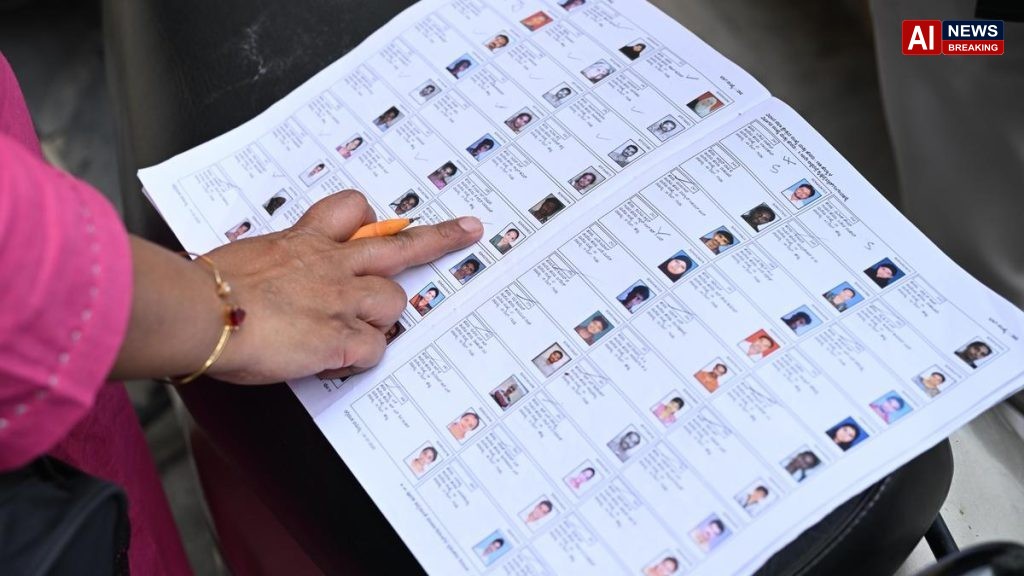
Electors face Form 6 and enumeration form quandary - AI News Breaking
electors face form enumeration:
Electors in Hyderabad’s Kukatpally and surrounding constituencies are grappling with a procedural tangle that has emerged after the Election Commission of India issued a clarification on 6 November. The clarification stated that voters whose names appear on the “ASDD” (Additional State‑wise District Docket) list may submit a fresh Enumeration Form even if they have already lodged Form 6, the document that records a change of residence. The announcement, intended to resolve ambiguities in the voter‑registration process, has instead produced a spate of mismatches, prompting questions about eligibility, the legality of double filing and the penalties that may follow.Form 6, introduced under the Representation of the People Act, is the standard instrument for electors who have moved from one constituency to another..
It requires the voter to furnish proof of the new address and to surrender the previous voter ID, thereby ensuring a clean transfer of voting rights. The Enumeration Form, by contrast, is used to verify the existence of a voter in a particular area and to confirm details such as age, gender and relationship to the head of the household. It is typically completed once a year during the electoral roll revision, and the data collected feed into the final electoral roll published ahead of elections.The crux of the current confusion lies in the overlapping timelines of the two forms..
The Election Commission’s notice allowed ASDD‑listed voters to submit a fresh Enumeration Form “without prejudice” to the earlier Form 6 filing, ostensibly to correct any errors that may have crept into the voter database. However, the language of the notice did not specify whether the new Enumeration Form would automatically supersede the previous Form 6 entry, nor did it outline the mechanism for reconciling the two submissions. As a result, many voters have found their names appearing twice on provisional lists, with one entry reflecting the original address and another reflecting the updated one.Local party workers and civic activists have reported a surge in enquiries at electoral offices across Kukatpally, Bachupally and the neighbouring Maheshwaram constituency..
“People are coming in with both forms and are being told different things by different officials,” said Ramesh Kumar, a senior activist with the civic group Citizens for Transparent Elections. “Some tell us the Enumeration Form will overwrite the Form 6, while others say it will be treated as a separate entry. The lack of a clear, unified instruction is causing genuine anxiety among voters who fear their votes may be invalidated.”Legal experts point out that the Representation of the People Act does not expressly prohibit an elector from filing both forms, but it does require that the electoral roll remain free from duplication..
“Section 20 of the Act mandates that the electoral roll be a true and accurate record of eligible voters,” explained Advocate Meera Joshi, who specialises in election law. “If a voter’s details appear twice, it could be construed as an attempt to manipulate the roll, even if the intention is merely to correct an error. The Commission therefore has a duty to resolve the duplication before the final roll is published, lest it expose the process to legal challenges.”The Election Commission has responded by setting up a dedicated helpline and promising to issue a further circular within the next week..
In a statement released on 12 November, the Commission acknowledged the “temporary inconvenience” and assured that any voter who files both forms will be contacted for verification. “Our objective is to maintain the integrity of the electoral roll while accommodating genuine corrections,” the statement read. It also warned that willful submission of false information on either form would attract penal provisions under the Act, including possible disqualification from voting for a period of three years.Despite the reassurance, the practical impact on the ground remains significant..
Many voters, particularly senior citizens and migrant workers, lack the digital literacy to navigate online verification portals, and must rely on in‑person visits to the electoral office. These visits often involve long queues and repeated explanations of the same issue. “I submitted Form 6 two months ago when I moved from Begumpet to Kukatpally,” said Sharmila, a 62‑year‑old homemaker..
“Now I’m being told I have to fill another form, and I’m not sure which one will count. I don’t want my vote to be rejected on the day of the election.”Political parties are also watching the development closely, as the outcome could influence voter turnout in a region that has traditionally swung between major national parties. A senior official from the opposition party expressed concern that the confusion might disproportionately affect marginalised communities, potentially skewing the vote in favour of the incumbent..
“If eligible voters are deterred from casting their ballots because of bureaucratic hurdles, it undermines the democratic process,” the official warned.The situation underscores broader challenges in India’s electoral administration, where the scale of the electorate and the frequency of internal migration place immense pressure on the system. The Election Commission has, in recent years, introduced measures such as the ‘Voter Helpline’ and online portals for form submission to streamline the process. Yet, as the Kukatpally case illustrates, the coexistence of legacy paperwork and digital platforms can create friction points that require swift, unambiguous guidance.As the final electoral roll is slated for publication in early December, electoral authorities are racing against time to resolve the duplications..
Voters who have already submitted both Form 6 and an Enumeration Form are advised to keep copies of all receipts and to monitor the provisional roll published on the Commission’s website. Those who encounter discrepancies are urged to approach the nearest Booth Level Officer or the District Electoral Officer for clarification, rather than risking a delayed or rejected vote.The episode serves as a reminder that procedural clarity is as vital to democracy as the act of voting itself. While the Election Commission’s intent to accommodate corrections is commendable, the execution must be transparent and consistent to preserve public confidence..
Until the pending circular provides definitive answers, electors in Kukatpally and neighbouring constituencies will continue to navigate an uncertain terrain, hopeful that their voices will be counted when the ballot boxes are finally opened..
Hyderabad’s Kukatpally voters are caught in a procedural maze after the Election Commission allowed those on the ASDD list to file a fresh Enumeration Form even after submitting Form 6, leading to duplicate entries and uncertainty over which record will count. Officials have set up a helpline and promise a clarifying circular, but seniors and migrant workers fear their votes could be invalidated amid the confusion.
The EC’s well‑meaning clarification has unintentionally turned voter‑registration into a bureaucratic minefield, risking disenfranchisement of migrants who already struggle with paperwork. If the duplicate‑form dilemma isn’t ironed out swiftly, it could depress turnout in a swing region and give the incumbent an inadvertent






