 Tao Tokyo Spring 2027
  Karnataka SIR: Teaching on the back burner
  Trump administration offers mixed messages on limits to Ukraine’s Starshield access
  US Treasury proposes a rule to crack down on high-tech investments in China, other adversaries
  Calley Means, a key MAHA advocate, resigns as a top RFK Jr. adviser
 Iran May Have Little Left to Lose: Why America’s Economic Squeeze May Not Force Tehran to Bend
Iran’s economy is under unprecedented pressure as the United States expands sanctions targeting oil, finance and trade. But after decades of surviving economic isolation, Tehran may have developed enough alternative networks and strategic partnerships to withstand further pressure. The bigger question is whether Washington can turn economic pain into political concessions—or whether maximum pressure will only deepen Iran’s resistance.
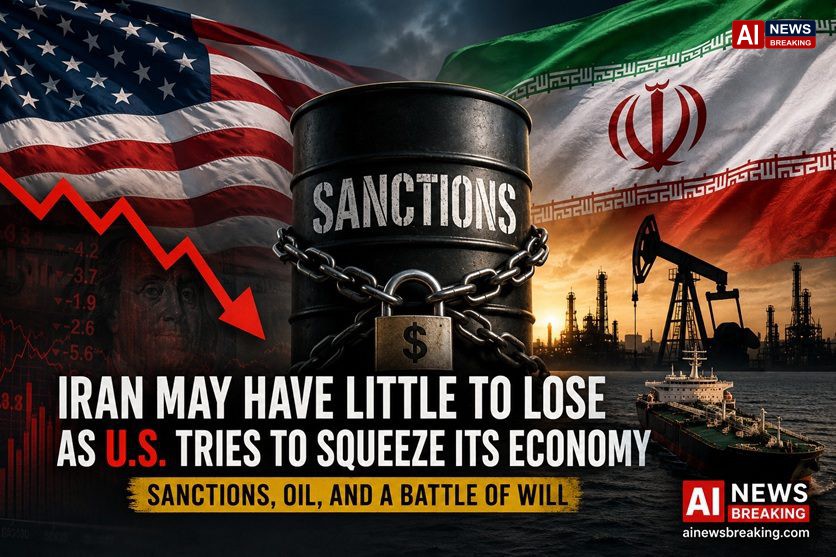
iran have little left:
Editorial: When Economic Pressure Becomes a Strategy Without an Exit
The United States is once again betting that economic pain can accomplish what diplomacy, military pressure and years of sanctions have failed to achieve: force Iran to change its strategic calculations.
Washington’s latest campaign is broader and more aggressive than another routine round of sanctions. The United States is targeting financial networks, oil traders, shipping, aviation, gold, cryptocurrency and technology, while threatening countries and companies that continue doing business with Tehran. On August 25, the US Treasury announced another major sanctions package involving nearly 60 Iran-linked individuals, entities and vessels.
The logic is straightforward. Cut Iran’s access to money, restrict its oil revenues, isolate its banks, disrupt its trading networks and eventually make the cost of resistance greater than the cost of compromise.
But there is a fundamental problem with this strategy: Iran has already spent decades learning how to survive precisely this kind of pressure.
The question, therefore, is no longer whether sanctions can hurt Iran. They clearly can.
The more important question is whether Washington still possesses enough economic leverage to convert that pain into political surrender.
And the answer may be far less certain than the rhetoric coming from Washington suggests.
Iran Is Already Living With Economic Isolation
Iran is not a normal economy suddenly being subjected to sanctions.
It is an economy that has been shaped by sanctions.
For years, Tehran has developed alternative payment channels, informal trading networks, oil-smuggling mechanisms, barter arrangements and relationships with countries willing to accept the risks of dealing with an isolated Iranian economy.
That does not mean sanctions are ineffective. They have imposed enormous costs.
Iran’s currency has fallen to unprecedented levels, inflation has surged and ordinary households are struggling to afford basic goods. The rial recently fell to around 2.02 million to the US dollar on the open market, illustrating the depth of the country’s monetary crisis.
Iran’s oil sector has also been severely damaged. Washington’s pressure has dramatically reduced the country’s ability to export crude, while restrictions on shipping and financial transactions have made every remaining barrel more difficult and expensive to sell.
But economic deterioration and political capitulation are not the same thing.
That distinction is at the heart of the current confrontation.
The Sanctions Paradox
There is a paradox at the centre of America’s Iran strategy.
The more Iran is isolated from the formal global economy, the more dependent it becomes on the informal economy.
And the more Tehran relies on informal networks, the harder those networks can become to dismantle through conventional sanctions.
Iran has already learned to operate under restrictions that would cripple many other economies. Its businesses have adapted. Its traders have adapted. Its political institutions have adapted.
The result is not prosperity.
It is economic survival.
That survival may be enough to prevent sanctions from producing the political outcome Washington wants.
Iran does not necessarily need a healthy economy to continue resisting. It may only need enough revenue, enough domestic production, enough trading partners and enough political control to prevent economic collapse from becoming regime collapse.
That is a considerably lower threshold.
China Is the Critical Variable
No discussion of Iran’s economic resilience can ignore China.
Beijing remains one of Tehran’s most important economic lifelines, particularly because Chinese buyers have continued to purchase Iranian crude despite American sanctions. Some estimates suggest China accounts for the overwhelming majority of Iran’s oil exports.
This creates a major strategic dilemma for Washington.
The United States can sanction Iranian companies.
It can sanction shipping networks.
It can target intermediaries.
It can threaten secondary sanctions against foreign businesses.
But if Washington wants to completely eliminate Iran’s economic lifeline, it may eventually have to confront major Chinese financial and commercial interests.
That is where the Iran sanctions strategy becomes much more complicated.
Washington’s objective is to squeeze Tehran without triggering a much larger confrontation with Beijing. The latest measures therefore reveal a delicate balancing act: punish the networks supporting Iran while avoiding steps that could destabilise the broader US-China relationship.
In other words, Iran’s economic survival is partly dependent on a geopolitical reality that extends far beyond Tehran.
The Shadow Economy Is Not Going Away Easily
The new American sanctions specifically target the mechanisms Iran has developed to survive isolation.
Gold, cryptocurrency, shipping, aviation and technology have become important channels through which money, goods and services can continue moving despite restrictions.
Washington’s strategy is therefore evolving from simply sanctioning Iran to attempting to sanction the ecosystem around Iran.
That is a much harder task.
Every additional intermediary that Washington targets creates another incentive for traders to find a new intermediary.
Every blocked shipping company creates demand for another vessel.
Every restricted financial channel creates demand for another payment mechanism.
This is the classic problem of economic sanctions: enforcement can raise the cost of doing business without necessarily eliminating the business itself.
Iran has become remarkably experienced at this game.
But Tehran Is Not Invulnerable
None of this means Iran is winning the economic battle.
Far from it.
Iran’s economy is under extraordinary pressure.
Inflation, currency depreciation, shortages, declining purchasing power and disrupted oil revenues are imposing a heavy burden on Iranian society. Reports from inside the country describe households cutting back on basic necessities as prices rise and economic uncertainty deepens.
That creates a dangerous domestic equation for Tehran.
A government can survive sanctions.
It can survive diplomatic isolation.
It can survive a period of economic contraction.
But there is a limit to how much economic pain ordinary citizens will tolerate before frustration becomes political instability.
The problem for Washington is that there is no guarantee that economic anger will automatically be directed at Iran’s leadership.
In wartime, external pressure can have the opposite effect.
Citizens who might normally blame their government for economic failures may instead blame the country imposing the sanctions.
Economic warfare can therefore strengthen nationalism at exactly the moment Washington expects it to weaken the regime.
The Human Cost Is Becoming the Central Question
There is another uncomfortable reality.
Sanctions are designed to pressure governments, but their consequences are often experienced first by ordinary people.
When a currency collapses, it is households that lose purchasing power.
When imports become expensive, families pay more for food and medicine.
When companies cannot access international finance, workers lose jobs.
When fuel supplies are disrupted, consumers face shortages and higher prices.
The humanitarian consequences of the current economic squeeze are already visible. Iran’s economic deterioration has left families struggling with basic expenses, while fuel shortages and inflation have added another layer of pressure.
This raises an uncomfortable question for American policymakers:
At what point does additional economic pressure stop changing Tehran’s behaviour and simply make ordinary Iranians poorer?
If the answer is that the pressure must continue until Iran’s leadership capitulates, Washington needs to explain what happens if capitulation never comes.
The Strait of Hormuz Changes Everything
Iran also possesses something that many sanctioned countries do not: enormous strategic leverage over global energy markets.
The Strait of Hormuz is one of the world’s most important oil and gas transit routes.
Any prolonged disruption could affect not only Iran but also Gulf producers, Asian importers, European consumers and global financial markets.
This makes the sanctions strategy inherently risky.
Washington can squeeze Iranian oil exports, but if Tehran responds by threatening regional energy flows, the consequences may extend far beyond Iran.
That creates a paradox.
The more aggressively the United States attempts to destroy Iran’s remaining oil revenues, the greater the incentive for Tehran to demonstrate that it can impose costs on the global energy system.
Even the threat of disruption can influence oil prices, shipping insurance, investment decisions and inflation expectations.
The economic battlefield therefore extends well beyond Iranian borders.
Maximum Pressure Has a Strategic Ceiling
There is a tendency in Washington to describe sanctions in increasingly absolute terms: maximum pressure, unprecedented sanctions, economic onslaught and the toughest measures ever imposed.
But economic warfare has a ceiling.
Once a country’s formal economic links have already been heavily restricted, each additional sanction can produce diminishing returns.
The first sanctions may eliminate legitimate banking channels.
The next may restrict major exporters.
Later measures may target intermediaries, shell companies and shipping networks.
Eventually, policymakers are hunting for increasingly obscure channels.
The cost to Iran continues to rise, but the additional political leverage gained by each new sanction may fall.
That is the strategic danger facing Washington today.
It may be able to make Iran poorer without making Iran more cooperative.
What Does Iran Have to Lose?
This is where the title of the debate becomes important.
Iran may have little left to lose economically.
That does not mean the Iranian people have little left to lose. They clearly do.
It means the Iranian state may calculate that the economic baseline has already fallen so dramatically that further sanctions cannot fundamentally change its strategic position.
If Tehran believes that Washington’s ultimate objective is regime capitulation, Iranian leaders may conclude that compromise offers few guarantees.
From that perspective, surrendering strategic assets could produce political vulnerability without necessarily producing sanctions relief.
Resistance, however costly, may therefore appear to be the safer option for the leadership.
That is precisely why sanctions alone rarely provide a complete diplomatic strategy.
The Real Test Is Whether Pressure Creates a Negotiating Door
Economic pressure can work when it creates a credible pathway toward an acceptable political settlement.
Without that pathway, sanctions risk becoming an end in themselves.
Washington needs to answer a basic question: What exactly would Iran have to do for the economic pressure to stop?
If the answer is constantly changing, Tehran has little reason to believe that compliance will bring relief.
If the objective is clearly defined, verifiable and connected to phased sanctions relief, economic pressure can become leverage for diplomacy.
Without such a mechanism, sanctions become punishment rather than negotiation.
And punishment alone does not necessarily produce compromise.
America Must Also Calculate Its Own Costs
There is another side to the equation.
The United States does not operate in an economic vacuum.
Aggressive secondary sanctions could affect China, India, Turkey, the United Arab Emirates and other countries with commercial links to Iran.
If Washington forces every major trading partner to choose between the American financial system and Iranian trade, the issue stops being merely about Iran.
It becomes a question about the architecture of global commerce.
The United States possesses extraordinary financial power because the dollar remains central to international trade and finance.
But excessive use of that power can encourage other countries to build alternatives.
That does not happen overnight.
But over time, repeated sanctions can create incentives for governments to reduce dependence on American-controlled financial channels.
The paradox is profound: the more Washington weaponises economic interdependence, the greater the incentive for others to reduce that interdependence.
The Bigger Lesson for the World
The Iran confrontation is becoming a test case for the future of economic warfare.
If the United States succeeds, it will demonstrate that even a heavily sanctioned state can ultimately be forced into submission through financial isolation.
If Iran survives, other governments under American pressure will learn something equally important: build alternative trading partners, diversify payment systems, develop domestic production and create shadow networks before the sanctions arrive.
Either outcome will shape the international economic system.
The battle over Iran is therefore not simply a battle between Washington and Tehran.
It is also a contest over who controls the channels through which money, energy, technology and trade move around the world.
Editorial Verdict
America can make Iran poorer.
It can make Iranian oil harder to sell.
It can make international transactions more expensive.
It can make the rial weaker and everyday life more difficult.
But none of those outcomes automatically means that Iran will surrender.
That is the central weakness of the current strategy.
Iran’s economy is suffering, perhaps more severely than at any point in decades. But Tehran has spent years preparing for economic isolation. Its leadership knows that sanctions can be painful without necessarily being decisive.
Washington should therefore be careful about confusing economic damage with strategic victory.
The real measure of success will not be how many Iranian companies are sanctioned, how many tankers are blocked or how far the rial falls.
It will be whether Iran’s leaders ultimately conclude that negotiating is preferable to continuing the confrontation.
If they do not, America may discover that it has succeeded in squeezing Iran’s economy without achieving its political objective.
And that is the danger of maximum pressure: when there is little left to lose, additional pressure can sometimes produce more resistance—not surrender.
The ultimate question is not whether Iran can survive another round of sanctions.
It is whether Washington has a credible diplomatic destination beyond them.