
 Pakistan’s leaders hail first astronaut aboard Chinese craft: ‘Proud one of us has gone into space’
 British tourist travels 29 hours from Mumbai to Amritsar for ₹5,461, rates Indian Railways 10/10 | Viral video
 The Supreme Court will decide whether assault weapons bans violate the Second Amendment
 A Critic of Beijing Falls Short in Taiwan’s Key Mayoral Election
 EPA says no rise in contamination after Army detonates lead azide stockpile in Iowa
Japan’s Leader, in Break with U.S., Defends International Criminal Court
**
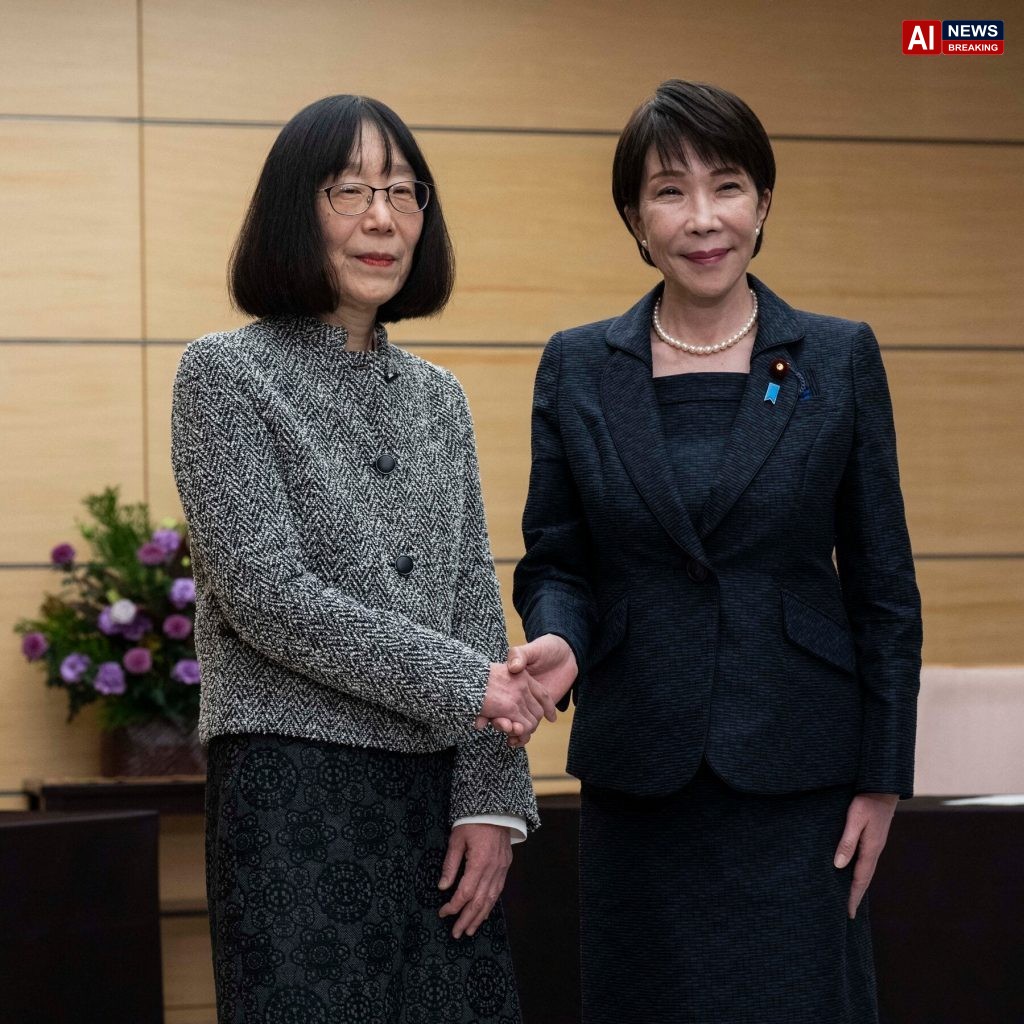
Japan’s Leader, in Break with U.S., Defends International Criminal Court - AI News Breaking
japans leader break defends:
Japan’s foreign minister, Sanae Takaichi, on Monday hosted the president of the International Criminal Court (ICC) in Tokyo, signalling a clear departure from the United States’ long‑standing policy of pressuring allies to limit the court’s reach. The meeting, which lasted for over two hours, concluded with Takaichi’s pledge to accelerate financial contributions to the ICC, a move that underscores Japan’s willingness to shoulder greater responsibility for global justice mechanisms even as Washington intensifies its campaign to marginalise the tribunal.The United States, under the administration of President Donald Trump, has repeatedly criticised the ICC, arguing that its jurisdiction over alleged war crimes and crimes against humanity infringes on national sovereignty. In recent months, the Trump administration has threatened to cut off aid to the court and has lobbied other allies, including Japan, to follow suit..
Despite these pressures, Takaichi’s remarks highlighted a “shared commitment to the rule of law and accountability,” emphasizing that Japan’s support for the ICC is rooted in its own post‑war pacifist constitution and its broader diplomatic strategy in the Indo‑Pacific region.During the talks, ICC President Fatou Bensouda, who was appointed to a second term in 2021, outlined the court’s current priorities, including investigations into alleged atrocities in Afghanistan, the Philippines and the Democratic Republic of Congo. She also warned that the withdrawal of financial contributions from major donors could jeopardise the court’s ability to conduct independent investigations and protect victims. Takaichi responded by announcing an increase of ¥30 billion (approximately US$270 million) in Japan’s annual contribution, raising the total to ¥120 billion for the 2022‑2023 budget cycle..
The pledge is the largest increase from any Asian donor in recent years and is intended to fund the ICC’s outreach programmes and victim‑support services.Analysts note that Japan’s decision reflects a broader strategic calculus. By aligning itself with the ICC, Tokyo seeks to reinforce its image as a champion of multilateralism at a time when its regional security environment is increasingly complex. The rise of China’s military assertiveness in the South China Sea and the ongoing tensions on the Korean Peninsula have prompted Japanese officials to cultivate stronger ties with institutions that promote international norms..
“Supporting the ICC is a way for Japan to demonstrate that it stands for a rules‑based order, not just in security but in human rights and humanitarian law,” said Hiroshi Nakayama, a senior fellow at the Japan Institute of International Affairs.The move also dovetails with Japan’s recent diplomatic overtures toward other democracies that have expressed concern over the ICC’s future. In the weeks preceding the Tokyo meeting, Japanese diplomats met with representatives from the European Union, Canada and Australia to coordinate a joint statement reaffirming commitment to the court. While the United States has not formally withdrawn its support for the ICC, it has enacted legislation that bars the use of U.S..
funds to support investigations into alleged crimes committed by U.S. This “no‑aid” policy, first introduced in 2019, has been expanded under the Trump administration to include broader sanctions on individuals and entities that cooperate with the tribunal.Critics within Japan, however, caution that the increased funding could strain the nation’s fiscal priorities, especially as the country grapples with an ageing population and a need for greater social‑welfare spending. A spokesperson for the opposition Liberal Democratic Party warned that “while the principles of international justice are commendable, the government must balance them against domestic imperatives.” Yet even dissenting voices acknowledge the symbolic weight of the gesture, noting that Japan’s support may encourage other Asian nations, such as South Korea and India, to reassess their own contributions.The United Nations has welcomed Japan’s announcement, with ary‑General António Guterres praising the “generous commitment” as “a vital lifeline for an institution that stands as a beacon for victims of the world’s worst atrocities.” Guterres reiterated that the ICC’s independence is essential for deterring future crimes and for delivering justice where national courts are unable or unwilling to act..
He also highlighted the importance of universal jurisdiction, a principle that many Asian states have historically approached with caution due to concerns over sovereignty and political interference.In Washington, the reaction was muted. A senior official at the State Department declined to comment on the specifics of Japan’s funding increase, but reiterated the administration’s stance that the ICC should not be used as a tool for political prosecutions. The official also pointed to the administration’s “robust” diplomatic efforts to persuade allies to adopt a more cautious approach, suggesting that Japan’s decision might be a “temporary divergence” rather than a permanent shift.Nevertheless, the meeting in Tokyo may have broader implications for the ICC’s legitimacy in the Asia‑Pacific region..
Historically, the court has faced scepticism from Asian nations, many of which view it as a Western‑led institution that does not fully appreciate regional contexts. By hosting the ICC president and pledging substantial financial support, Japan is effectively extending an invitation for the court to deepen its engagement with Asian stakeholders, potentially paving the way for more collaborative investigations and capacity‑building initiatives.The next steps will involve detailed negotiations over the allocation of the new funds, with the ICC’s Office of the Prosecutor expected to submit a budget proposal later this year. Observers anticipate that Japan’s contribution will be earmarked for victim‑assistance programmes, outreach to civil society, and the development of forensic capabilities in conflict zones..
If successful, the partnership could serve as a model for how middle‑income countries can play a constructive role in international justice without compromising their own strategic interests.In the meantime, the diplomatic dance between Tokyo and Washington continues to unfold. While the United States remains steadfast in its effort to curtail the ICC’s influence, Japan’s overture demonstrates that the alliance is not monolithic when it comes to global governance. As the world watches, the evolving stance of a key U.S..
ally may signal a broader realignment of support for international legal institutions in an era marked by rising great‑power competition and renewed calls for accountability..
Updated: November 24, 2026
Japan’s hefty ICC pledge flips Tokyo into a “justice‑leadership” role, using multilateral law to counterbalance China’s assertiveness and signal a values‑based foreign policy beyond mere security ties.
If other Asian powers follow suit, the ICC could evolve from a Western‑centric outpost into a





