
 Pakistan’s leaders hail first astronaut aboard Chinese craft: ‘Proud one of us has gone into space’
 British tourist travels 29 hours from Mumbai to Amritsar for ₹5,461, rates Indian Railways 10/10 | Viral video
 The Supreme Court will decide whether assault weapons bans violate the Second Amendment
 A Critic of Beijing Falls Short in Taiwan’s Key Mayoral Election
 EPA says no rise in contamination after Army detonates lead azide stockpile in Iowa
Judge halts construction at West Potomac Golf Course for two weeks
**
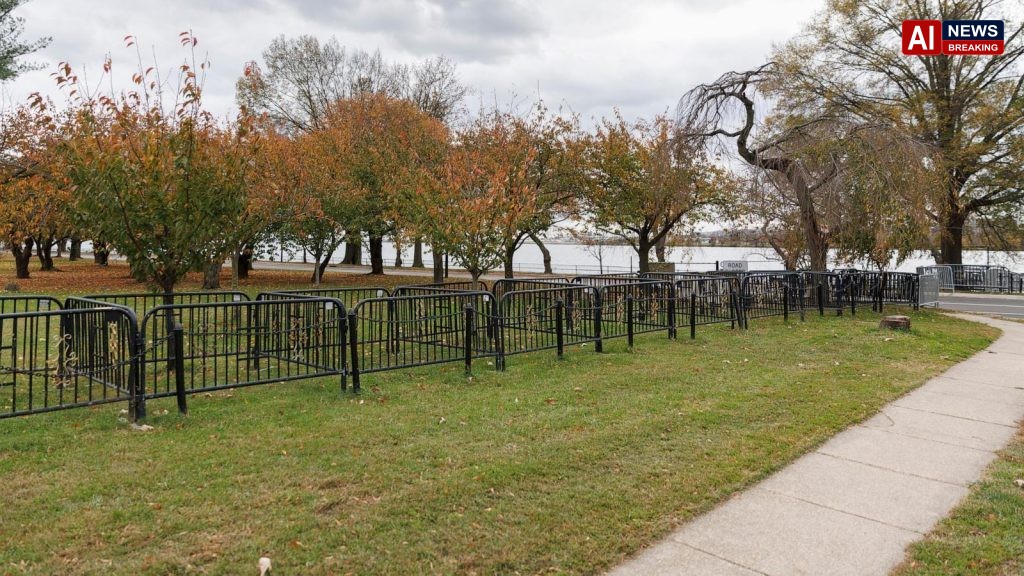
Judge temporarily blocks Trump from moving ahead on Washington public golf course redevelopment - AI News Breaking
judge halts construction westpotomac:
A federal judge in Washington, D.C., has issued a temporary restraining order that halts any construction or redevelopment work at the historic West Potomac Golf Course for a period of two weeks. The order, handed down on Tuesday, follows a lawsuit filed by a coalition of preservationists, neighborhood groups and environmental advocates who argue that the proposed redevelopment plan, backed by former President Donald Trump and a private development firm, would violate federal historic‑preservation statutes and cause irreversible damage to a public amenity that has served the city since the 1930s. The judge’s ruling does not address the merits of the case but simply preserves the status quo while the parties prepare for a more detailed hearing.The West Potomac Golf Course, located just a mile from the White House along the banks of the Potomac River, is one of the nation’s oldest municipal golf facilities..
Opened in 1937 as part of a New Deal-era public works program, the 18‑hole course has been managed by the National Park Service and the District of Columbia’s Department of Parks and Recreation. Its design, attributed to noted architect William D. “Bill” H. Hobart, is celebrated for blending traditional parkland aesthetics with the natural riverine landscape..
Over the decades, the course has hosted community tournaments, youth programs and occasional diplomatic events, cementing its role as both a recreational venue and a cultural landmark.In 2023, a development consortium led by Trump Golf Properties submitted a proposal to the National Park Service to transform a portion of the course’s western greens into a mixed‑use complex that would include a boutique hotel, retail spaces and a modern clubhouse. The plan, estimated at $250 million, was marketed as a means to generate revenue for the upkeep of the historic course and to boost tourism in the capital. Supporters of the project, including several local business groups, argue that the infusion of private capital is necessary to address the chronic under‑funding of the park’s facilities, which have suffered from deferred maintenance and declining usage in recent years.Opponents, however, contend that the redevelopment would breach the National Historic Preservation Act (NHPA), which requires federal agencies to consider the impact of any undertaking on historic properties..
The plaintiffs’ filing asserts that the National Park Service failed to conduct a thorough Section 106 review, a statutory process designed to evaluate adverse effects on historic sites and to explore alternatives. They also claim that the project would encroach on protected wetlands, disrupt local wildlife habitats and diminish public access to a cherished green space. Environmental groups have highlighted the potential for increased storm‑water runoff into the Potomac, warning that construction could exacerbate flooding in adjacent neighborhoods.U.S..
District Judge Ellen R. Brown, appointed by President George W. Bush in 2007, granted the temporary restraining order after reviewing an affidavit submitted by the plaintiffs that detailed alleged procedural deficiencies and potential irreversible harms. In her written order, Judge Brown emphasized that the court must act swiftly when there is a risk that “irreparable injury” could occur before a full hearing on the merits. She noted that the two‑week pause would provide sufficient time for the parties to exchange additional documentation, file supplemental motions and schedule a status conference to set a timetable for a more comprehensive adjudication.The ruling has immediate practical implications for the site..
All ongoing site‑preparation activities, including vegetation clearing, grading and utility installation, have been ordered to cease. Contractors who had already mobilized equipment are required to secure the area and prevent any further disturbance of the landscape. The National Park Service has issued a statement indicating that it will cooperate fully with the court’s directive and will work with the developer to ensure compliance while the legal process unfolds..
“Our priority remains the preservation of this historic resource, and we will adhere to any judicial instructions aimed at safeguarding that goal,” the statement read.Trump Golf Properties, represented by a team of high‑profile litigators, expressed disappointment with the decision but said it would not deter the company’s commitment to the project. In a press release, the firm argued that the proposed redevelopment complies with all applicable regulations and that the temporary injunction “unduly hampers a plan that would revitalize a valuable public asset and create jobs.” The company also indicated its intention to seek a modification of the order, asserting that it has already taken steps to mitigate environmental impacts, including the installation of erosion control measures and the preservation of several historic features of the course.Legal experts suggest that the case could set an important precedent for how federal historic‑preservation laws are applied to public‑private partnerships involving iconic sites. Professor Laura M. Gonzalez of Georgetown Law noted that the outcome may influence future projects that seek to blend commercial development with heritage conservation..
“If the court ultimately finds that the National Park Service’s Section 106 analysis was deficient, agencies may need to adopt more rigorous review processes, especially when private interests are involved,” she said. Conversely, some commentators warn that prolonged litigation could delay much‑needed improvements to aging public facilities, potentially leaving them in a state of disrepair.The two‑week pause is scheduled to expire on Friday, after which the parties will reconvene for a status conference. At that hearing, the judge is expected to set a schedule for a pre‑trial conference, exchange of evidence and possibly a trial on the substantive issues of historic preservation compliance, environmental impact and the adequacy of public‑interest considerations..
Both sides have indicated they will bring expert testimony—architectural historians to speak on the course’s significance, and environmental scientists to assess ecological risks.As the legal battle unfolds, local residents remain divided. Some community members, who have long advocated for better amenities at the course, welcome the prospect of a modernized facility that could attract visitors and stimulate the neighborhood economy. Others fear that the introduction of commercial elements will erode the democratic character of a public space that has historically been accessible to all, regardless of income..
A public hearing scheduled by the District’s Office of Planning later this month will provide a forum for these voices, though the immediate future of the West Potomac Golf Course now rests in the hands of the judiciary, awaiting a determination that balances preservation with progress..
Updated: November 15, 2026
The injunction spotlights a looming clash: if courts tighten historic‑preservation standards, private developers may find public‑land partnerships increasingly untenable, curbing profit‑driven revamps of cherished civic spaces.
Yet the pause also warns that unchecked neglect can invite costly, market‑driven fixes, suggesting the real challenge lies in crafting a sustainable funding model that honors heritage without surrendering it to commercial imperatives.







