
 The Supreme Court will decide whether assault weapons bans violate the Second Amendment
 A Critic of Beijing Falls Short in Taiwan’s Key Mayoral Election
 EPA says no rise in contamination after Army detonates lead azide stockpile in Iowa
 Israeli Strike Kills 2 Workers at Gaza Clinic, Doctors Without Borders Says
 McQueen Pre-Fall 2027
Pentagon Issued Memo Limiting ‘Social Activities’ With Canadian Military
The Pentagon’s new directive curbs informal social events between American and Canadian troops, sparking debate over security versus camaraderie. While the policy aims to prevent classified leaks amid heightened cyber threats, Canadian officials warn it could erode the trusted bonds that underpin NORAD and decades‑long joint operations. Both nations are set to meet in Ottawa to review the memo’s impact.
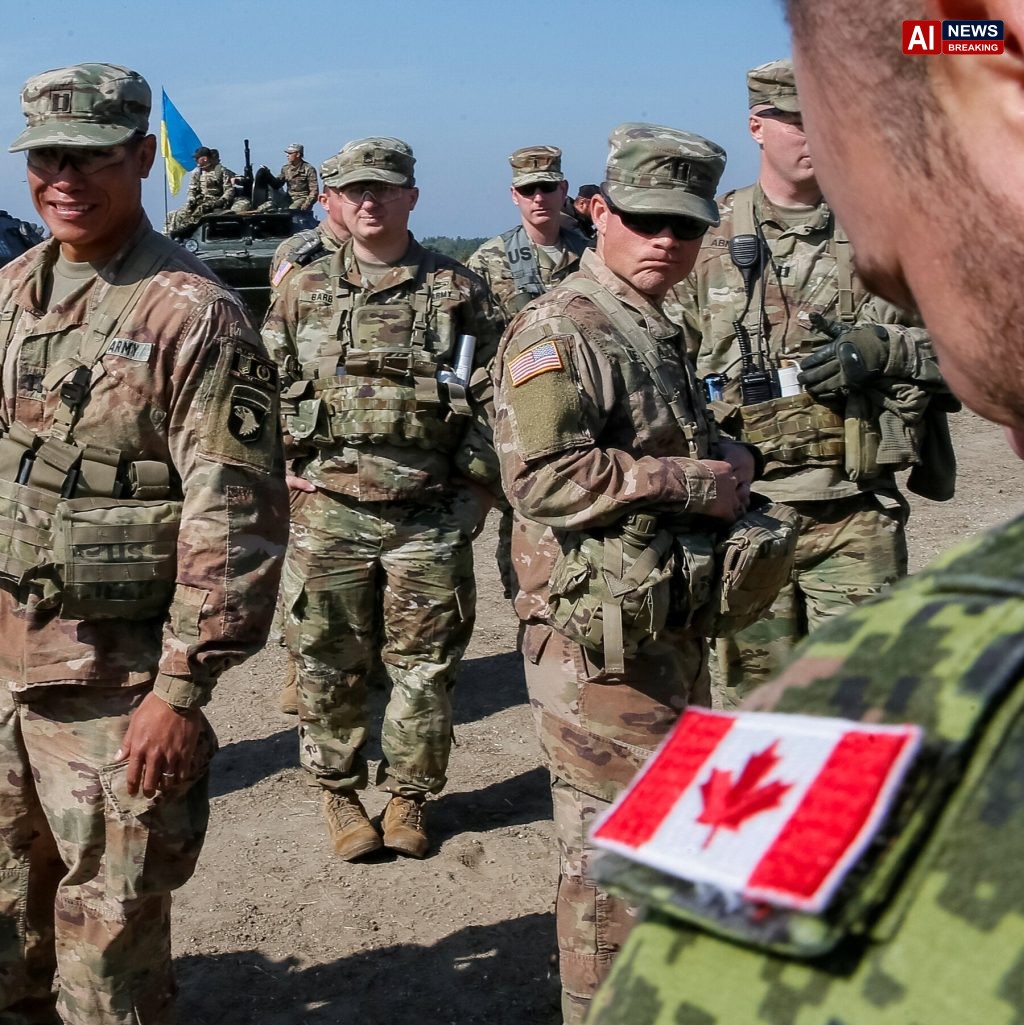
Pentagon Issued Memo Limiting ‘Social Activities’ With Canadian Military - AI News Breaking
The United States Department of Defense has issued a new directive restricting the nature of social interactions between American service members and their Canadian counterparts, a move that has sparked debate in both capitals over the balance between operational security and the long‑standing camaraderie that has characterised the bilateral military partnership for decades. The memorandum, circulated to senior officers last week, specifies that joint activities such as informal gatherings, recreational sports and shared dining events must be approved in advance and limited to settings that do not compromise classified information or create perceived conflicts of interest. While the language of the memo is deliberately broad, its immediate effect is to curtail the informal networking that has traditionally underpinned the close working relationship between the two forces.The policy arrives at a time when the United States and Canada are navigating a series of diplomatic tensions unrelated to defence, ranging from trade disputes over dairy and lumber to divergent approaches to climate policy and the handling of cross‑border immigration flows..
Analysts suggest that the memo may be an attempt by Washington to reassert control over an alliance that, despite its depth, has occasionally been perceived as too informal for the increasingly complex security environment of the twenty‑first century. “There is a legitimate concern that casual social contact can inadvertently lead to the leakage of sensitive operational details,” said a senior Pentagon official who requested anonymity. “The memo is not intended to erode the partnership, but to ensure that our joint activities remain strictly professional.”Canadian officials, while acknowledging the United States’ prerogative to set its own security protocols, have expressed disappointment that the measure was introduced without prior consultation..
The Department of National Defence released a statement indicating that the memo “introduces unnecessary friction into a relationship that has been built on trust, mutual respect, and shared sacrifice.” The statement further noted that Canadian forces have consistently adhered to strict security standards and that the restriction could hamper the morale‑building aspects of joint training exercises, particularly those that involve multinational crews on the North American Aerospace Defense Command (NORAD) air‑defense missions.NORAD, a binational command established during the Cold War to monitor and defend North American airspace, remains a cornerstone of the U.S.–Canada defence architecture. The command’s daily operations are largely unaffected by the new memo, as the directive explicitly exempts mission‑critical coordination and technical briefings from its scope. However, the subtle shift in policy may have downstream effects on the informal debriefings and after‑action discussions that often occur in the evenings following high‑intensity simulations..
Such interactions have historically provided a venue for pilots, engineers and intelligence analysts to exchange insights in a low‑pressure setting, fostering a level of interoperability that formal briefings sometimes cannot achieve.The timing of the memo also coincides with a broader U.S. defence review aimed at tightening information‑sharing protocols across all allied forces, a process accelerated by recent cyber‑intrusions attributed to state‑linked actors. In this context, the Department of Defense argues that the guidance is part of a systematic effort to minimise “non‑essential contact” that could be exploited by adversaries seeking to infiltrate allied networks..
The directive calls for a risk‑assessment framework to be applied to each proposed social event, with higher‑risk activities requiring clearance from the chain of command and, in some cases, the involvement of security officers.Critics of the policy warn that the emphasis on risk mitigation may be disproportionate to the actual threat level. A former NATO liaison officer, now a security consultant, pointed out that the Canadian and American militaries have a long record of successful joint operations with minimal security breaches. “The real danger lies in eroding the interpersonal bonds that make rapid decision‑making possible in crisis situations,” she said..
“When trust is institutionalised rather than cultivated organically, the agility that has defined NORAD’s response to emerging threats could be compromised.”In response to the growing concerns, both governments have agreed to convene a joint working group to review the implementation of the memo and to explore alternative mechanisms that preserve operational security without stifling the personal connections that have proved valuable over decades. The working group, slated to meet in Ottawa later this month, will include senior officers from the U.S. Army, Navy, Air Force and the Canadian Armed Forces, as well as representatives from the intelligence and cyber‑defence communities..
Its mandate includes drafting clear criteria for event approvals and establishing a transparent appeals process for denied requests.The diplomatic dialogue surrounding the memo also reflects a broader conversation about the future of North American defence cooperation in an era of shifting geopolitical realities. With the rise of China’s strategic influence in the Arctic and renewed Russian activity in the North Atlantic, both Washington and Ottawa recognise that seamless coordination is essential. Yet, the balance between security imperatives and the human dimension of alliance‑building is now being tested in a way that had not been required during the Cold War, when the threat of a conventional Soviet attack dominated strategic calculations.Public opinion in both countries appears largely indifferent to the intricacies of the policy, with most citizens unaware of the nuanced constraints that govern military camaraderie..
Nevertheless, veterans’ groups have voiced support for maintaining the “spirit of cooperation” that has long defined the U.S.–Canada military bond. A spokesperson for the Canadian Forces Veterans Association argued that any policy that could undermine the morale of service members should be reconsidered, especially at a time when recruitment challenges and retention issues are already putting pressure on the armed forces.The Pentagon’s memo underscores a subtle but significant shift in how the United States approaches its alliances, moving towards a more guarded posture that prioritises data protection over the relational aspects of partnership. While the directive is unlikely to affect the core operational capabilities of NORAD, its ripple effects may be felt in the everyday interactions that keep joint forces cohesive..
As the two nations navigate this new terrain, the outcome will likely set a precedent for how other allied militaries manage the tension between security and solidarity in an increasingly digital and contested world.In the weeks ahead, the joint working group’s findings will be closely watched by policymakers, defence analysts and the rank‑and‑file alike. Whether the United States and Canada can reconcile the memo’s security objectives with the need for genuine interpersonal engagement will determine not only the health of their military relationship but also the effectiveness of the broader North American defence posture at a time of evolving threats. The balance struck may well become a template for future allied interactions, illustrating how modern security imperatives can be woven into the fabric of longstanding partnership without fraying the ties that have held it together for over seven decades..
Updated: November 21, 2026
Summary: The Pentagon has ordered pre‑approval for informal gatherings between U.S. and Canadian troops, citing concerns that casual contact could expose classified information. Canada has warned the move could strain the long‑standing military rapport, prompting a joint working group to seek a balance between security safeguards and the camaraderie that underpins the alliance.
By tightening social protocols, Washington trades the intangible trust forged in informal camaraderie for a bureaucratic shield against cyber‑espionage—risking slower, less intuitive coordination just as Arctic and Atlantic threats are intensifying. If the joint working group cannot preserve genuine interpersonal bonds, the memo may become a cautionary blueprint for allies that over‑securitization erodes the very agility it aims to protect.







