
 The Supreme Court will decide whether assault weapons bans violate the Second Amendment
 A Critic of Beijing Falls Short in Taiwan’s Key Mayoral Election
 EPA says no rise in contamination after Army detonates lead azide stockpile in Iowa
 Israeli Strike Kills 2 Workers at Gaza Clinic, Doctors Without Borders Says
 McQueen Pre-Fall 2027
US senator says Pentagon restrictions on Canada focus on think tanks and social events
**
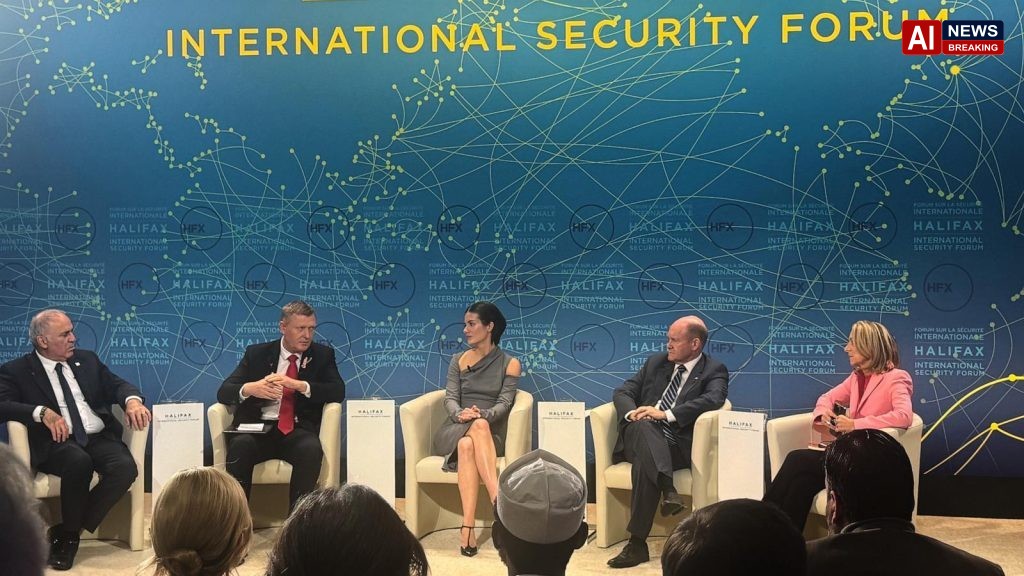
US senator says Pentagon restrictions on Canada focus on think tanks and social events - AI News Breaking
US senator says Pentagon restrictions on Canada focus on think tanks and social events The United States Senate Armed Services Committee’s top Republican, Sen. James M. Harris of Ohio, has sparked a fresh round of diplomatic debate by claiming that the Pentagon’s new restrictions on Canadian engagement target “think‑tank briefings and cocktail‑party gatherings” rather than any substantive military cooperation. Harris, a vocal critic of what he calls “soft‑power interference,” told the Senate floor on Tuesday that the measures were designed to curb U.S..
officers’ participation in policy‑shaping forums that, in his view, risk compromising national security. His remarks have been seized upon by both allies and opponents as a barometer of the growing chill in North‑American defence ties. The restrictions, announced in a classified memorandum leaked to the press last month, prohibit senior U.S..
defence officials from attending any non‑official events hosted by Canadian think tanks, universities or private‑sector organisations. The directive also bars them from taking part in social functions such as charity galas or cultural receptions where Canadian officials are present. The Pentagon says the policy is intended to prevent the inadvertent sharing of “sensitive operational concepts” and to avoid the perception of U.S..
endorsement of foreign policy positions that have not been cleared by Washington. Harris, who chairs the committee’s sub‑panel on military personnel, argued that the move represents a “misguided attempt to police ideas rather than actions.” He cited a recent roundtable in Ottawa where U.S. Army generals discussed emerging cyber‑warfare strategies alongside Canadian scholars, asserting that the conversation was “purely academic” and posed no threat to operational security..
“We are not asking our troops to stop fighting,” he said, “we are asking them to stop debating over drinks.” The senator’s colorful language has drawn both applause and criticism from the political spectrum. Canadian officials have dismissed the U.S. narrative as “overblown” and warned that the restrictions could erode decades‑long military-to‑military rapport..
In a statement, Defence Minister Anita Miller called the policy “a disproportionate response that undermines our shared commitment to collective security.” She noted that joint training exercises, intelligence exchanges and NATO obligations remain untouched, but warned that “the informal channels that build trust are the very ones being choked.” The statement underscored that Canada continues to view the United States as its most important security partner. The Pentagon, for its part, has refused to comment directly on Harris’s statements, citing “operational sensitivity.” A senior defence official, speaking on condition of anonymity, said the focus on think‑tank events is “a precautionary measure” aimed at limiting exposure to “unvetted foreign policy narratives” that could be leveraged by hostile actors. The official added that the policy is under review and may be adjusted as the administration assesses its impact on allied cooperation..
This cautious tone suggests the restrictions could be temporary, pending a broader strategic review of U.S. Analysts at the Atlantic Council argue that the controversy reflects a deeper rift within the U.S. defence establishment over how to balance transparency with security..
Eleanor Cheng, a senior fellow, warned that “excluding senior officers from academic discourse hampers the flow of ideas that are essential for innovation in warfare.” She pointed out that many of the world’s leading defence concepts have emerged from collaborative seminars, not from classified war rooms. Conversely, think‑tank director Michael O’Leary defended the policy, insisting that “the line between open dialogue and operational leakage is thin, and the Pentagon is right to err on the side of caution.” In Washington, the debate has taken on a partisan hue. Democratic senators have accused Harris of “politicising routine military outreach” and warned that the rhetoric could embolden isolationist factions within the administration..
Senate Majority Leader Karen Thompson called for a bipartisan review of the restrictions, urging “a balanced approach that safeguards our s without sacrificing the soft‑power tools that keep our alliances robust.” The call for a review comes as the Senate prepares to vote on a $782 billion defence appropriations bill that includes funding for joint U.S.–Canada projects. Outside the Capitol, Canadian think‑tank leaders have expressed frustration at being sidelined. The Centre for Strategic Innovation in Toronto issued a joint statement lamenting that “the loss of access to senior U.S..
officers deprives scholars and policymakers of critical perspectives.” The centre’s director, Dr. Luis Ramos, warned that the policy could lead to a “brain drain” of expertise, as Canadian researchers may seek forums elsewhere. He added that the restrictions “risk turning a long‑standing partnership into a cold, transactional relationship.” The ripple effects are already being felt in the field..
At the annual NATO summit in Brussels, a scheduled panel featuring a senior U.S. Air Force commander and a Canadian defence analyst was abruptly canceled after the Pentagon’s office cited the new guidance. Attendees described the scene as “awkward,” with several senior officials quietly exiting the conference hall..
NATO ary‑General Jens Stoltenberg later released a diplomatic note urging “member states to resolve internal policy differences that threaten the cohesion of the Alliance.” Meanwhile, senior military officers on the ground are navigating a shifting terrain of protocol. Colonel Rebecca Hayes, who leads a joint U.S.–Canadian cyber‑defence unit, told reporters that the new rules have “created a gray area” regarding informal briefings. She said her team now requires explicit clearance before attending any non‑official event, a process that can take days and sometimes stalls the exchange of timely threat intelligence.
Updated: November 21, 2026





